
Residential property appreciation in India has traditionally followed economic growth centres such as business districts, industrial zones and transport corridors. Over the past few years, however, a different category has begun to show steady gains housing located near major temples and pilgrimage belts. Market analysts tracking Tier-2 and Tier-3 regions say this shift is being shaped by a mix of infrastructure investment, lifestyle migration and long-term ownership behaviour.
Data from property research reports and financial publications indicates that residential land and low-density housing near established religious centres have seen more stable price movement compared to speculative urban pockets. Unlike conventional real estate cycles driven by employment growth, temple-linked housing is influenced by repeat visitation, cultural attachment and restricted land supply.
Several locations illustrate this pattern. Ayodhya, following major corridor and civic upgrades, saw a sharp rise in residential demand within a defined radius. Similar trends have been observed in Ujjain after the Mahakal corridor development, as well as in parts of Rishikesh, Haridwar and Tirupati, where tourism infrastructure gradually translated into longer stays and second-home ownership.
Real estate experts say the price behaviour around sacred zones differs because land supply is naturally capped. Development density is regulated, expansion is limited, and proximity to heritage sites cannot be replicated elsewhere. As a result, price corrections tend to be less frequent, and resale cycles remain relatively tight.
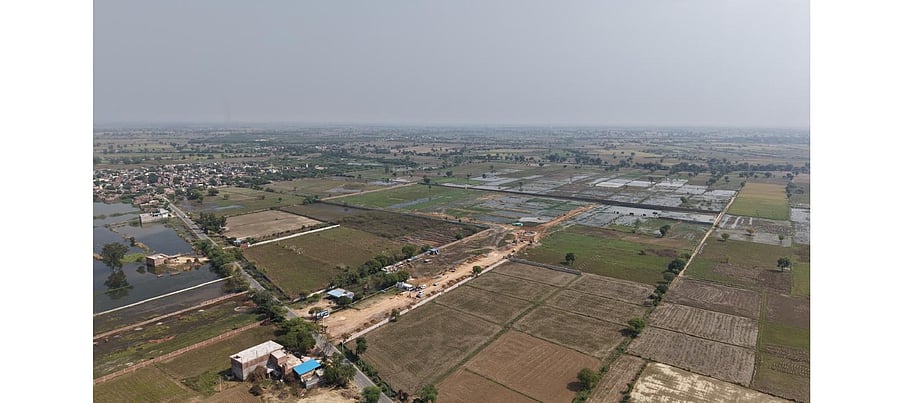
Within the Mathura–Vrindavan belt, smaller towns are now drawing attention as demand spreads outward from more saturated locations. Barsana, known for its religious significance, is one such town where early-stage residential planning has begun to take shape. Property consultants tracking the region describe it as being in an early transition phase, where tourism-led activity is slowly giving way to ownership interest, particularly for plots and low-rise developments.
Developments such as Aanandam Valleey have emerged in this context as part of the broader residential activity around Barsana. Industry observers note that plotted townships are often preferred in sacred regions because buyers value flexibility, long-term holding and the option to build at a later stage. Unlike apartments, plotted land is less dependent on construction cycles and developer timelines, which suits buyers looking at legacy or retirement planning.
Another factor supporting demand is demographic change. With a growing senior population and increasing interest in slower, community-oriented living, towns near pilgrimage centres are being viewed as viable long-term residences. Buyers from NCR and nearby urban regions are exploring these locations for weekend use, second homes or future relocation, especially where basic infrastructure and road connectivity have improved.
Government spending on tourism and heritage infrastructure has also played a role in creating a baseline for value. Road upgrades, access improvements and public amenities tend to increase visit frequency, which over time supports residential demand. Analysts caution that while not all sacred towns will see the same trajectory, locations with controlled development and sustained footfall are more likely to attract long-term buyers.
As India’s real estate market becomes more segmented, temple-proximity housing is emerging as a distinct category shaped by cultural continuity rather than short-term speculation. While still smaller in scale compared to metro-driven markets, this segment is increasingly being tracked by investors and end users looking for stability, lower volatility and long-term value preservation.