
The 300-km-drive on the highway through the desert from Dubai seemed never-ending.
Eyes could behold only vast expanse of featureless desert stretching to the horizon. The monotony of rust-coloured sand dunes was broken only by the occasional fence,
to prevent camels from straying into the highway.
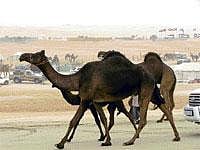
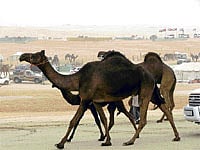
As we move further, we see camels everywhere. The humped beasts accompanied by Arabs in flowing robes and traditional head gear, jostling with high-end four-wheel drives for space is a delight to watch. A few are tied to slow-moving pick-ups proceeding to the festival venue. At a distance, hundreds of tents become visible against the backdrop of sand dunes.
Camel beauty pageant
The ten-day festival is organised by the Abu Dhabi Authority for Culture and Heritage (ADACH) and held under the patronage of Sheikh Mohammad Bin Zayed Al Nahyan — Crown Prince of Abu Dhabi. The fare includes heritage activities and trips to the Bedouin poetry competition, the handicrafts market and photography competition. But its main attraction remains the Camel Mazayin — the beauty contest.
The objective is to celebrate and preserve the culture, heritage and tradition of the desert nomad. By showcasing the vibrant world of the Bedouin, the pageant reminds the younger generation of its roots and intends to make it a major tourist attraction to boost the economy of Al Gharbia. The festival is all about camels, celebration of the symbiotic relationship between the ship of the desert and the Bedouin. As a result, the festival has filled the arid desert with breeders and their herds.
Over 28,000 camels, 1200 owners and 42 million dirhams (Rs 60 crore) in prize money make the show extremely grand. The biggest camel owners in the Gulf attend the festival and owners vying for prizes in various competitions include participants from Saudi Arabia, Oman, Qatar, Bahrain and Egypt besides UAE.
Most camel owners pitch their tents in the desert for the entire duration of the festival while people who live in the comforts of their modern villas in cities also descend on the desert to live as Bedouins along with their camels. Some arrive with a large entourage, consisting of their family, friends with dozens of four-wheel-drives in tow. They also bring along imported wool tents, expensive carpets, generators and other modern gadgets to ensure that they live comfortably.
A few people opt for walking with their camels from far away places instead of shipping them in order to carry on the traditions of their forefathers, who trekked across the deserts of Arabia on prolonged journeys.
But the real action lies at the main arena where all the daily competitions are held in 48 different categories. Desert beauties thrill spectators in the stands, who closely follow the contests while experts keenly watch every camel and assign marks based on different criteria. Some contests are for individual camels while in others, these animals are judged in groups of 25, 35 and 50.
And it’s not just the overall appearance that matters. The head of a camel is given maximum weightage, followed by the sound it makes, its posture, leg size, neck width, nose shape, hump, fur, eyes, ears, hump height and length. Also, for many competitions, only pure-bred camels of Asayel (light-haired) and Majahim (black) breeds are allowed to participate.
As for the grand finale — the Bayraq beauty competition — 50 owners present their best-looking camels and parade them around the track. Like supermodels, some of these animals command millions. As camel trading is an integral part of the festival, people dole out huge sums of money to buy and sell these creatures. For instance, Hamdan bin Ghanim Al Falahi of UAE shelled out 24 million Dirhams (Rs 30 crore) for three camels, including one which cost 1 million at the auction.
Symbol of heritage
Not just the camels or competitions, another attraction of the festival is its diversity. Thousands of visitors from many countries flock to the event. I met on such visitor — Shaun McKeogh of Australia who had come down to Al Gharbia with his whole family to enjoy the pageant. “The festival has helped my children and me experience the unique culture of UAE,” he says.
Apart from the main arena where the contests are held, visitors can also visit the traditional market in an Arabian ambience. Various stalls recreate a souk setting where wares integral to Bedouin lifestyle are sold. Dates, perfumes, camel harness, coffee and tea pots, ceramic pots, cloth bags and tents along with handicraft items of the region are displayed in rows in various small shops made of mud and palm leaf roofs.
Although the items on sale may appear to be simple and rustic but the prices are not. Fatima Al Mansouri, the guide who accompanied us, explained the significance of the market in promoting local handicraft items. She is a student of a technical institute, and is among the many volunteers drafted to be a part of the festival.
What also met my eye was the dates packaging competition to encourage date producers to adopt modern packaging and preservation methods to improve marketing. Besides, the organisers hope to promote dates as a healthy part of people’s diet and as an important symbol of UAE’s heritage.
Another attraction of the festival was the milking contest where the camel that yielded the maximum quantity of milk won. “It’s this festival that succeeded in promoting UAE’s heritage and culture and put Al Dhafra on the world tourist map in a very short time,” remarked Salim Al Mazrouei, Director of the festival. I very much agree.