
The Big Bang theory of the origin of the universe grows straight out of Einstein’s General Theory of Relativity and in fact has a meaning quite different from the popular picture of an explosion, which is of a bomb going off.
The ‘explosion’ is in the ‘four dimensional space-time continuum’ and it does not make sense to represent it by things that we have seen in our three-dimensional world.
Origin of the theory
The simple science of the 19th century stood firm on the Galilean transform, which said that one could add or subtract the speed of things in relative motion - if one threw a stone at a speed of 80 kmph from a car moving at 120 kmph, the stone would move at 200 kmph or at 40 kmph, depending on whether it was thrown forwards or backwards. And if it were thrown sideways, we could still find out the speed, somewhere in between.
This easy thinking was disturbed by the Michelson-Morely experiment of 1887, which was an arrangement that attempted to add the speed of the earth in orbit (some 30 km per second) to the speed of light. The result was that for light waves (or radio waves or X Rays, electromagnetic waves, in general) you could not add velocities like this - light moved at the same speed, regardless of the motion of the source, or the receiver!
Einstein resolved the contradiction by questioning the basis of thinking that time and space were invariant when measured from points that were in relative motion. His celebrated Theory of Relativity goes on to show that lengths and time intervals are measured shorter when measured from a moving position.
Speeds then do not add up quite to the sum of the two speeds, but always to a little less, in such a way that when adding very large velocities, the total could never add up to the speed of light! (The results get significant only for speeds comparable to that of light, and in ordinary activities like throwing stones from cars, the Galilean transform is not far wrong). And time intervals also appear to be longer when the observer is moving – a result that has been verified with radioactive particles that take longer to decay when they are moving, than when they are at rest.
A new vocabulary
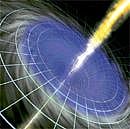
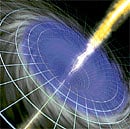
The interdependence of time and space leads to new, four-dimensional ‘space’, measured not by length, breadth and depth alone but also by time! When the laws of motion and gravity are worked out in this interrelated ‘space-time’, mass and energy get connected by the famous E=mc2 relation and gravity, gets explained as being a ‘curvature in space-time’.
The new world is quite counter-intuitive and even our ideas of ‘now’, ‘before’ or ‘after’ do not remain valid any more! It is in this basically non-intuitive view of things that space-time is seen to start from a point and then expand in its four dimensions, as the Big Bang.
Ant on a big balloon
An analogy that is used to explain how the additional dimension changes the meaning of ‘expand’ is that of an ant that lives on the surface of a large balloon. Let us take it that the ant knows nothing of the ‘depth’ and imagines the world to be just the two-dimensional surface on which it lives. When the balloon is blown up some more, this ant would only see that any two points on the balloon are moving apart.
It is in this sense that astronomers have discovered that faraway galaxies are receding and also that the furthest objects are receding the fastest! This observation is the ‘expanding universe’, which when worked backwards, leads us to the starting point which is literally a point, which is the foundation stone of the Big bang theory itself!
But as we go back in time towards this primeval origin, we encounter speeds and energies, much like approaching a black hole, at nearly the speed of light! Time itself, then, slows and the journey may take so long as never to get done.
Questions like, “so what came before the Big Bang”, which depend on our usual understanding of ‘now’ and ‘before’, hence do not make sense in the relativistic syntax from which it was a departure when the catchphrase Big Bang was coined.