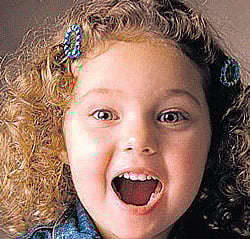
Here is why your Facebook profile picture should never be a close-up! Close-up photo subjects are judged to look less attractive, less trustworthy and less competent, according to a new study.
Researchers from the California Institute of Technology (Caltech) led by Pietro Perona, an art history enthusiast, suspected that Renaissance portrait paintings often featured subtle geometric warping of faces to make the viewer feel closer or more distant to a subject. Perona wondered if the same sort of warping might affect photographic portraits—with a similar effect on their viewers.
He and colleagues gathered opinions on 36 photographs representing two different images of 18 individuals. One of each pair of images was taken at close range and the second at a distance of about seven feet. “It turns out that faces photographed quite close-up are geometrically warped, compared to photos taken at a larger distance,” Bryan said in a statement.
“Of course, the close picture would also normally be larger, higher resolution and have different lighting—but we controlled for all of that in our study. What you’re left with is a warping effect that is so subtle that nobody in our study actually noticed it. Nonetheless, it’s a perceptual clue that influenced their judgments,” Bryan said.
The subtle distance warping, however, had a big effect: close-up photos made people look less trustworthy, according to study participants. The close-up photo subjects were also judged to look less attractive and competent.
“We went through a bunch of experiments, some testing people in the lab, and some even over the Internet; we asked participants to rate trustworthiness of faces, and in some experiments we asked them to invest real money in unfamiliar people whose faces they saw as a direct measure of how much they trusted them,” researcher Ralph Adolphs, said.
Across all of the studies, the researchers saw the same effect, Adolphs said.
In photos taken from a distance of around two feet, a person looked untrustworthy, compared to photos taken seven feet away.
These two distances were chosen by the researchers because one is within, and the
other outside of, personal space—which on average is about three to four feet from the body. In some of the studies, the researchers digitally warped images of faces taken at a distance to artificially manipulate how trustworthy they would appear.
“Once you know the relation between the distance warp and the trustworthiness judgment, you could manipulate photos of faces and change the perceived trustworthiness,” Perona said.