
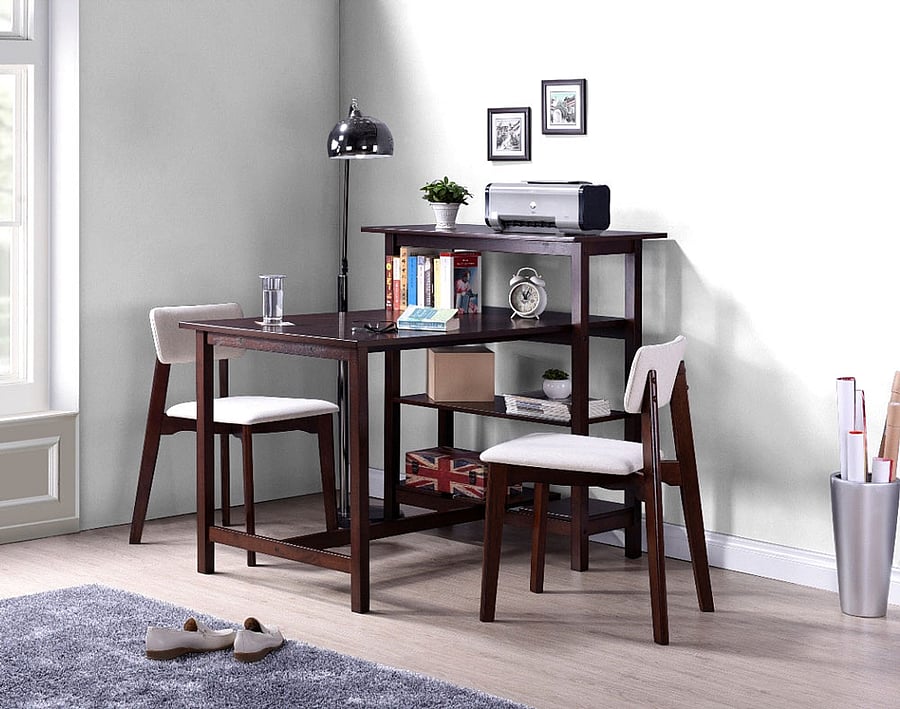
If you are someone who needs to work or study from home, it is essential to dedicate a conducive and comfortable place for that purpose. Pradeep James tells you how
Do you get tied up with distractions around the dining room table when you’re supposed to be focusing on work? Or do you doze off in bed when trying to learn about something? If so, finding a better study space should be your quest. Some study spaces are more effective than others. Research indicates that the place — or ‘context’—in which you study affects how you understand and remember that information. With the right equipment, some planning, organisation, and a personal touch, you can carve out the perfect studying/working spot. Consider these tips to fill your study space with positivity and style:
Dedicate a space to studying
Use the space only for studying. If your study space is your bed, you’ll be more tempted to think of (or actually) sleep. If it is possible for you to carve out a space — even a corner, a niche, a large closet etc. — dedicated exclusively to studying, do it. Associate your presence there only with studying.
Choosing the right table & chair
It turns out, your bed is not the best option for you to work from, or study. You need adequate workspace to spread out. Find a good desk (or table) and chair. You want to be comfortable, but not so comfortable that you lose focus or fall asleep.
If your study is not air-conditioned, steer clear of leather or art leather. Choose a chair with a breathable fabric that will keep you ventilated. Choose a chair with good support for your lumbar, mid and upper back. An ideal backrest should be 12 to 19 inches wide, and curved to match the curve of your spine.
When you sit, your feet should be flat on the ground and your arms at the same
level as the table. The chair should have adjustable armrests which can be raised or lowered, and ensure that your arms and shoulders are relaxed. The elbows and lower arms need to rest lightly on the armrests as you type or read. A study chair with a rocking motion can help you focus better and keep fatigue away. It also helps you with creative thinking.
Find a desk or table with a top that rests somewhere between your waist and rib cage when you sit at it, so that your elbows can rest easily upon it without having to hunch your shoulders forward. At the same time, you want to be able to rest your feet flat on the ground.
Let there be light
If natural light is available, certainly make use of it. A study area that is too dark will not only make it difficult to focus, it can worsen eye strain, which will dampen on any study session. Harsh lighting, such as fluorescent light, can be bad for your eyes too. Use a desk lamp to focus light on your workspace, and also a nearby table or overhead light to brighten the area. Good lighting is one of the most crucial components of an at-home study station.
Supplies on demand
Keep things organised. Make use of the desk drawers to keep things you need close by. If you don’t have enough (or any) drawers, use boxes, small crates etc. that you can stack on the desktop along the perimeter of your study area. Organise your study materials by course/subject in folders or binders. Mark each clearly and store them for easy access. You can also organise assignments and notes by using bulletin boards, cork tiles, and wall calendars. Consider a clock to keep track of time.
Make it yours
Make it functional to motivate. Hard-working people all over the world try to find the best way to accommodate a creative and inspiring working environment in their homes. Bringing your study space with posters, signs, and photos that are important to you may help give you that boost to keep going. Appeal to your senses, if you can add colour to your study space, keep in mind that cool colours like blue, purple, and green tend to inspire feelings of peace and balance, while warmer colours like red, yellow, and orange tend to inspire activity, and even restlessness.
Transforming an entire wall into a whiteboard/blackboard will create a practical and re-usable area for scribbling anything from inspiring quotes to mathematical
formulas and your to-do lists.
(The author is head – design & development, Urban Ladder)