
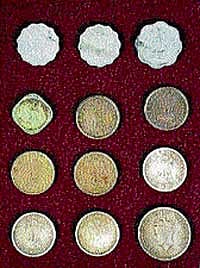
People have collected coins for a very long time. Earlier, coins were made of precious metals like gold and silver and people collected and hoarded them to tide over difficult economic times. Circulating coins were often “shaved” by unscrupulous people who cut off small amounts of precious metal from their edges. In Britain coins were sometimes reduced to half their minted value.
The famous scientist Isaac Newton – who was also the master of the Royal Mint in Britain, suggested the idea of milling lines on the edges of the coins to detect coin shaving. You can still see these milling lines on our thick 5-rupee coin.
Casual coin collectors often begin the hobby by saving notable coins found by chance. These coins may be pocket change left from an international trip or an old coin found in circulation. As old coins are expensive so coin collection became known as the ‘Hobby of Kings’. The systematic study of coins is called ‘Numismatics’.
During Akbar’s reign, the main small denomination copper coin was called the dam (pronounced daam). Dam is believed to be the source of the (originally British) expression “to not give a damn” (i.e. to not care even a little). Later the dam was also referred to as the paisa – the smallest denomination.
Indian coins are mainly produced in the four cities of Delhi, Mumbai, Hyderabad and Kolkata.
Each city puts an identification mark under the year of issue. Coins produced in Delhi have a dot; Mumbai - a diamond; Hyderabad – a star, with Kolkata having nothing beneath the year.
You can easily check this out with a handful of coins.
With galloping inflation little can be bought with small coins. It sometimes costs more to manufacture a coin than its “intrinsic” value. For this reason on June 29, 2011 the 25-paise coin popularly called the chavanni was laid to rest for ever.
Despite the small “money value” of coins much can be done with them. The father of Russian popular science, Y Perelman, in his book ‘Fun with Physics’, published over a century ago, used coins as standard weights. Many of the old Indian coins could be used for weights. The 10-paise circular steel coin weighed exactly 2gms. The old 25-paise coin was 2.5gms and 50-paise weighed 5 gms.
COIN DANCE
Take an empty glass bottle. Apply a few drops of water on the mouth of the bottle and cover it with a one-rupee coin. Then rub your hands to warm them. Cup your warm hands around the bottle and hold it for half a minute.
The coin will begin to jump up and down. This shows that air expands when heated. When you hold the bottle with your warm hands, the cold air in the bottle becomes warmer.
Warm air expands and comes out of the bottle and makes the coin dance. See this video http://www.youtube.com/watch?v=Li9eyds1Y_g
COIN INERTIA
Lay a stiff card across a tumbler. Place a coin on the card. Then give a sharp flick to the card with your thumb and index finger. The card will fly away but the coin will drop in the tumbler because of its inertia.
COIN CENTRIFUGE
Place a coin in a transparent balloon. Inflate the balloon and close its mouth with your hand. Rotate the balloon and make the coin spin.
The coin will begin to spin smoothly around in circles on its own – like a motor cycle in a circus cage! This is a wonderful and graphic demonstration of Centrifugal Force. However, if you replace the circular coin with a cycle hex nut then the spinning nut makes a roaring noise! See video http://www.youtube.com/watch?v=HkUNiOC1YB8
COIN HANGER
This delightful experiment may require some practice, but it will regale your friends no end. Take a thick aluminium wire hanger. Hold its hook with one hand and pull away the mid-point of the long end with the other.
This way the hanger will bend in a diamond shape. Then gently perch a 5-rupee coin on the end of the hook. Hang the hanger by your index finger and spin it. If you are careful then you will be able to spin the hanger round-and-round without the coin falling.
The coin stays in place because of the force of rotation. When the hanger spins the coin sticks to the hook and does not fall off. See this video http://www.youtube.com/watch?v=uEAz_Hm9r_I