
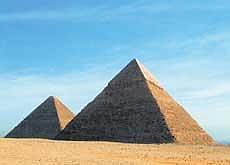
What will you say if somebody suggests that 1.618 is the prettiest number known in nature? Well, the suggestion, may be right. 1.618 is the enigmatic ‘divine proportion’ or ‘golden ratio’ that rules the roost from art to anatomy. The Egyptians supposedly used it to guide the construction of the Pyramids. When the Greeks designed Parthenon in ancient Athens, they thought to have been plan it around this proportion.
Not only architecture, 1.618 – also recognised as PHI – is found in biological nature, in human anatomy, in major art works including Leonardo Da Vinci’s Mona Lisa and even in music. PHI appeared in the organisational structures of Mozart’s sonata, Beethoven’s Fifth Symphony and in the pieces created by other masters. Stradivarius used it to calculate the exact placement of f-holes in the construction of his famous violin.
Fibonacci sequence
The golden ratio also comes out of an equally mathematical pattern known as Fibonacci sequence (0, 1, 1, 2, 3, 5, 8, 13, 21, 34...) in which the quotient of two adjacent terms always leads to approaching the number 1.618. Architecturally, it describes a rectangle with a length roughly one and a half times its width.
Incidentally, the Fibonacci sequence and PHI provided fictional Harvard symbologist Robert Langdon vital clues in his effort to unravel the mysteries in the blockbuster novel The Da Vinci Code.
Now a Duke University engineer claims PHI to be a compelling springboard to unify vision, thought and movement under a single law of nature’s design.
Adrian Bejan, a mechanical engineer professor at Duke’s Pratt School of Engineering, thinks he knows why the golden ratio pops up everywhere: the eyes scan an image the fastest when it is shaped as a golden-ratio rectangle.
The natural design that connects vision and cognition is a theory that flowing systems, from airways in the lungs to the formation of river deltas, evolve in time so that they flow more and more easily.
Bejan, who proposed this theory in 1996, reported its latest application in the International Journal of Design and Nature and Ecodynamics. “When you look at what so many people have been drawing and building, you see these proportions everywhere. It is well known that the eyes take in information more efficiently when they scan side-to-side, as opposed to up and down,” he said. Bejan argues that the world – whether it is a human looking at a painting or a gazelle on the open plain scanning the horizon – is basically oriented on the horizontal. For the gazelle, danger primarily comes from the sides or from behind, not from above or below, so their scope of vision evolved to go side-to-side. As vision developed, he argues, the animals got “smarter” by seeing better and moving faster and more safely.
“As animals developed organs for vision, they minimised the danger from ahead and sides. This has made the overall flow of animals on earth safer and more efficient,” he said. While the golden ratio provided a conceptual entryway into this view of nature’s design, Bejan sees something even broader. “It is the oneness of vision, cognition and locomotion as the design of the movement of all animals on earth,” he said. “The phenomenon of the golden ratio contributes to this understanding of the idea that pattern and diversity coexist as integral and necessary features of the evolutionary design of nature.”
Not only in cognition, physicists have discovered golden ratio is in the nano-world also, The research conducted by scientists at Helmholtz-Zentrum Berlin für Materialien und Energie (HZB), in cooperation with colleagues from Oxford and Bristol Universities was published in the January 8 edition of Science.
They measured the signatures of a quantum-scale symmetry showing the same attributes as the golden ratio.
Quantum effect
On the atomic scale, particles do not behave as we know it in the macro-atomic world. New properties emerge from the famous quantum theory known as Heisenberg’s Uncertainty Principle. To study these nanoscale quantum effects, scientists focused on the magnetic material cobalt niobate. When applying a magnetic field at precise points in the molecule, the material transforms into a new state called quantum critical. Alan Tennant, the leader of the Berlin group, explains, “The system reaches a quantum uncertain – or a Schrödinger cat state. We have tuned the system exactly in order to turn it quantum critical.”
By tuning the system and artificially introducing more quantum uncertainty, the team observed that the chain of atoms acts like a nanoscale guitar string. In the guitar string, the tension comes from interaction between spins causing them to magnetically resonate.
“Here. For these interactions we found a series (scale) of resonant notes. The first two notes show a perfect relationship with each other. Their frequencies (pitch) are in the ratio of 1.618…, which is the golden ratio famous from art and architecture,” said Radu Coldea from Oxford University explains. “It is no coincidence. It reflects a beautiful property of the quantum system – a hidden symmetry. This is its first observation in a material,” he explains.