
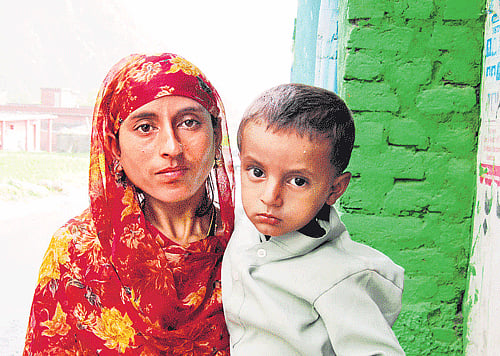
Zahida Parveen, from Bhimber district of Pakistan Occupied Kashmir (PoK), recounts her nerve-wracking experience of clandestinely crossing the heavily militarised Line of Control (LoC) in Kashmir that divides India and Pakistan.
Zahida’s parents had married her off to Mohammad Shokat, a resident of Surankote block in Poonch district. At the time, the young man was allegedly undergoing training as a militant after he had crossed over, a few years ago, to Moong Bajree in PoK with a group of militants for arms training.
Clandestine crossing
“It was a night in December last year, and rain was pouring down. All through the night we kept walking, crawling, panting and perspiring. We didn’t catch sight of any Pakistani soldier but by the time we stepped on to the Indian side it was almost morning. We came to a halt in the nearby Degwar village and the very next moment we were encircled by army men with their guns pointed at us. After being grilled for some hours, we were handed over to the police,” Zahida recalls.
The couple claimed that they were not armed and this perhaps helped their case. Zahida was arrested and bailed out after 15 days. Her husband had to spend six months in jail under the Public Safety Act. Today, she lives in Khardi, a village that almost adjoins the border. Every three months, both husband and wife have to appear before the district court.
Grim living
“Our life at the camp was miserable. Women there are not treated like human beings. We came here to start our life afresh after hearing about the government’s rehabilitation policy, but so far we have not received any help from the authorities,” regrets Zahida.
Zahida worries about her younger sister, Safia Parveen, who is also married to a surrendered militant, Mukhtayar Hussain, from Surankote. Hussain too had gone across the LoC to join the ranks of the militants on the other side, but returned secretly with his wife and three children by slipping through the almost unguarded Nepal border.
The grass on the other side
“My sister’s in-laws don’t like her. They want to remarry their son to a local girl. Last winter they repeatedly beat her and threw her out of their home. She remained out for three months, spending a month with me. After that, because of the intervention of some local people, they took her back,” elaborates Zahida.
While she was with Zahida, Safia kept pining for her children. Zahida tried to help her and even approached the local police, but nothing came of it.
Mere paper policy
Under the Government of India’s Rehabilitation Policy, native militants who abjure violence and pledge allegiance to India can surrender by arriving in the country through four recognised border crossings – Poonch-Rawlakote in Jammu region, Uri-Salamabad in Kashmir, Wagah in Amritsar and the International (IGI) Airport in Srinagar.
However, because of non-cooperation on the part of the Pakistani authorities, these converts to peace are unable to cross over to the Indian side legitimately. Says Advocate Taj Hussain Shah, who has been pursuing such cases at the Poonch district court, “These women have no presence in the ongoing conflict for either side, yet they are facing the worst kind of human rights abuse.”
Adds Shah, “I have been arguing in the courts that this is really a political issue. If India claims PoK as part of its territory, then these women – or for that matter anyone coming from that region – are automatically citizens of India.”
Ignorant wives
Then there is the case of, Parveen Akhtar, who was married to a surrendered militant in 2008. She was living a normal life until her husband was rearrested by the police who claimed that his was a case of mistaken identity as he was not a local militant, as he had claimed, but a Pakistani mole. This arrest evidently followed intelligence inputs that the man was a Pakistani national, living under the fake identity of a local surrendered militant. Soon after the police nabbed her husband, his family abandoned her. Presently, Parveen is living with her maternal family.
Wandering women
Holding her three-year-son, Bilal, in her arms, Parveen says, “My husband was not known to me before marriage. Even after marriage I never asked him about his past life. He was working as a manual labourer at a road construction site in a nearby village, when he was rearrested.”
Only one question haunts Parveen’s father: if his son-in-law is proven to be a resident of PoK, what will happen to his daughter and her child? The answer to this question remains elusive. So far, the courts have not pronounced on the status of women like Parveen, Safia and Zahida. They continue to live in a circle of fear and anxiety.