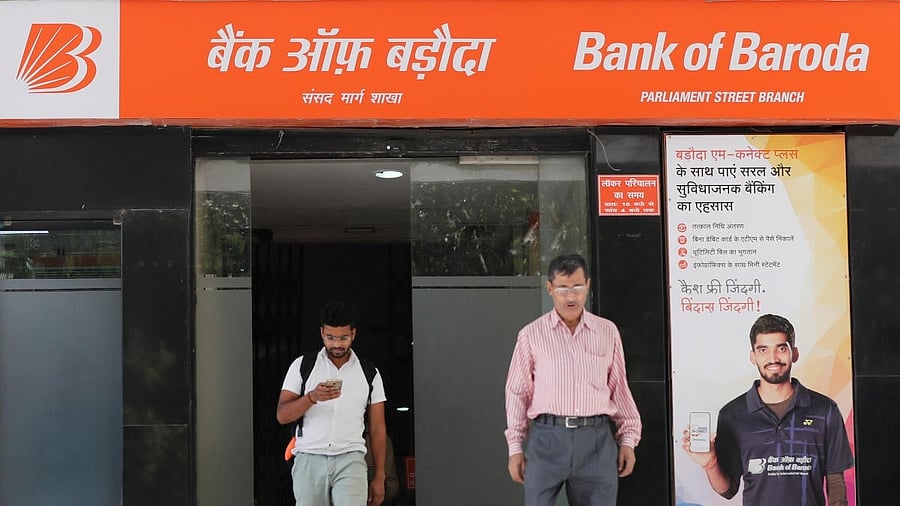
Bank of Baroda (BoB).
Credit: Reuters File Photo
New Delhi: Hours after the RBI slashed key policy rate, state-owned lenders, Bank of Baroda (BoB) and Bank of India, on Friday announced an interest rate cut on loans linked to repo rate by 25 basis points, a move expected to be followed by other lenders too.
Bank of India reduced Repo Based Lending Rate (RBLR) to 8.10 per cent from 8.35 per cent effective Friday, Bank of India said in a regulatory filing.
Baroda Repo Based Lending Rate (BRLLR) to come down to 7.90 per cent as against the existing 8.15 per cent, BoB said in a separate filing.
The new rate would be effective from December 6, it added.
Another state-owned lender Indian Bank, earlier this week, trimmed the Marginal Cost of funds based Lending Rate (MCLR) by 5 basis points to 8.80 per cent for a tenure of 1 year, effective from December 3.
Earlier in the day, the Reserve Bank of India (RBI) cut key benchmark interest rate for the first time in six months and vowed to provide Rs 1 lakh crore liquidity boost to the banking sector to support a "goldilocks" economy in the face of high US tariffs.
The six-member monetary policy committee, led by RBI Governor Sanjay Malhotra, voted unanimously to lower the repurchase or repo rate by 25 basis points to 5.25 per cent and retained a neutral stance, which gave room for further rate cuts.
The step is being seen as lending support to the economy that has been hit hard by the steep 50 per cent tariff US President Donald Trump slapped on Indian goods.
RBI's move will supplement government efforts in lending support to the economy in the form of the biggest GST reforms, relaxing labour rules and easing financial sector regulations.
A cut in the repo rate will lead to lower borrowing costs for individuals as well as corporations because it reduces the interest banks pay to borrow from the RBI. With cheaper funding, banks can lower lending rates such as MCLR and base rates, making home, auto, and business loans more affordable.
This reduces EMIs, encourages consumers and businesses to borrow more, and supports economic activity.