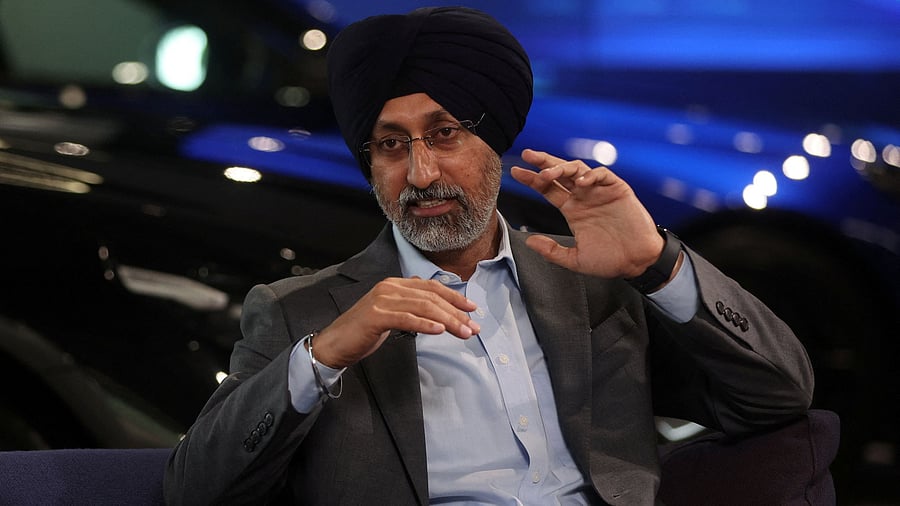
BMW Group India delivered record annual sales in 2025 at 18,001 units, growing over 14%, well above the luxury segment’s average 9% growth. Despite GST rate changes, geopolitical churn and currency-led import pressures, the German auto giant remains focused on growing India’s luxury car market, with a sharp emphasis on electric vehicles, while navigating policy changes and evolving customer behaviour. BMW Group India President and CEO Hardeep Singh Brar speaks to DH’s Hrithik Kiran Bagade.
Edited excerpts.
How was 2025 for BMW, and the Indian luxury car segment in general?
The luxury car segment did much better than the mass segment till August. The GST rate cut benefited the mass segment more, while the luxury segment remained largely unchanged. BMW, however, performed better. Until August, we were growing at about 13%, and in the fourth quarter we grew 17%, with sales of 6,023 cars. Overall, we clocked our highest-ever sales of 18,001 units, growing 14%.
Certain models performed exceptionally well, especially the electric iX1. Customers are increasingly seeking lower cost of ownership, and EVs fit that bill. Many have shifted from diesel to electric, with demand for EVs rising while diesel demand is diminishing. From an economic perspective, India has a large fuel import bill, and e-mobility helps. From the consumer viewpoint too, EVs are easy on the pocket due to lower running costs. In that sense, we are the first luxury OEM in India to sell over 5,000 EVs.
You grew 200% in EV sales last year. What did you do differently?
The luxury segment in India still accounts for just about 1% of the total market. Someone has to take responsibility to grow that share, and we have done that. The iX1 is positioned at the entry level at around Rs 50 lakh, priced at par with petrol and diesel cars in that range. For the first time, a carmaker competitively priced its EV, and it worked in our favour. We also offer over 500-km range, and the design has been well-received. Out of 18,001 total sales, 3,753 were EVs, compared with 1,249 EVs in 2024.
What is the strategy for your sustainable mobility push?
We will launch three more EVs this year as part of a broader product offensive comprising 27 offerings — six new models, four facelifts and 17 variants. However, triple-digit growth may not be possible going forward, as that would require moving to lower price points, which is not the plan currently.
Frankly, we didn’t anticipate this level of demand. We initially expected to sell about 200 units a month, but we are now doing around 300 — a 50% jump. Demand exists, but supply constraints limit further growth. Since we opened with a strong EV pipeline, we are now focused on improving supply. Going ahead, we expect to stabilise at double-digit growth. We will remain flexible and respond to customer demand rather than pre-deciding what to sell.
Do geopolitical tensions pose supply-chain challenges for BMW in India?
What impacts us most is the depreciation of the rupee against the euro. We import parts, and currency movements directly affect costs. With the rupee weakening against both the dollar and euro, imports become more expensive.
Currently, we manage about 50% localisation. While we operate SKD, CKD and CBU models, nearly 95% of our cars are assembled at the Chennai plant. We are working to improve localisation every year, but without compromising on component quality.
The GST on EVs is 5%. What do you expect from government policy?
There is recurring discussion around increasing GST on EVs. It is critical that EVs — in both mass and luxury segments — remain untouched. A country’s development is also reflected in the size of its luxury car market. In China, luxury cars account for 15% of the market; in other developed nations, 10-15%. In India, it’s just 1%.
Even today, EV manufacturing costs are 40-50% higher than ICE vehicles. This gap is offset by a GST difference of about 35%, which is why EVs still cost 10-15% more. If this benefit is withdrawn, it could severely impact the EV segment. EVs currently account for just 4% of India’s market, growing only about 1% annually, compared with 40% in China. India needs much faster growth, and the GST benefit is crucial.
There is also discussion around alternative powertrains like hydrogen and hybrids. The government took a clear call years ago to push EVs to reduce pollution and oil imports. Hybrids reduce emissions marginally, but EVs are zero-emission. At this nascent stage, introducing multiple powertrains could derail the EV narrative. Charging infrastructure also needs scale-up.
Are you investing in charging infrastructure?
Our customers expect a charging station every 300 km. Accordingly, we have installed 12 high-performance chargers across highways from North to South, ranging from 120 kWh to 720 kWh, enabling charging in under 20 minutes.
Will EVs remain a key focus area?
In 2024, petrol accounted for 60% of our sales, diesel 30%, and EVs around 10%. In 2025, petrol remained stable, diesel dropped to 18%, and EVs rose to 21%. EVs are a major focus. There is also some direction from the government on diesel vehicles, and consumer demand for diesel is declining. As a brand, we intend to remain flexible.