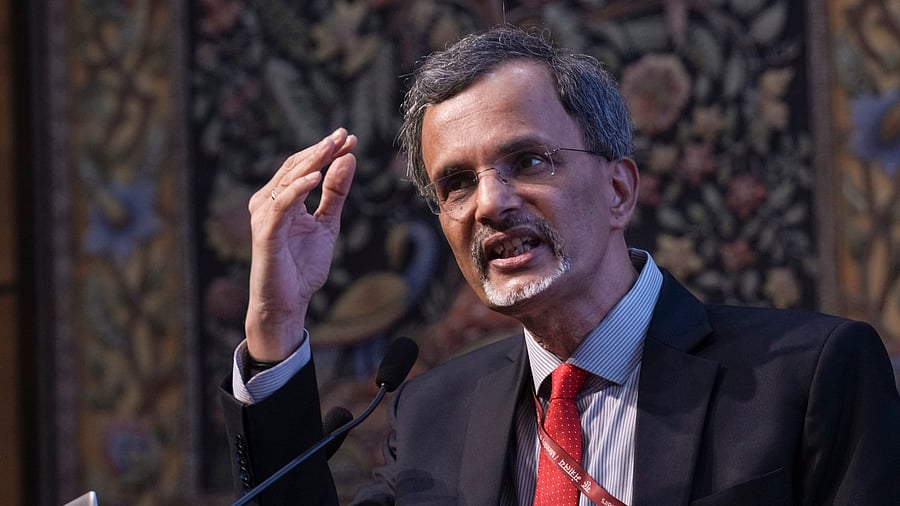
Chief Economic Adviser V Anantha Nageswaran.
New Delhi: The Economic Survey 2025-26, tabled in Parliament by Union Finance Minister Nirmala Sitharaman, paints a rosy picture of India’s economy. However, it also flags the uncertain global environment and risks to the economy due to the recent surge in cash freebies by states. Chief Economic Adviser V Anantha Nageswaran, who authored the Survey report, has termed India as an oasis of macro stability in an otherwise turbulent world. In an interview with DH’s Gyanendra Keshri, Nageswaran delves on the growth projections and challenges to the economy. He also talks about the US tariffs and the impact of gold and silver prices and currency fluctuations on the economy.
Edited excerpts -
In the Economic Survey the GDP growth potential has been upgraded to 7% from 6.5%, which was for the past three years. What are the key drivers for this optimism?
We said in 2022-23 that we will be upgrading this number (6.5% GDP growth potential) provided economic reforms happen and that's exactly what has happened. The government has opened up foreign direct investment, created more public investments and deregulation is happening in states. The Centre has notified Labour Codes, cut direct and indirect taxes, putting more disposable income in the hands of people and inflation has been well behaved. So, I think it is a combination of various actions, policy actions, process reforms in the states and continued improvement in infrastructure that has given us the confidence to upgrade India's trend growth estimate to 7%.
This upgraded 7% growth potential is only for next financial year or you expect the similar growth momentum in the subsequent years?
This is for the medium-term. It's about somewhere between 5 and 10 years. However, there is no specific number of years. These are not easy to define more precisely than that.
In the current financial year the growth has been substantially higher than last year’s Economic Survey projection. The actual growth is projected to be 7.4% against the Economic Survey’s projection of 6.3 to 6.8%. Do you expect a similar positive surprise in the next fiscal?
I think we should wait for the year to begin and see how global factors shape up. We have just made the projections, it would be premature to anticipate right now whether there will be an upside surprise for this number. I think it’s too early to make that kind of forecast.
How will the proposed trade deal with the US impact GDP growth?
Certainly it will have a positive impact and the upside risk. If the deal happens the growth estimates will go up.
The Survey has flagged that Unconditional Cash Transfer schemes followed by many states are shrinking their fiscal space and negatively impacting their growth-oriented spending. What is the message to the states?
The message is obvious, we need to basically kind of find a way to use these resources to invest in building the capital assets and infrastructure that give a higher multiplier benefit to the households, to the individuals in terms of employment generation and income growth that will be more long-lasting than cash transfers. Apart from the fiscal consideration, the cash transfers are also having an impact on the public's incentive to take on jobs and upskill themselves.
Do you expect any substantial change in states’ strategies given the political compulsions?
That is not for me to speculate. States have shown an appetite for reforms as well. As and when things become clearer to them in terms of the net costs and benefits of what they are pursuing, I'm confident that they will do the right things.
Despite strong macro-economic fundamentals the Indian currency has been among the worst performers. It has depreciated by around 7% against the US dollar in the past one year. Why is the Rupee punching below its weight?
When capital flows become weaker, the currency becomes weaker as well. And that is what we have seen in 2025. The capital imports have become difficult. To tackle these issues, we need to do whatever we can to improve capital inflows into the economy. But sometimes there could be factors beyond our control. We shouldn't be worrying about things beyond our control, but we should focus on what it is that we can do within our capabilities and within our policy scope to make it easier for capital to flow into India.
Do you anticipate improvement in capital flows and rupee exchange rate this year?
We don't make forecasts for these kinds of variables. We can only have anticipations but the world is also becoming a trickier place and therefore there are multiple variables that could impact these things. The Ministry of Finance and the government don't make forecasts for the currency.
There has been a record run in gold and silver prices. The Survey notes that it may rise further given the global uncertainties. How will it impact the Indian economy?
I don't think gold and silver prices have any major impact on the economy. Gold prices have been up significantly since the beginning of the last year. Since Indian households have a lot of gold there can be a positive impact on household net worth and it creates a sense of feeling good.