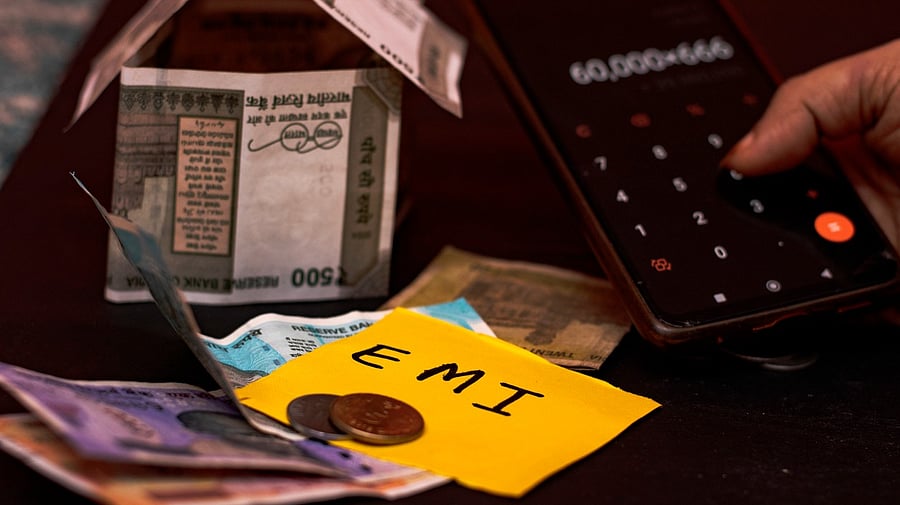
Representative image showing EMI.
Credit: iStock Photo
Bengaluru: Significant imbalance between earnings and monthly loan instalments is adding financial stress on Indian families, forcing them to borrow more and face harassment from creditors, according to a survey involving financially distressed people conducted across the country.
At least 72 per cent of the borrowers surveyed by Expert Panel, which specialises in cases related to loan defaults and harassment by recovery agents, reported some form of harassment from recovery agencies, while 67 per cent reported receiving frequent calls, often abusive, from lenders.
The report highlighted that financially stressed individuals with an average monthly income of Rs 35,000 - Rs 65,000 range have an average EMI obligation between Rs 28,000 and Rs 52,000. This imbalance in income-EMI ratio is forcing them to credit card rotation, additional loans, friends and family support, along with informal lending.
Buy now, pay later (BNPL), instant loan apps and personal loan EMIs are a significant source of loan distress.
The report was based on a survey of 10,000 financially distressed borrowers, conducted from June to December 2025 across the country, including in Bengaluru and Tier-2 cities and semi-urban areas.
While banks (45%) and non-banking financial companies (40%) remain major lending sources, digital lending apps account for 15%.
Despite repeated advisories and regulatory action by the Reserve Bank of India, many borrowers continue to fall into illegal lending traps because urgency often overrides caution.
Medical emergencies, job losses, or short-term cash-flow gaps push people toward apps promising instant, paperless loans and "no credit checks", especially when banks or NBFCs turn them away, law firm Accord Juris Managing Partner Alay Razvi said.
He said BNPL products worsen the problem by breaking spending into small instalments, making debt appear manageable while quietly piling up until repayments become unworkable.
Once trapped, borrowers often face harassment, data misuse and intimidation practices that are illegal, Razvi added.
In July last year, the RBI listed legal digital lending apps on its website. But still, some borrowers turn to illegal loan apps.
"This is not due to lack of awareness, but because of urgency and access gaps. When individuals face immediate cash needs and are unable to qualify for formal credit due to thin credit histories or documentation constraints, illegal apps present themselves as fast, frictionless solutions. These platforms exploit moments of financial stress by offering instant approvals and minimal checks, often masking the long-term consequences until it is too late. Awareness alone does not always translate into safer choices when speed and convenience outweigh caution," Vartis Platforms and Insta Money Co-Founder & CEO Bhavin Patel said.
Consumers must be encouraged to verify whether a lender is RBI-regulated, understand the true cost of borrowing, and avoid platforms that demand unnecessary permissions or access to personal contacts, Kiwi Co-founder Siddharth Mehta said.
According to him, when safe credit is readily available at the point of payment, reliance on unregulated and exploitative lending apps reduces significantly.
Alay Razvi also said that affected individuals should promptly report such apps to cybercrime authorities, lodge police complaints where threats are involved, and approach RBI grievance mechanisms for regulated lenders. There should be stronger action against illegal apps, tighter oversight of digital lending partners, mandatory credit bureau checks for BNPL, and behaviour-focused financial literacy are essential.
Alongside enforcement, we need responsible product design, caps on BNPL exposure, cooling-off periods, and repayment alerts and wider availability of regulated micro-credit to reduce demand for illegal alternatives, VERTICES PARTNERS Founder and Managing Partner Vinayak Burman said.
"Ultimately, awareness alone is not enough. Unless frictionless digital credit is matched with strong safeguards, borrowers will continue to drift toward illegal loan apps," he added.