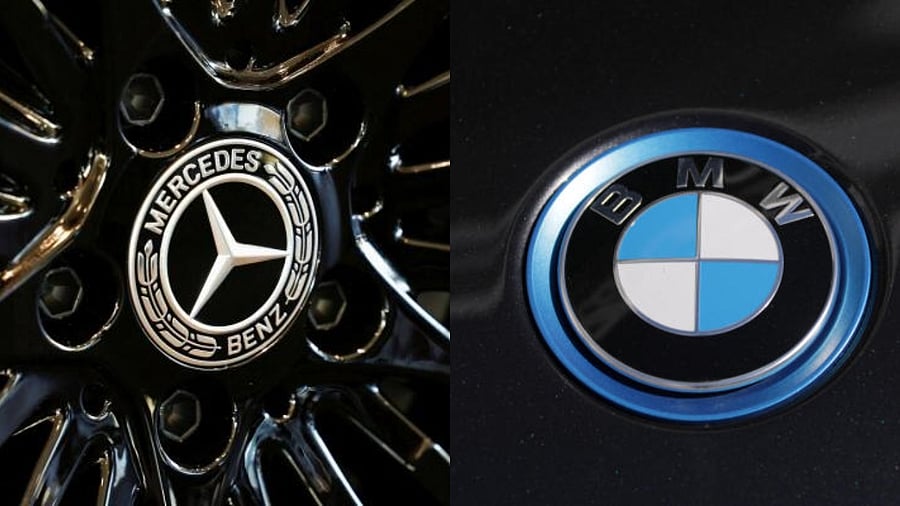
Logos of Mercedes-Benz and BMW.
Credit: Reuters Photos
Bengaluru: With India and the EU announcing the conclusion of the landmark Free Trade Agreement (FTA) on Tuesday, European cars, especially luxury ones, are set to become cheaper in the Indian market.
Under the agreement, which is expected to come into force next year, India has committed to granting tariff concessions to the EU, including a phased reduction in import duties on vehicles from as high as 110% to as low as 10%. This is likely to impact a wide range of European cars, primarily imported as Completely Built Units (CBUs), with limited spillover benefits for Semi-Knocked Down (SKD) and Completely Knocked Down (CKD) models.
Import duties on EU-origin CBUs are expected to fall sharply from the current 70-100% range to about 40%, though the lower rates would apply to a capped number of vehicles with an import price above 15,000 euros, according to analysts. For CKD models, the reduction in tariffs on components and technical inputs could lower costs, potentially making even locally assembled luxury cars more affordable.
European automakers such as Mercedes-Benz, BMW and Audi already assemble several models in India through the CKD route. They see the FTA as a positive step, particularly in easing supply-chain bottlenecks, improving access to global technologies, and enabling smoother movement of parts and platforms.
Mercedes-Benz India said the FTA would have a positive cascading effect on customer sentiment in the luxury segment and support overall economic growth. “A gradual reduction in vehicle tariffs and full liberalisation of automotive parts are strategically important for the industry,” said Santosh Iyer, Managing Director and CEO, Mercedes-Benz India.
He added that the pact could improve vehicle allocations, enhance availability of top-end global models, and accelerate access to new technologies. However, Mercedes-Benz would continue to focus on adding value through local production of world-class models in India.
BMW Group India also hailed the agreement, reiterating its long-standing support for free trade. “Free trade enhances fair market access, strengthens economic collaboration, and builds more resilient supply-chains,” said Hardeep Singh Brar, President and CEO, BMW Group India.
Over 95% of BMW’s sales in India come from locally manufactured models, with fully imported vehicles accounting for only about 5%. Brar said the FTA could open doors for introducing new and niche products, though he did not foresee immediate price changes. “We will evaluate the detailed implementation roadmap, timelines and qualification criteria once the fine print is available,” he said, adding that deeper localisation could follow if demand scales.
Audi India echoed similar sentiments. Brand Director Balbir Singh Dhillon said the FTA could support innovation, supply-chain efficiency and technology collaboration across the automotive ecosystem, while cautioning that pricing implications would only become clear once final terms and timelines are known.
Skoda Auto Volkswagen India MD and CEO Piyush Arora said greater tariff certainty would allow automakers to assess the introduction of a wider range of European models, while supporting long-term investment, technology transfer and capability building in India.
“While we look forward to specific details of the India-EU FTA with respect to the auto industry, the calibrated approach to balance market access and domestic manufacturing should give us a win-win between increased global participation, and growth of the domestic auto industry with investments and employment. This will also enable increased choice for consumers in both regions,” said Shailesh Chandra, MD and CEO of Tata Motors Passenger Vehicles, and President of SIAM.
"Auto components and emerging electric-vehicle components, a key industry in terms of employment generation in India, are projected to experience faster growth, in the range of 10-15% annually, and potentially higher for EV-linked products, given currently high EU tariffs and India’s cost competitiveness." mentioned Ranjeet Mehta, CEO and Secretary General, PHDCCI.
Brussels-based European Automobile Manufacturers’ Association (ACEA) termed the FTA a landmark in global trade relations, noting that it would help European automakers access India’s passenger vehicle market of around 4 million units, which has until now been protected by import tariffs of up to 110%.