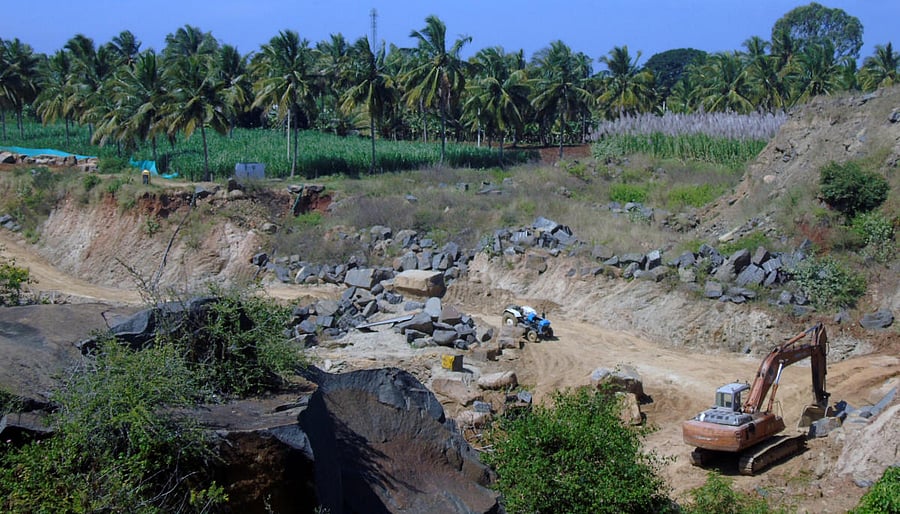
Image representing for mining.
DH file photo
Bengaluru: India is serious about harnessing the potential of critical minerals, in its effort to transition to more renewable energy sources.
According to the Economic Survey, the global energy transition is no longer solely determined by technology; it is increasingly constrained by who controls critical minerals.
"Metals like Lithium, cobalt, nickel, copper, and rare earth elements have become the new strategic chokepoints in shaping the contours of a low-carbon economy, influencing energy security, industrial competitiveness, and geopolitical power, as observed through several trade restrictions on export of critical minerals by source countries," it said.
As demand accelerates, advanced economies are responding by promoting standards-based critical mineral markets, emphasising sustainability, traceability, and governance. Initiatives such as the G7 Roadmap to Promote Standards-Based Markets for Critical Minerals aim to enhance transparency, reduce concentration risks, and encourage responsible sourcing.
From the perspective of developing countries, the current direction presents three significant challenges.
First, there's a risk that standards could turn into barriers instead of facilitating progress. With the introduction of digital traceability systems, certification requirements, and ESG compliance, the upfront costs and ongoing expenses can be quite steep. "For many resource-rich developing nations, these financial burdens may lead to investor pessimism, and slow down project development, and limit supply," the survey said.
Second, there is a real concern that standards wherein if narrowly defined or asymmetrically enforced, can trap developing countries in the lowest-value segments.
Third, affordability is adversely impacted. Sustainability premiums that tend to raise mineral prices without parallel support for finance, technology, and capacity building will increase costs to transition globally and disproportionately impact emerging economies.
"A transition that is clean but unaffordable is neither rapid nor just. A durable global framework for critical minerals must therefore move beyond compliance-centric thinking. It must be inclusive, capacity-sensitive, and development oriented. Resource-rich regions in Africa, Latin America, and Asia must be treated as co-producers of value, rather than merely sources of raw materials," the survey added.
India’s strategy reflects this balance with a focus on domestic capabilities through the National Critical Mineral Mission (NCMM), along with suitable incentive mechanisms, while engaging in international partnerships like the Minerals Security Partnership and the Indo-Pacific Economic Framework. The Union Cabinet approved the setting up of the NCMM on January 29, 2025, with a financial outlay of Rs 16,300 crore and expected investment of Rs 18,000 crore from PSUs and others.
It aims to secure a long-term sustainable supply of critical minerals and strengthen India’s critical mineral value-chains encompassing all stages from mineral exploration and mining to beneficiation, processing, and recovery from end-of-life products. "To build supply chain resilience in critical minerals, the Union Cabinet has approved a Rs 1,500 crore Incentive Scheme for Promotion of Critical Mineral Recycling under NCMM," it said.