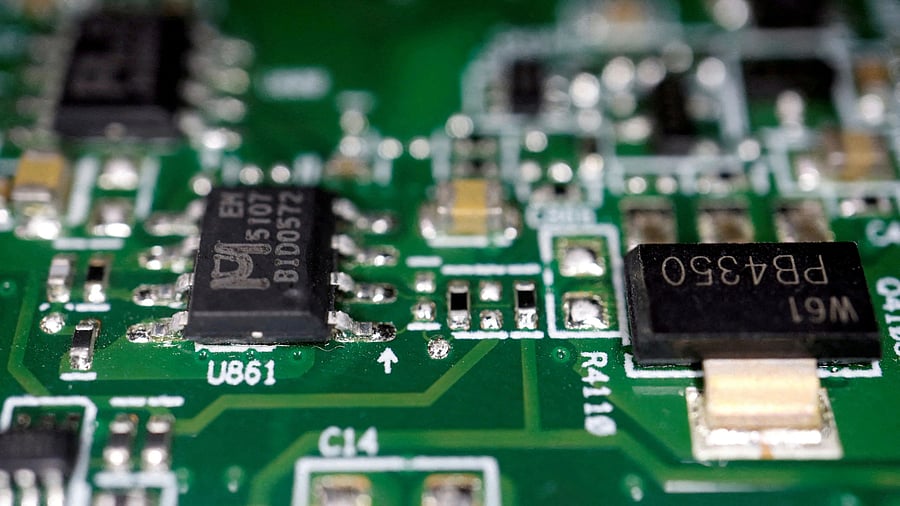
Semiconductor chips are seen on a printed circuit board in this illustration
Credit: Reuters Photo
Bengaluru: The India-US trade deal announced by President Donald Trump on Monday will help accelerate semiconductor design and manufacturing, boost electronics value addition, and expand cooperation across AI, data centres, and advanced manufacturing, say industry experts.
“The India–US trade deal can be a major catalyst for India’s electronics, semiconductor, and technology ecosystem.
By improving market access, enabling smoother flow of capital equipment and advanced technologies, and—when complemented by the iCET and TRUST initiatives—strengthening trusted supply chains and deepening technology collaboration, the agreement significantly enhances India’s attractiveness as a global manufacturing and innovation hub,” says Ashok Chandak, President, SEMI India and IESA.
He says the vision of $500 billion bilateral trade can have over $100 billion trade for the electronics and semiconductor sector.
Sujan Hajra, Chief Economist & Executive Director, Anand Rathi Group says, while the imposition of a 50% US tariff disrupted a wide swathe of Indian exports, its direct impact on the earnings of India’s listed corporates was limited. India’s tariff impacted parts of goods export exposure to the US is skewed toward privately held MSMEs and low-margin manufacturing rather than large, listed firms. Consequently, the subsequent rollback in tariff rates is unlikely, by itself, to materially alter the earnings trajectory of Indian equities.
Yet, the macroeconomic and strategic consequences of the episode have been far more significant. The tariff shock acted as a catalyst for reforms that may ultimately prove far more valuable than the relief from tariffs themselves, he adds.
“It accelerated rationalisation of GST rates to protect domestic demand, pushed long-pending labour and compliance reforms to the forefront, and encouraged a deliberate diversification of India’s foreign-exchange reserves away from excessive dollar concentration. Most importantly, it forced India to seek deeper market access and geopolitical hedging through a landmark trade agreement with the European Union — opening a far larger, richer and more stable export market for Indian manufacturing and services,” Hajra adds.
With the India–US treaty now in place, that overhang is beginning to lift. The key shift is not incremental tariff relief, but the restoration of geopolitical and trade stability. As risk premia normalise, India once again looks investable to global capital — a high-growth, politically aligned, strategically important economy with deep domestic demand and improving external linkages to both the US and Europe.
Indian equities, in that sense, have been pricing in a geopolitical discount that is now fading. The case for a catch-up rally lies less in near-term earnings upgrades and more in the reversal of capital-market pessimism that the tariff shock and diplomatic friction had previously created.