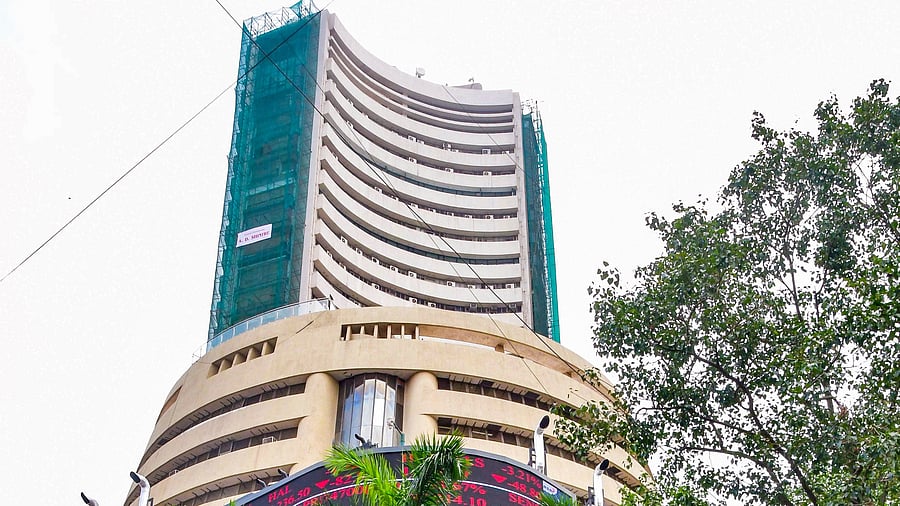
People walk past the Bombay Stock Exchange (BSE) building, in Mumbai.
Credit: PTI photo
The New Year has brought renewed optimism to markets, reflected in improved broader market participation and selective buying in mid-cap stocks. Expectations around upcoming Q3 results and supportive policy signals ahead of the Union Budget have further buoyed sentiment.
We expect this positivity to continue and Indian equities to trade firm this week with focus on the ongoing pre-quarterly business updates, followed by start of the earnings season with TCS result announcement on January 12.
On the global macro front, investors would watch out for Manufacturing and Services PMI data from the US and India and the US jobs data including Non-farm payrolls, Jolts Job Openings and Unemployment rate.
In an earnings preview on banks, we estimate system credit growth to remain at 12%+ YoY in FY26E and improve to ~13% in FY27E. We expect large private banks to grow at 3-4% QoQ and mid-sized banks to grow at a faster pace. Further, we estimate PSU banks’ PAT to grow by 2.6% YoY (0.7% QoQ) in 3QFY26E, dragged down by marginal decline in NIMs as well as modest treasury gains.
Last week, markets ended on a strong note with Nifty50 up 1.1%, rising to a record high of 26,340 on Friday amid upbeat corporate updates lifting expectations for Q3FY26 earnings and boosting investor sentiment. In the broader market, Nifty Midcap100 and Smallcap100 were up 1.7% and 0.8% respectively. Amongst sectors, Nifty Metal index emerged as the top gainer, recording weekly gains of 5.7% on the back of uptick in global commodity prices and supportive government policy announcements. Bank Nifty reached an all-time high of 60,152 on Friday, surpassing its previous peak of 60,114 recorded on December 1, 2025. Both Nifty PSU Bank and Nifty Private Bank indices touched fresh lifetime highs during Friday’s session. Meanwhile, FMCG index was the top loser, falling by 3.9% as heavyweight ITC shares crashed on new excise duty rules on cigarettes.
As auto companies reported monthly volumes on January 1, 2026, the wholesale numbers remained strong, beating expectations for several OEMs, driven by positive consumer sentiment post GST cuts, a strong festive and wedding season, and a low base. PV wholesales grew 18.5% YoY, led by M&M and Maruti, while Tata PV and Hyundai underperformed peers. Two-wheelers posted robust 43% YoY growth, CVs grew a healthy 26% YoY, and tractor OEMs delivered ~39% YoY growth. Retail demand remained equally healthy across segments. Thus, OEMs are likely to have ended 2025 with lean inventory, which we believe should help them sustain the volume momentum in 4QFY26 as well.
The government’s recent notification proposed a sharp increase in cigarette taxes effective February 1, 2026, implying an overall tax hike of ~50% (assuming NCCD continues), alongside implementation of the higher GST rate (40% vs 28% earlier). This would necessitate a steep price hike at the industry level to protect net realisations. Such a sharp increase is unprecedented after several years of tax stability, which had helped curb the illicit cigarette market. If there is no change in taxes, we expect that it will significantly impact the legal cigarette market, and the price arbitrage between legal and illegal brands will be huge. It can shift volume from legal to illicit brands and could lead to down trading within the legal brands.
Further, Indian government recently imposed trade-remedy measures, including anti-dumping duties, on select steel products to curb the influx of low-priced imports, largely from countries such as China and Vietnam. These measures, which include a safeguard duty of around 11–12% for up to three years on certain flat steel products, are aimed at protecting Indian manufacturers from unfair pricing and import surges. The move is broadly positive for Indian steel companies as it improves pricing power, supports margins, enhances capacity utilisation and provides earnings visibility for large players.
As we enter CY26, the broader market setup remains constructive, supported by improving liquidity, a stabilising earnings cycle and a policy environment conducive for private investment and credit expansion. Any resolution of the tariff stalemate with the US could provide an additional external catalyst.
Wishing all a Happy New Year!
(The writer is Head of Research, Wealth Management, Motilal Oswal Financial Services Limited)