
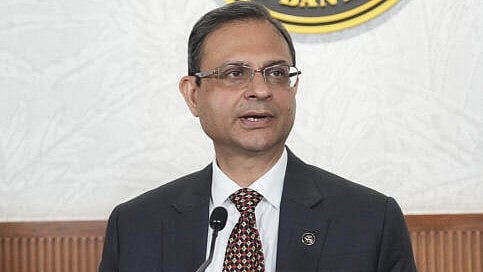
Reserve Bank of India Governor Sanjay Malhotra
Credit: PTI Photo
The Reserve Bank of India's Monetary Policy Committee (MPC) on Friday reduced the repo rate by 25 basis points to 5.25 per cent with immediate effect.
Governor Sanjay Malhotra said that the decision was unanimous.
In his comments following the committee's meeting over the last two days, Malhotra said geopolitical and trade environments continued to weigh India's economic outlook, adding that the headline inflations in emerging markets are contained, allowing room for accommodative monetary policy.
Here are the key highlights from Malhotra's address:
The MPC decided to continue with the neutral stance
"The STF (Standing Deposit Facility) rate under the LAF (Liquidity Adjustment Facility) shall stand adjusted to 5 per cent and the MSF (Marginal Standing Facility) and bank rate to 5.5 per cent," Malhotra said.
Look back at the year so far with satisfaction
"The economy witnessed robust growth and benign inflation. Since the October policy, the Indian economy has witnessed rapid disinflation, with inflation dipping to a mere 0.3% in October 2025. Real GDP growth accelerated to 8.2% in Q2, aided by strong festive spending and rationalisation of GST rates. Inflation at a benign 2.2% and growth at 8% for the first half of the year presents a rare Goldilocks period,” Malhotra said.
Real GDP growth for this year is projected at 7.3%
This is up from earlier estimates, with Q3 at 7%, Q4 at 6.5%, and next year’s Q1 and Q2 at 6.7% and 6.5%.
RBI to conduct OMO purchases of govt securities
"In view of evolving liquidity conditions, the Reserve Bank will conduct OMO purchases of government securities worth Rs 1 lakh crore and a three‑year rupee buy-sell swap of 5 billion US dollars this December to inject durable liquidity into the system," the governor said.
Headline inflation has eased significantly and is likely to be softer than the earlier projections
MPC noted that headline inflation has eased significantly and is likely to remain softer than earlier projections. This is primarily on account of the exceptionally benign food prices.
Inflation projection to 2 per cent for the current financial year
This is down from earlier 2.6 per cent. "The inflation outlook provides headroom for us to remain growth supportive while ensuring macroeconomic stability.”
Headline and core inflation revised downwards
Malhotra said, core inflation, which had been rising steadily since Q1 last year, eased at the margin in Q2 this year and is expected to remain anchored in the period ahead. So, both headline and core inflation are expected to be at or below the 4% mark during the first half of next year. The underlying inflation pressures are even lower, as the impact of increased prices of precious metals on this inflation number is about 50 basis points. Growth while remaining resilient is expected to soften somewhat
Services exports are expected to remain strong
However, Malhotra said merchandise exports face headwinds, with external uncertainties posing downside risks.
Merchandise exports contract in October, imports rise
"Merchandise exports contracted year-on-year in October 2025 while imports rose for the second straight month, widening the trade deficit. Strong services exports and remittances, however, are expected to keep the current account deficit modest," Malhotra said.
Gross FDI grew at a robust pace in the first half of the year
Net FDI increased due to lower repatriation despite higher outward flows.
FPI saw net outflows of 0.7 billion US dollars so far
This was mainly due to equities, while ECB and non-resident deposit flows moderated. India’s forex reserves stood at 686 billion US dollars as of November 28, providing more than 11 months of import cover.
India's external sector remains resilient
External financing needs can be met comfortably. System liquidity averaged a surplus of Rs 1.5 lakh crore since the MPC’s last meeting in October.
Real GDP registered a six-quarter high growth of 8.2% in Q2
"This is underpinned by resilient domestic demand amidst global trade and policy uncertainties. On the supply side, real GVA (Gross Value Added) expanded by 8.1%, aided by buoyant industrial and services sectors. Economic activity during the first half of the financial year benefited from income tax and GST rationalisation, softer crude oil prices, front-loading of government capital expenditure, and facilitative monetary and financial conditions supported by benign inflation," Malhotra said.
Indian economy has shown remarkable resilience and is poised for high growth
“Despite an unfavorable and challenging external environment, the Indian economy has shown remarkable resilience and is poised for high growth. The headroom provided by the inflation outlook has allowed us to remain growth-supportive. We will continue to meet the productive requirements of the economy proactively while ensuring macroeconomic stability,” Malhotra added.