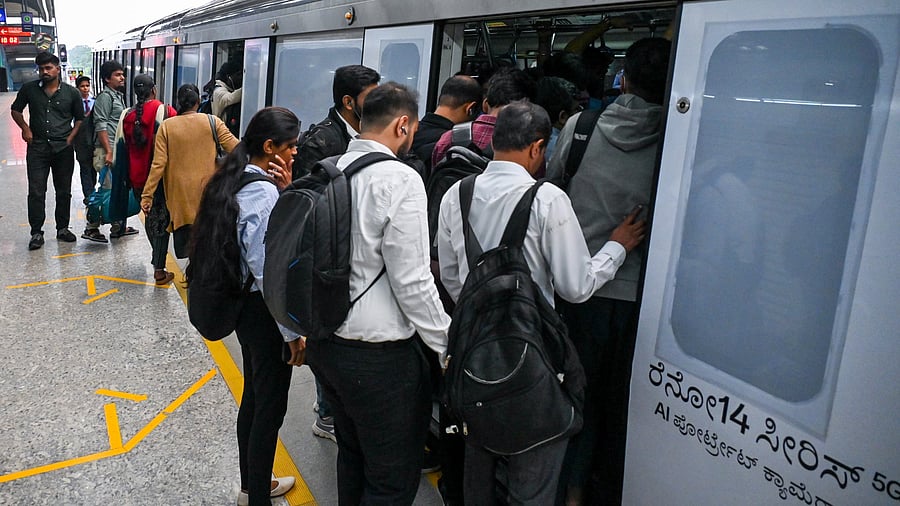
Commuters entering the Green Line metro train in Bengaluru.
Credit: DH PHOTO/PUSHKAR V
New Delhi: India’s urban story is neither one of decline nor adequacy, but of unfinished promise, the Economic Survey 2025-26 said on Thursday, while observing that many urban pressures stem from persistent supply-side constraints in land, housing and mobility.
The pre-Budget document tabled in Parliament further said Indian cities are sites of daily strain: long commutes, uneven services, and shared spaces that often fall short of collective expectations.
"..India’s urban story is therefore neither one of decline nor adequacy, but of unfinished promise," it said.
The Survey noted that many urban pressures stem from persistent supply-side constraints in land, housing and mobility.
"Restricted density, unclear titles and limited land recycling constrain affordable housing, while transport systems remain overly reliant on private vehicles," it said The Survey observed that core services such as sanitation, waste, and water services have expanded markedly, but must now evolve from expansion to reliability, circularity and efficiency.
"However, beneath these sectoral stresses lies a deeper institutional issue: fragmented metropolitan governance and limited fiscal autonomy for cities – to plan, finance and deliver at scale," it said.
Beyond infrastructure, the Survey said there is a need to improve the intangible foundations of urban life, such as civic norms, shared responsibility, and respect for public spaces.
The Survey pointed out that the quality of urban experience depends as much on collective behaviour as on budgets and bridges.
"Strengthening civic consciousness, alongside better institutions, is essential to creating cities that feel not only efficient but also welcoming," it said.
According to the Survey, in advanced and emerging economies alike, a small number of metropolitan regions function as nodes in global production networks, financial systems, logistics chains, and knowledge ecosystems.
"Despite India’s economic scale today, its cities struggle to perform this role at the level of established global cities such as New York City, London, Shanghai, or Singapore," it said.