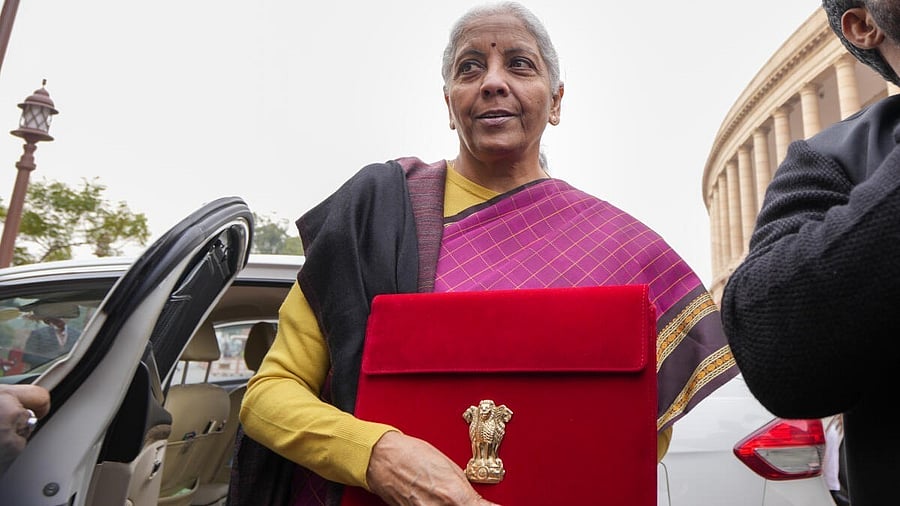
Union Finance Minister Nirmala Sitharaman as she arrives in the Parliament to present the Union Budget 2026 on Sunday
Credit: PTI Photo
While emphasising that India is in a goldilocks zone, experiencing high growth with low inflation even in a difficult environment of geopolitical tensions and trade disruptions, the Economic Survey had underlined the need to initiate forms to sustain high growth.
Although the Survey pointed out that the economy has moved into a higher growth trajectory, it did point out the surprising lack of foreign investment and the need to attract foreign capital.
In this scenario, the budget was expected to initiate proposals to provide impetus to attract foreign investment.
The market expectation was that the finance minister will help the cause by rationalising the long term capital gains tax by removing the discriminatory nature of the mutual funds based on debt and equity.
There were expectations of ensuring greater stability and certainty in tax policy to prevent it from restoring its character as residence-based after the Supreme Court ruled in January 2026 on Tiger Global’s USD 1.6 billion stake sale in Flipkart to Walmart (2018) is taxable in India. However, the uncertainty on this front has continued. It is important to assure the foreign investors that the country follows a stable and well accepted residence-based policy.
The government was able to adhere to the budgeted fiscal deficit as a ratio of GDP despite lower tax revenues due to the rationalisation of GST.
The revised estimate of tax revenue for 2025-26 is lower than the budget estimate by Rs 1.7 lakh crore, or 0.45% of GDP, and yet the fiscal deficit was contained at 4.4% of GDP.
On the macroeconomic front, the budget is on expected lines. The trend of maintaining high capital expenditures while continuing fiscal consolidation has continued.
The disappointing aspect of the budget is that it has lost another opportunity to rationalise the customs tariff. If we are serious about orienting policies to achieve “Viksit Bharat” by 2047, the most important reform is to impart competitiveness to manufacturing in order to make a commitment to roll back customs duties. This will ensure that the revenue does not decline. Simultaneously, regulations and non-tariff barriers can be reduced.
(The author is former director, NIPFP, and Member of the 14th Finance Commission. Views are personal)