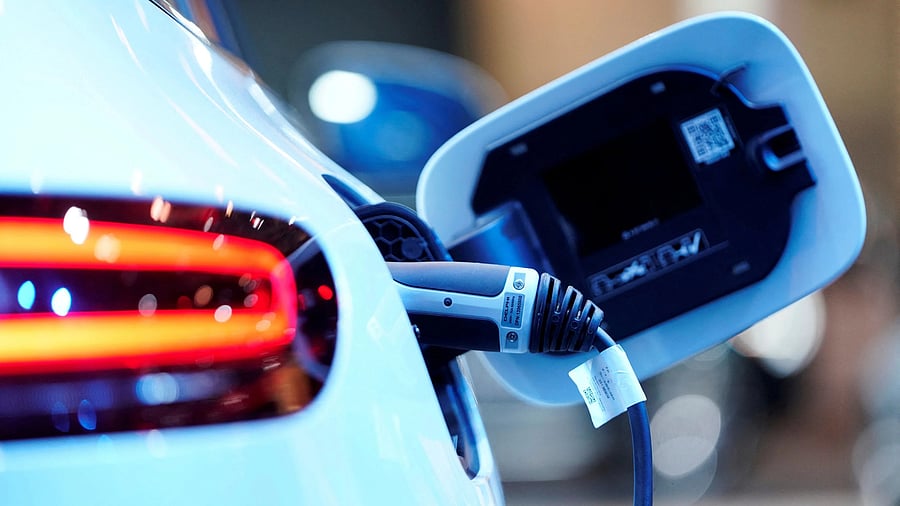
Representational image for an electric vehicle.
Credit: Reuters Photo
Bengaluru: The Union Budget 2026 has unveiled a set of measures aimed at strengthening India’s manufacturing base, with a sharp focus on semiconductors, rare earth minerals and battery cells — initiatives expected to deliver long-term benefits for the automotive and electric mobility sectors.
Building on the India Semiconductor Mission (ISM) 1.0, which expanded domestic semiconductor capabilities, the government has proposed launching ISM 2.0. The new phase will focus on manufacturing equipment and materials, designing full-stack Indian intellectual property, and reinforcing supply chains. “We will also focus on industry-led research and training centres to develop technology and skilled workforce,” Union Finance Minister Nirmala Sitharaman said during her Budget presentation.
The government has also proposed increasing the outlay for the Electronics Components Manufacturing Scheme from Rs 22,919 crore to Rs 40,000 crore, underscoring its push to deepen localisation in electronics manufacturing.
Industry stakeholders, particularly from the e-mobility space, have welcomed the proposals. Madhumita Agrawal, Founder and CEO, Oben Electric, said, “The ISM 2.0 and the Electronics Components Manufacturing Scheme will help build domestic capabilities in semiconductors and other electronic components, strengthening the supply chain for critical EV systems and reducing dependence on imports.”
Describing the initiatives as both timely and necessary, Audi India Brand Director Balbir Singh Dhillon said, “The development of rare earth corridors and the advancement of ISM 2.0 signal a clear intent to build resilient domestic supply chains and a technology-driven manufacturing ecosystem that will support the future of automotive and electric mobility in India.”
Among the key Budget announcements is the proposal to establish dedicated Rare Earth Corridors across mineral-rich states including Odisha, Kerala, Andhra Pradesh and Tamil Nadu, aiming to support mining, processing, research and manufacturing of critical minerals. The extension of basic customs duty exemptions on capital goods used for lithium-ion battery cell manufacturing has also been welcomed by the sector.
Kunal Arya, Co-founder and MD, Zelio E Mobility, said further growth could be unlocked through targeted interventions. “As the ecosystem matures, momentum can be driven through focused PLI support for battery cells and motor controllers, along with rationalisation of GST on electric two-wheelers to enhance affordability,” he added.
Mahindra Group CEO and MD Anish Shah termed the focus on critical minerals and electronics manufacturing as essential. “Initiatives to promote rare earth corridors and enhanced electronics and capital goods manufacturing are forward-looking and vital for a resilient industrial ecosystem amid global uncertainties,” he said.
Toyota Kirloskar Motor Country Head and Executive Vice-President (Corporate Affairs and Governance) Vikram Gulati highlighted the broader impact of the measures, stating that the focus on upstream processing of critical raw materials, ISM 2.0 and the Electronics Component Manufacturing Scheme would strengthen supply ecosystems across industries, including automotive. He also pointed to excise relief on biogas-blended CNG and allocations for Carbon Capture, Utilisation & Storage (CCUS) as evidence of India’s commitment to decarbonisation.
Infrastructure is another major beneficiary of the Budget, indirectly supporting automotive demand. Public capital expenditure has been raised to Rs 12.2 lakh crore, alongside initiatives to promote sustainable cargo movement and a new Scheme for Enhancement of Construction and Infrastructure Equipment (CIE).
“With Rs 12.2 lakh crore allocated for infrastructure, sustained capital expenditure will play a critical role in supporting demand for trucks, buses and logistics assets,” said Vinod Aggarwal, MD and CEO, VE Commercial Vehicles.
BMW Group India President and CEO Hardeep Singh Brar concluded: “The Budget has reinforced the fundamentals that matter most to the auto industry — economic stability, policy predictability and sustained infrastructure development.”