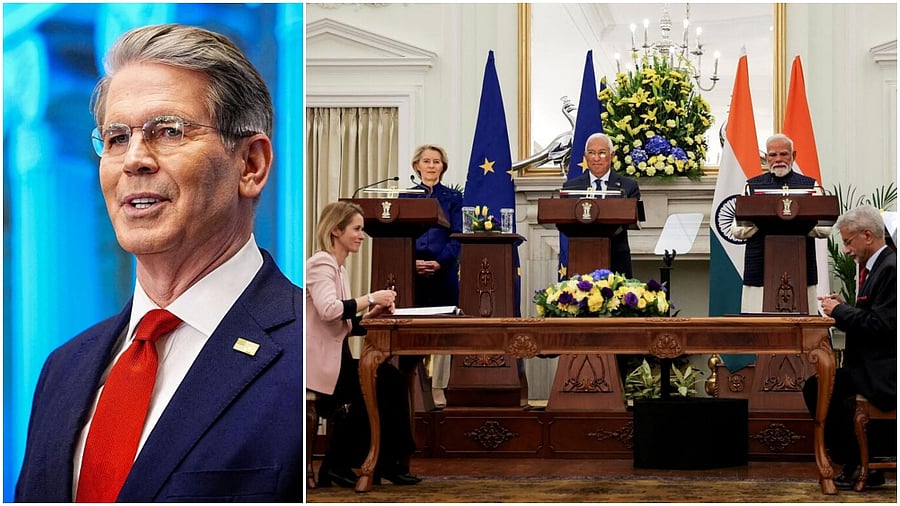
European Union High Representative for Foreign Affairs and Security Policy and European Commission Vice-President Kaja Kallas and India's Foreign Minister Subrahmanyam Jaishankar sign an EU–India Security and Defence Partnership agreement
Credit: Reuters Photo
Washington: US Treasury Secretary Scott Bessent said on Wednesday he was disappointed by Europe's decision to strike a major trade agreement with India, saying it showed Europe put trade ahead of the interests of the Ukrainian people.
Bessent told CNBC that Europe had been buying refined products made in India with sanctioned Russian oil supplies, and had been unwilling to match higher US tariffs on Indian goods because they were separately negotiating a trade agreement.
The European Union on Tuesday finalized a long-delayed trade deal with India that aims to boost two-way trade and reduce the bloc's reliance on the United States amid growing global trade tensions.
The deal is expected to double EU exports to India by 2032 by eliminating or reducing tariffs on 96.6% of traded goods by value, and will lead to savings of 4 billion euros ($4.8 billion) in duties for European companies, the EU said.
Asked whether this deal and others among countries excluding the United States would threaten the US, Bessent said, "They should do what's best for themselves, but I will tell you, I found, I find the Europeans very disappointing."
He said the deal made it clear why Brussels had balked at joining Washington's decision to impose 25% tariffs on India last year as part of a push to reduce its purchases of Russian oil.
"The Europeans were unwilling to join us, and it turns out, because they wanted to do this trade deal," he said. "So every time you hear a European talk about the importance of the Ukrainian people, remember that they put trade ahead of the Ukrainian people." Bessent last week had signaled the potential removal of the 25% additional US tariffs on India following a sharp reduction in Indian imports of Russian oil.
Bessent's disparaging comments about Europe came amid heightened tensions after President Donald Trump threatened to raise tariffs on imports from certain European countries over their opposition to his pursuit of Greenland. That tariff threat was later dropped, but it left many Europeans unsettled and anxious about the future of Transatlantic trade. U.S. officials remain frustrated that the EU has not enacted the tariff reductions it promised as part of a framework trade deal reached with Washington in July. Those concerns were heightened this week when Trump raised duties on imports from South Korea to 25% from 15%, citing slow moves by the country's parliament to implement a framework trade agreement reached with Washington last year.
Bessent defended Trump's action, saying it was "helpful to get things moved along", adding that the South Korean parliament needed to ratify the trade deal. Trump on Tuesday said he expected the United States and South Korea to work out a solution, but he did not elaborate. South Korean officials are due to arrive in Washington on Wednesday for talks with trade officials.