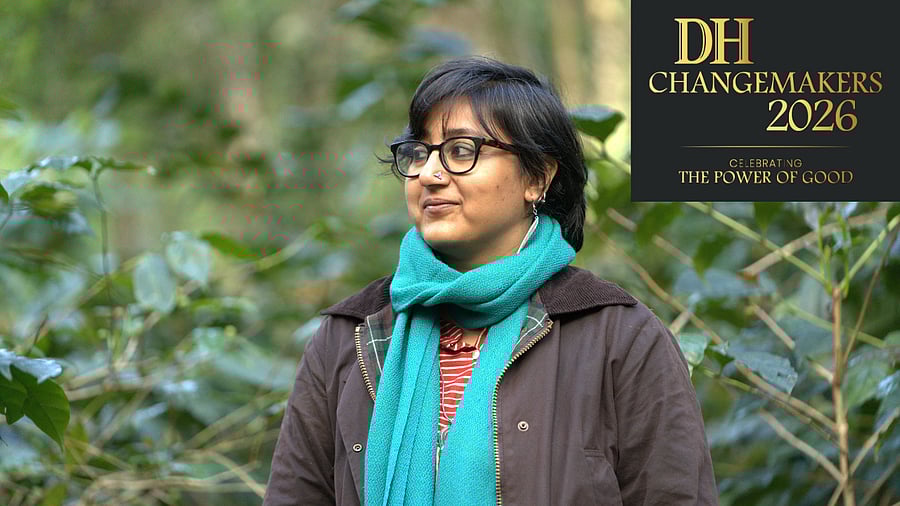
In the haadis (hamlets) of Biligirirangana Hills (B R Hills), the homes of coffee growers reflect new changes — roofs are being repaired, storefronts are being renovated, and the odd new mobile phone or motorbike can be spotted. Behind these changes are better trading rates for coffee growers, value addition through post-harvest processing and even a community pulping plant.
It was nearly ten years ago that the seeds of change first sprouted here — it began with Arshiya Bose, a human geographer by profession, connecting with the coffee growers in the Soliga community and exploring the links between the social, ecological and economic contexts. What started with buying coffee from 10 growers has now expanded to around 650 people across four landscapes, including the Nilgiris and Palani Hills in Tamil Nadu.
Coffee cultivation has had significant ecological consequences — deforestation, increased replacement of native trees with exotic trees, increased pesticide use, and habitat loss. This was especially concerning as the region is rich in biodiversity.
Many growers in the B R Hills come from farming families, with coffee being a more recent shift. “We used to grow crops like corn and ragi earlier, but wild boars and elephants would consistently destroy the harvest. About 30 years ago, the Coffee Board gave 12 people coffee beans to grow, and when that yielded good results, we realised this was a good option,” says Kethe Gowda, a grower from the Soliga tribe who is now on the board of Black Baza, one of India’s first biodiversity-friendly coffee brands started by Arshiya in 2016.
His colleague and fellow Soliga, Sannarangegowda, adds, “While we got good yields, the issue was bad prices. Middlemen used to buy coffee at Rs 50-60 per kg, even though the market rate was Rs 100 per kg. It was disheartening to face these troubles, despite our hard work.”
For indigenous communities, access to the market is especially challenging, notes Arshiya. “They are forced to sell at lower rates. We noticed a 56% differential in the price at which we bought coffee, versus what the farmers were used to getting,” she adds.
Black Baza introduced better practices, paying growers 1.2-1.3 times the market rate and weighing coffee at the farm. “Over time, the higher rates and transparent weighing process caught on across the community. Even if we were not buying from every grower, they became empowered to ask for transparency,” says Arshiya.
“We had grown coffee for years, but Arshiya madam brought knowledge with her,” says Kolle Gowda, a coffee grower from the Soliga tribe. “She taught us how to pick, wash and dry coffee. We realised we had been selling below the standard rate,” he adds.
Kolle Gowda and his wife now help manage the new motor pulper in the locality.
From here came the avenue to grow further, with the introduction of post-harvest processing methods and new varieties. “We learnt how to make various flavours. For example, I now produce ‘honey coffee’, and earn more when I sell it,” says Kethe Gowda. Black Baza incentivises different varieties, allowing growers to opt to process the coffee and earn a premium for their hard work. This includes yellow honey coffee, red honey coffee and washed coffee, to name a few.
Earning premium rates has had a tangible impact across the grower community. Beyond home improvements and new household items, some families have also been able to clear their debts.
Capacity-building in the community has involved training on various aspects, explains Asjad Ahmed, who works on post-harvest processing, quality and exports at the company. From soil health and planting to post-harvest drying, growers have been introduced to new nuances. “We learnt how to set up drying beds, how to extract the pulp, and how to ferment coffee. We also spent time tasting and learning about how different varieties turn out,” says Kethe Gowda.
A unique, ongoing challenge is translating the largely foreign lexicon of coffee aromas and flavours. Terms like ‘yuzu’ or ‘roselle’ are often used to describe flavour notes, but over time, the team found flavours like ‘tamarind’ to be a more accessible reference. “We invest a lot of time introducing farmers to different coffees and flavour notes so that they can identify defects and characteristics,” says Asjad.
Grower communities generally engage enthusiastically with the process, as it is hands-on. “In the Nilgiris, I noticed that women farmers are very involved and engaged. They participate actively, ask questions,” says Asjad.
The process of learning together and bringing tangible change has been slow, taking over a decade. However, Arshiya’s tenacity stands out among colleagues and the community. “Entering a traditionally male-dominated space as a young woman from a different region was a major challenge,” says Radha Rangarajan, who works with Arshiya on communications. Radha points to how Arshiya was determined to connect with the community and learnt Kannada. “I am amazed hearing her speak and interact with the community,” she says. These efforts, along with consistent perseverance, have built slow but lasting trust with the community.
Ecological impact
In addition to the focus on sustainable livelihoods, Black Baza’s work centres around regenerative, biodiversity-friendly farming practices. “Our partner producers grow coffee without any chemical fertilisers. We also ensure that the farm retains a diversity of indigenous tree species and forest cover,” explains Arshiya.
Arshiya first became aware of the potential for change during her PhD, when she studied market incentives for conserving biodiversity. Her research took her to coffee-growing communities across Karnataka, including the B R Hills.“I was specifically looking at the impact of certifications. Coffee is one of the largest certified commodities worldwide. My research found that, in the Indian context, certification had little impact on farmers' livelihoods or on ecological practices. There were not many differences between certified and uncertified farms,” the researcher-entrepreneur explains.
The standards were commonly designed for countries that practice extractive farming, written from a market perspective, and relied on a top-down approach.
“Instead of broad principles, we develop conservation priorities based on the landscape and what producers want to conserve. This often includes smaller species like bees, earthworms and termites, as well as native trees,” she says.
Translating these principles to the brand has involved unique approaches — each variety is named after an endangered species, so consumers choose among options such as the tiger beetle, loris, or galaxy frog for their morning cup. The range includes Robusta, Arabica and various blended coffees. Customers can filter options by variety, roast, and even ‘vibe’.
“Jumping Ant is one of my favourite varieties," says Bharath Surendra, a product designer based in Goa. “Their coffee packs come with small cards with photos of the farmer who harvested the coffee, and information about where it was grown. I have the cards up on my fridge. I also keep all the packaging as I find it quite nice,” he says.
Customers also engage with the growers’ stories and innovation in varieties at regular events at the roastery in Bengaluru, along with talks on biodiversity.
“I came across Black Baza when I was researching farm food market systems back in 2020, and found it interesting that an academic had chosen to start a business to support livelihoods and promote biodiverse cultivation of coffee,” says Bharath.
Arshiya’s path into entrepreneurship was accidental. “During my research, farmers were asking if I would do something useful with my study,” she says. She credits National Geographic Explorers and the Acumen Network for aiding peer-to-peer learning as she navigated a new field.
Entering the space was no mean feat. “In the early days, coffee traders resisted the change. We faced threats in the field and our trucks were stopped. But we persevered,” she says.
But the fruits have been worth it. “So much of grassroots work is led by men, but now women speak up more at gatherings,” she says.
What’s ahead? Expansion into other landscapes, a cafe in Bengaluru and coffee tastings in various cities. The vision: Empowered grower communities, diverse plant and animal life at farms, sustainable practices, and thousands of cups of quality coffee.