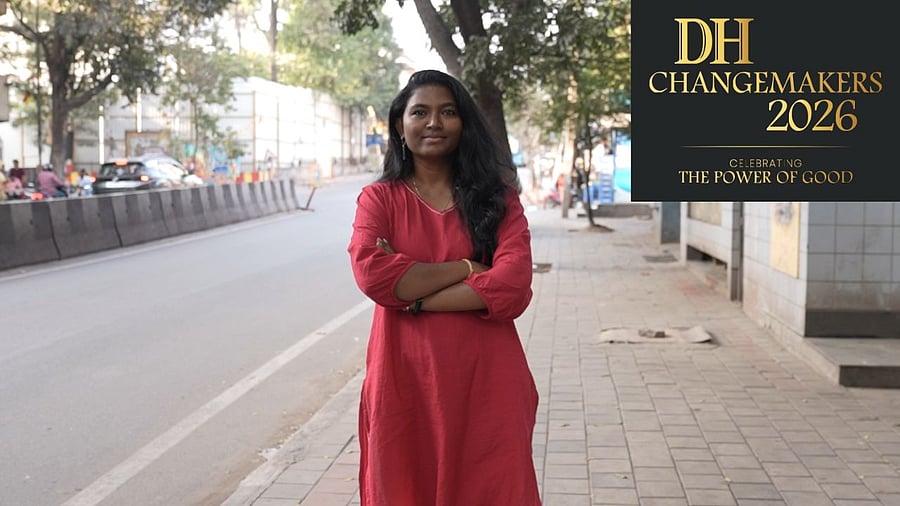
In the cool, mist-laced folds of the Western Ghats, where Archana K R grew up walking barefoot to her government school, dreams were modest and practical: a pair of Hawai chappals, a desk to sit on, and even a steel cup to drink coffee from — cups her family had at home, yet outside she was often served drink in coconut shells because of caste‑based discrimination. Yet one dream, quiet and persistent, would come to define her life: a toilet.
Archana was 14 when she first saw a toilet — at the veterinary hospital in Sakleshpur, where her father worked as a veterinary assistant. Enclosed toilets with running water simply did not exist at her school or in her hometown of Nelagahalli, where her mother served as a branch postmaster. Fear of snakes, shame and deliberate dehydration during school hours were everyday realities, not things to be spoken about.
“I would avoid drinking water during school hours because I was afraid of having to urinate in the open. But I never spoke about any of this with my parents or teachers, because it was not a priority for them. I grew up believing that sanitation was not important. As I got older, I began to notice the gaps. It is appalling to see the same situation continue decades later,” she says.
Turning point
Years later, long after she had left her village to pursue a master’s degree in social work in Bengaluru, the memory returned with sudden clarity. It surfaced at a government school during her early work with the Children’s Movement for Civic Awareness, a non-governmental organisation. While auditing sanitation facilities, she asked the girls where their toilet was. They hesitated. Finally, they led her to a newly inaugurated block — locked, unused and draped in spiderwebs. The MLA-funded building had not seen running water yet. Beer bottles lay inside. The girls avoided drinking water altogether.
“Standing there,” she says, “I realised I was staring at my childhood again.”
Little had changed. Girls still avoided drinking water. Toilets stood locked, broken or unusable. Sanitation remained invisible, dismissed or hidden behind ribbon-cutting ceremonies.
Across districts — Bengaluru, Dharwad, Tumakuru — she saw the same story: toilets that existed only on paper, budgets that disappeared, designs that ignored the realities of children and menstrual waste piled up in corners due to lack of guidance and infrastructure to handle it. Some schools converted boys’ toilets into staff rooms; others used accessible toilets as storage.
Between 2017 and 2020, while auditing 300 schools for non-profits, she found a startling figure: on average, a school had an annual toilet-maintenance budget of Rs 108.
This was the moment her work shifted from observation to activism.
Today, at 35, Archana is one of Karnataka’s leading voices in the sanitation movement. Through her work, Archana has improved sanitation in schools and public spaces across the State.
She is the founder of Stand4SHE, a grassroots initiative that helped push the State towards its first dedicated toilet-maintenance budget. From childhood longing to policy-level advocacy, her journey is a testament to how a single unmet need can become a lifelong mission.
Archana discovered the power of petitions and public pressure early in her career. Her first campaign in 2018 demanded that Swachh Bharat toilets along National Highway 75 be unlocked; 10 of the 14 were eventually opened.
Next, she began a petition to increase funds for toilet maintenance and improve education in government schools. Archana leveraged social media to highlight poorly maintained school toilets. Every broken latch, every dry tap, every dark cubicle she documented from her school visits went online, tagged to the Education Minister. The images were hard to ignore, gradually started drawing attention and eventually reached the then Education Minister S Suresh Kumar.
On March 8, 2021 — after months of relentless pressure — the Karnataka government announced a dedicated sanitation and drinking-water budget of Rs 100 crore for government schools. It was the first such allocation in the State. For Archana, who remembers praying not to feel thirsty during class, it felt like a personal milestone. But she knew policy announcements were only the beginning.
Today, Stand4She works across four pillars — data and research, behavioural change, redesigning infrastructure and training sanitation squads. “We plan to identify and train motivated youth across villages so that sanitation advocacy becomes local, continuous and future-focused,” she says.
Archana and her team of dedicated volunteers have also raised awareness of menstrual health and hygiene by conducting campaigns and workshops for teens in government schools.
During these sessions, the young girls learn not only about menstruation but also about consent.
From the young girls to their teachers, everyone beams as they talk about the changes these awareness campaigns have brought into their lives.
The awareness doesn’t stop at school. After attending Archana’s session, high school students at Karnataka Public School in Kaggalipura took it upon themselves to spread the word about menstrual hygiene.
“Apart from helping younger students, these children have also tried to educate their parents and other elders in the community. Despite resistance, they went from house to house, speaking about menstrual health,” says Shoba, the school’s physical education teacher. She hopes that such awareness campaigns will be conducted regularly.
Organising such workshops across the State regularly is one of Stand4SHE's goals, as the organisation is currently in the process of registering as a non-profit.
“We plan to identify and train motivated youth across villages so that sanitation advocacy becomes local, continuous and future-focused,” she says.
The way forward
Along with raising awareness, the organisation plans to conduct a reality check on how funds released by the State government are being utilised in schools. “A ground report will be prepared after visiting around 10 schools in each district. We are also working on creating an entity called Neelakarshana, bringing together various like-minded organisations,” says Ashish V R, Archana’s colleague at Stand4She.
For people who work with Archana, she continues to remain a beacon of hope. “Having been part of the private school ecosystem and witnessing the effort that goes into maintaining clean toilets, the contrast with government schools is stark; many either lack a water connection or receive water only once a week. This is an issue that demands systemic attention. Seeing the work Archana was doing to drive change inspired me to contribute to this effort as well,” says Joseph Philip, another colleague.
For Archana, this journey is still unfolding. Every time she walks down a street or passes a highway, her eyes naturally drift towards public toilets — wondering why the women’s toilets remain locked, whether the janitors have the necessary supplies or if they are being required to stay on the premises. “My days constantly revolve around these issues. Yet, despite the effort I put in, my work is still not a matter of pride for my family, because it involves sanitation. In their eyes, anything related to sanitation is not respectable, and they worry about how the world will perceive me. I have even had marriage proposals rejected because my work revolves around toilets,” she shares.
But every time a girl confidently points to her school toilet and says, “We use it now,” Archana feels the gap between her barefoot childhood and her present narrow just a little more. For her, dignity begins with something as simple — and as revolutionary — as a toilet.