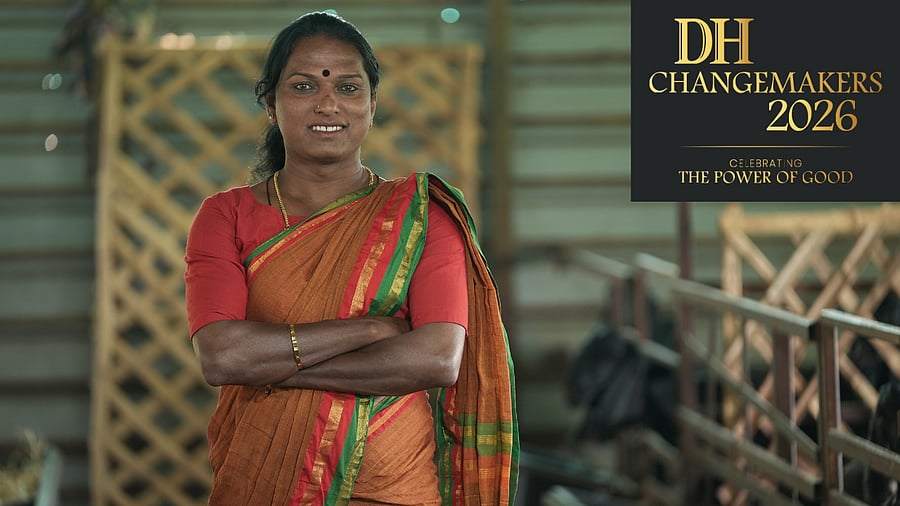
On the highway from Bengaluru to Davangere, near Bharamasagara in Chitradurga taluk, stands Arundathi Mandya’s farm. Built with mud, sweat and tears, her life and farm reflect her resilience. She has developed a thriving poultry and animal husbandry enterprise and created a sustainable model to help sexual and gender minorities who give up begging and sex work.
A 2018 study by the National Human Rights Commission (NHRC) found that 96% of transgender individuals are denied jobs and forced into low-paying, often unsafe work. The community’s national literacy rate is 56.07%. A low literacy rate makes formal employment even harder. In Karnataka, where the 2011 Census found over 20,000 transgender persons, Arundathi’s journey from discrimination to job creator stands as a story of hope and change.
Arundathi’s path is marked by rejection and sorrow. Born Arun in Dakshina Kannada, her early years were filled with confusion and alienation as her body began to change around age ten. Classmates taunted her, giving an early taste of societal prejudice.
Though her mother supported her, her elder brother’s constant pressure and demands that she behave like a boy forced her to leave home after completing her SSLC. While sitting alone at Mangaluru railway station, contemplating her future, she met a trans man from Kerala who promised to take her to a trans community organisation.
In Kerala, she found her first sense of community through the Malabar Cultural Forum, a trans community-based organisation in Kozhikode that supported her academic pursuits. Determined to earn a dignified living, she pursued a postgraduate degree in Sociology through distance education while working as a public relations person during the day and as a security guard at night.
This wasn’t easy. She faced numerous challenges, including language barriers, issues with social acceptance and harassment from street rowdies who forced sex work upon members of their community. Her friend Sundari, a trans woman from Tamil Nadu with whom she spent six years, helped her navigate these difficulties — teaching her everything from the language to cooking.
In 2011, armed with a postgraduate degree, she returned to Karnataka and joined an NGO, first as a migrant counsellor and later as a district project manager for an empowerment project in Ramanagara. It was here that she began training other transgender people in skills such as raising hens, goats and sheep. But this work ended abruptly when the project was discontinued in 2012.
When she sought formal work, societal prejudice hit hard. For six months, she looked for jobs in factories and garment units, only to be asked about her gender. One employer said she had to present as male if she wanted to be hired. She refused, saying, “I will stay the way I am. I don’t mind even if I don’t have a job.”
When all doors to formal employment closed, she resorted to begging and sex work, which led to thoughts of self-harm: “Why was I even born?”
Savitramma, an acquaintance who saw her begging, advised her to take up shepherding and poultry and lead an independent life so that she would become a model for others in her community. She even helped her get a job as a shepherd.
With the help of four women who taught her the basics of shepherding, Arundathi began her entrepreneurial journey with four lambs. By 2019, she had scaled her business, owning 25 goats, 100 hens and some sheep. Her reputation grew, and she became known as Mandya Arundathi. When a disease affected farm‑grown hens, her local naati hens became an instant hit due to their quality and taste.
However, her success was met with adversity. She and members of her community were banished from Induvala village, where they lived, by locals who labelled them as sex workers. During the Covid‑19 lockdown in 2020, her entire stock of 20 sheep and 30 hens was stolen from her farm, leaving her with no income. “I had no other way during that time. I was forced into sex work for three months to look after my five daughters.” There is a tradition in the community to care for younger members as daughters.
She eventually relocated to Chitradurga, where she started a new life raising goats. Unfortunately, in 2023, all 50 of her goats were stolen. To make matters worse, she faced betrayal and a lack of support from her own community and the police. At her lowest point, she attempted to hang herself, but the rope broke, and she lost consciousness. “When I woke up, I was shocked to see that I was alive,” she chuckles.
Soon after, Pushpalatha, then Managing Director of the Karnataka State Women's Development Corporation, contacted her after hearing about her work and promised support. Introduced by trans activist Mallamma Kumbara, Pushpalatha visited her farm, heard her plans, and agreed to lend a loan. She also began supporting her with advice and training. After verifying Arundathi's work, Mahila Nigama facilitated a loan of about Rs 23 lakh with a 50% government subsidy, supporting her enterprise.
Pushpalatha says she learned about Arundhathi's work through media reports and community members and was impressed by her skills and strong desire to be self-reliant. “Arundhathi is repaying the loan promptly, an achievement that stands out, as many beneficiaries often struggle with repayments,” she adds.
Soon, she started a tea stall near the highway at Bharamasagara. Her friend Chaithra, a trans woman from Davangere, helped her secure the highway plot and introduced her to local community members. With a small loan and a fellowship for business training, she invested in five high‑yielding Osmanabadi goats. Now her farm has about 50 hens, 100 goats, and sheep.
She has established the Madilu Swavalambi Trust (South India) as the core of her economic empowerment model, which now has 25 members.
Arundathi gives two goats and five hens free to sexual and gender minorities who commit to leaving begging or sex work. This comes with an agreement that once self‑reliant, they must pass on hens and goats to others, creating a pay‑it‑forward chain. “I wanted to help them lead a dignified life,” she explains.
The model is working: Mamata, from Dinka village in Mandya, is now economically independent and has left begging and sex work behind. “Arundathi is a big inspiration. She gave me five goats and four hens. I have added cattle and now feel proud to lead a dignified life. I have about 10 goats, six cattle and some sheep and hens,” she adds.
So far, Arundathi has given free poultry animals to 25 sexual minorities and trained 35 transgender persons in farming. Her work has inspired other transgender persons to start agricultural ventures in Koppal, Mandya, Vijayapura, Bagalkot and Chikkamagaluru.
Legal assistance
Beyond entrepreneurship, Arundathi helps her community resolve legal issues and obtain essential identity documents, such as Aadhaar cards, Voter IDs, and ration cards, all free of cost. She notes that many community members do not register for IDs because they believe society will not accept them anyway. Migrants from states like Andhra Pradesh, Tamil Nadu, and Kerala face additional hurdles when returning home or renting houses without proper ID.
“We conduct awareness campaigns through our Samara Sarathi movement, highlighting the right to identification and access to government benefits,” she adds. The Madilu Trust also runs health check-ups, awareness programmes and counselling sessions.
Santhosh from Bagalkot speaks of the selfless help he received from Madilu: “We are very poor and daily wagers. Arundathi found people like us and helped us. Even our own relatives won’t help, but she has helped a lot by donating sheep and hens to us.” Apart from transgender people, Arundathi supports members of the marginalised communities as well.
Megha Malnad from Chikkamagaluru, from a trans-community‑based organisation, says, “Madilu Swavalambi Trust gave us five goats, which we donated to those in need. For example, Anju raised the goats, and when her herd grew to 10, she donated five to Harshitha. Now, Harshitha has given five goats to someone else. This chain reaction is exactly what our community needs for empowerment.”
Mallamma Kumbara, a consultant for Aneka Trust, a trans‑community‑based organisation in Bengaluru, said she has known Arundathi and her activism for over a decade. “She is a self‑sustained and hardworking individual leading a model life on her 1.5‑acre leased plot in Bharamasagara, inspiring many in the community to pursue a dignified, independent life.”
She added that trans people face many challenges as government support systems are lacking and change is slow.
Arundathi, once hopeless, now finds pride and purpose in her flock of 100 animals, feeling a motherly love that eases her past difficulties. Her mission is clear: to become India’s top transgender entrepreneur and change society’s perception of her community.
She plans to establish a skill training school for poultry farming, shepherding, dairy and agriculture. She sees economic empowerment as key to combating the stigma that marginalises her community. Reflecting on the prejudice, she says customers often avoid her tea stall after hearing her voice or seeing her: “Society disowns us, even if we earn a livelihood through hard work.”
Her demand to the government is clear: “There should be a Transgender Corporation like in Tamil Nadu and Kerala. This would mean a lot to us.”
“My request to people is, let us live. Don’t pull us back from independent, respectable lives. Let us work hard and stop branding us as beggars or sex workers,” she says
(If you are struggling with thoughts of self-harm or suicide, know that help is available. Please reach out for support at 14416 or 78930 78930)