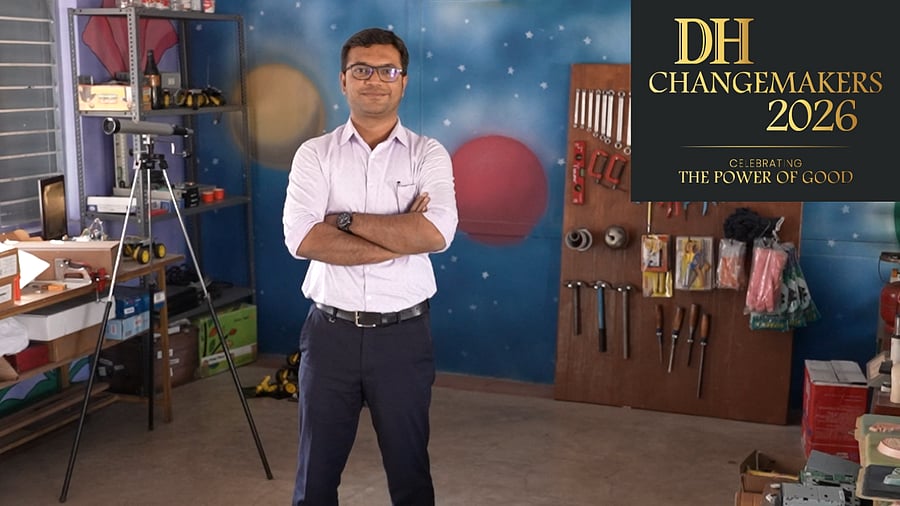
The bell has barely rung at the Hinkal Higher Primary School on the busy Hunsur Road in Mysuru, and from the outside, the government school looks much the same as always. Inside, however, the scene is strikingly different. In one corner, a group of children is assembling a tiny car on a laptop screen, wearing virtual reality (VR) headsets. Another group waits eagerly as a 3D printer begins to take shape. At the centre of this buzz stands science teacher Madhusudan K S, the man who has turned an ordinary government school into a small innovation hub.
Madhusudan (40), grew up in Kedaga, about 60 km from Mysuru, in a household where teaching was a way of life. His father, a strict mathematics teacher in a government school, shaped much of Madhusudan’s discipline, even if he once wanted anything but a classroom life. He studied in government schools and later joined Navodaya. Before enrolling, he did not check the labs or hostel facilities, but whether the school had a playground.
Kabaddi, football, handball, shuttle badminton, table tennis — Madhusudan played them all with equal passion. Once, he even took a loan from his school principal to participate in a state-level kabaddi competition. “I always wanted to be a sportsman,” he says with nostalgia. However, his father’s insistence and a lack of awareness about sports as a viable career pushed him towards teaching. After he got a job, he underwent two knee surgeries for sports injuries, which forced him to stop playing.
He completed a BSc in Computer Science, followed by a BEd, and gradually discovered that the classroom he once tried to escape was becoming his own playing field. Today, he holds a Master’s in Economics and is pursuing a master’s degree in English and Education, which will give him three postgraduate degrees. He aims to pursue a PhD.
He also trains teachers and university faculty, often opening his sessions with a joke: “If I am boring you, stop me.” The humour is light, but the intent is serious. He wants every class to be different, packed with information and useful learning.
Eleven years of learning
Madhusudan began his teaching career in 2008 at a remote government school in Yeremanuganagahalli, Mysuru district, after a year at a private institution.
For the next 11 years, he moved from one rural school to another, working closely with children from families where schooling often competed with farm work and household responsibilities. “Those years taught me to keep things simple and practical,” he says.
In 2019, he was transferred to the Hinkal Higher Primary School. Madhusudan saw it as an opportunity to build something that did not exist in most government schools. In his previous schools, he had experimented, but departmental work, limited time and lower pay restricted him. At Hinkal, with better pay and encouragement from colleagues, he challenged himself to create a space where children could touch, break, repair and build, not just memorise.
He began by asking a simple question: What should a child actually know to survive and live a meaningful life?
Building a lab
The answer took shape as a “makerspace” he calls C Lounge — Camp, Create, Celebrate. It is a room without a blackboard, looking more like a workshop than a classroom. On one wall is a large wooden board made from scrap, neatly labelled and filled with tools such as screwdrivers, spanners, hammers and a small drilling machine. Students themselves designed and built the board as part of an experiential learning project.
Madhusudan used it to teach carpentry basics, surface measurement and geometry. Mathematics moved out of textbooks and into pieces of wood, with children from classes 5 and 6 learning angles by cutting and joining planks. He says he does not want them to become plumbers or carpenters, but to be confident enough to fix a leaking tap or a loose screw at home. This, he believes, also strengthens their understanding of geometry. Students use the space to learn across subjects, including experiential learning outcomes, team building, addition, subtraction and division.
None of this came through special government grants. Madhusudan bought tools, robotics kits, VR headsets and eventually a 3D printer using his own savings. Over time, he has spent around Rs 5 lakh to Rs 6 lakh setting up the lab and related systems. Friends and well-wishers contributed, including a local paint shop owner who donated tools. The lab became a kind of local crowdfunding effort, which, he says, gave him the confidence to take on larger projects.
Norway dreams
Beneath the electrical components and gadgets lies a quiet obsession. Madhusudan began reading about global benchmarks and came across the Programme for International Student Assessment (PISA), which evaluates how 15-year-olds across countries apply knowledge of reading, mathematics, and science to real-life problems. Norway’s education system, known for its focus on equity and skills, became his reference point.
He knows his students are far removed from Norwegian classrooms, but he aims to bring the spirit of such systems to a government school in Mysuru. He introduced robotics classes using a kit ordered from an American company, paid for from his own pocket. To overcome the shortage of physical VR kits, he used virtual reality modules where students could assemble robots. A 3D printer and an AI-integrated smart board followed as part of a gradual effort to normalise advanced tools for children who might otherwise never encounter them. His goal, he says, is not to collect gadgets, but to use each tool to spark curiosity.
Digital literacy sessions
His innovation extended beyond hardware. Madhusudan purchased and customised a Learning Management System (LMS) for the school. Through it, he tracks attendance using QR codes for 50 students of his class, uploads scanned answer sheets, manages homework and conducts online quizzes. Parents can log in to see what their children are learning, monitor performance and even revisit the answer scripts page by page. The LMS is currently a pilot project that he hopes to scale.
He also conducts digital literacy sessions for parents, many of whom are using such systems for the first time. Almost all the parents, he says, appreciate the effort to bridge the gap between school and home. Like the lab, the LMS is entirely self-funded. For Madhusudan, ensuring government school children are not left behind in a rapidly changing world is a part of life’s mission.
“I used to think he was very strict, but eventually I found out he is actually very friendly,” says Preksha, a class 5 student. Instead of only memorising textbooks, she spends time in the lab doing activities, while Madhusudan also helps her with spoken English and handwriting. “I had only seen VR headsets, robotics and smart boards on TV and never imagined they would be in a government school classroom,” she says. “People say government schools are not good, but now children near my house want to join my school because it is fun and because of the lab.” Watching him teach, she says softly, “When I grow up, I want to be like him.”
What keeps him going?
Madhusudan, who received the National Teachers’ Award in 2025, calls teaching a “high-stakes job” because it involves children’s emotions every day. On difficult days, he turns to friends who act as sounding boards. Swetha C G, an English teacher at the Hinkal Higher Primary School and his colleague for three years, says his classes are where “new-age students meet new-age teaching”. His technology-driven lessons, she says, push her to experiment as well. While she follows more traditional methods, she notes that he blends gadgets with interaction. “Together, it makes learning fun,” she says.
What truly drives him, Madhusudan says, is the visible change in his students — the moment a child who once feared science confidently reaches for a spanner, or the excitement of flying a drone for the first time.
The second home
Madhusudan’s wife is also a government school teacher, teaching English. They have a daughter who is now in class 9. He laughs when he says that his daughter often complains that he gives more attention to his schoolwork than to her. Most of his tools from home have migrated to the C Lounge, which he calls his second home. Balancing this passion with family life is not easy, and he admits to worrying about how long he can sustain such voluntary effort.
His dream is to build a team of like-minded teachers so the responsibility can be shared. Although private schools have made offers to him, he is clear that, for now, he wants to remain in the government system. “These are the kids who need it most,” he says. His next goal is to set up a full-fledged robotics lab, open it to nearby government schools, and allow any child to walk in, pick up a tool and start creating.
Bhagyalakshmi A, a lecturer at the District Institute of Education and Training (DIET), Mysuru, has closely followed Madhusudan’s work for over five years. She describes him as technically strong and deeply committed, someone who “works day and night to come up with innovative ways to teach students.” Among the many schools she has visited, she finds students at the Hinkal Higher Primary School the most lively and enthusiastic. “If we can find equally dedicated teachers, his model can be replicated in other schools,” she says. Madhusudan has also served as a resource person, training teachers at DIET.
For a boy from a village who once ran away from classrooms to chase a ball or get his hands dirty in the mud, the journey has come full circle. Today, the lab is his playground, marked not by boundary lines but by quiet tools, machines and the clatter of tiny wheels on a race track. What Madhusudan sees now is what he has been chasing all along: children discovering what they can do with their own hands.