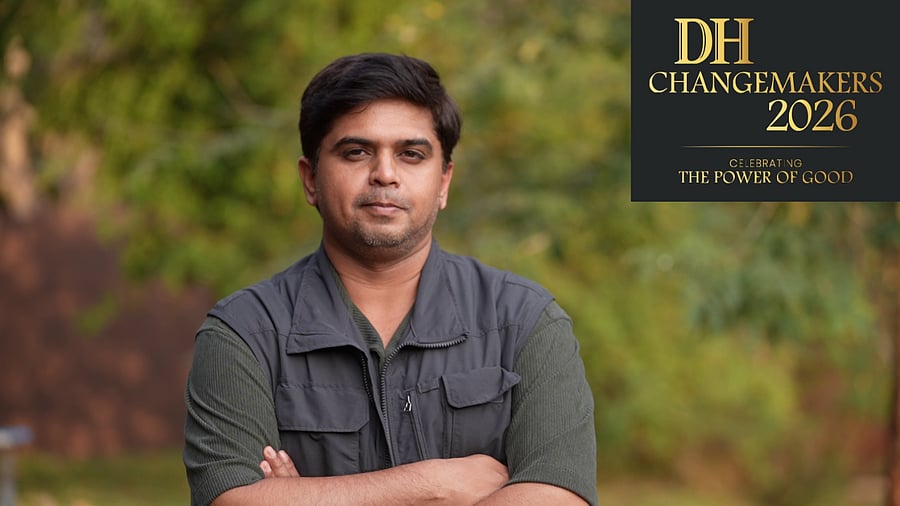
When Kartik Sunagar shows footage of a mouse collapsing and dying within a minute of being injected with Russell's viper venom, the outcome appears grim. Russell's viper, one of India’s ‘big four’ snakes, accounts for nearly 43% of all snakebites.
However, in the next clip, after the same venom is given alongside his lab‑designed antibody, the mouse is scurrying around hours later. The “gamechanger”, as Kartik calls it, is this antibody, which saved the mouse and could potentially save human lives.
This stark demonstration marks one of the most significant advancements in snakebite treatment: an oral tablet that victims can swallow immediately after being bitten, potentially eliminating the need for rushed hospital visits and risky antivenom infusions.
For Kartik (40), who heads the Evolutionary Venomics Lab at the Centre for Ecological Sciences at the Indian Institute of Science in Bengaluru, this innovation addresses an urgent crisis. India records roughly 58,000 snakebite deaths annually, almost half of the global total of 1.4 lakh. "Three times that number lose limbs," Kartik notes, “Most are primary breadwinners from farming families in rural areas, so it devastates entire households.”
The challenge lies not only in the high frequency of bites but also in the limitations of current treatments. Modern antivenoms rely on century-old technology: horses are immunised with venom and their antibodies are then extracted. This method is often inefficient, expensive and frequently ineffective.
“Antivenom vials contain less than 10% antibodies that actually target venom components, with probably under 1% neutralising toxins dangerous to humans. Essentially, the majority of the vial serves no therapeutic purpose,” says Kartik.
The consequences are severe: patients often require multiple vials, driving up costs and increasing the risk of potentially deadly allergic reactions to horse proteins. Research shows that nearly 80% of snakebite victims experience adverse reactions to the antivenom itself.
However, before developing a new antivenom, a bigger challenge lies in improving our understanding of snakes. Kartik's team, with special permission, collected venom samples from over 1,000 snakes across India and at least 14 other countries, discovering striking variations, even between populations separated by just 50 km.
The venom of Tamil Nadu cobras differs significantly from that of Karnataka cobras. Some Russell’s vipers produce venom up to three times more potent than that of others of the same species. Kartik’s research also shows that venom varies with the snake’s age, environmental conditions and diet.
This research is significant because India’s entire antivenom supply depends on snakes from just two districts in Tamil Nadu. "We produce antivenoms by collecting venoms from one-point location," Kartik explains, "and that antivenom treats snakebites across all of India." It resembles designing a universal key from locks in a single neighbourhood, expecting nationwide functionality.
This realisation drove Kartik towards two revolutionary approaches. First, he and his team engineered synthetic monoclonal antibodies designed to work across species and continents. These antibodies are effective against kraits in Southeast Asia, monocled cobras in Eastern India, king cobras in Western India and black mambas in Africa. Separately, for Russell's vipers, which cause more deaths and disabilities globally than any other snake and account for over half the snakebites in India, they created a single antibody that provides complete protection. “A solution to Russell's vipers’ bites is basically a solution to the snakebite problem in India,” Kartik said.
The second breakthrough, oral tablets from small-molecule inhibitors, could prove more transformative and revolutionise treatment approaches nationwide. The combination neutralises Russell's viper venom effectively. Unlike antibodies that require intravenous administration in hospitals, these pills can be carried in pockets and taken orally. The tablets would provide crucial time for reaching hospitals, a window that often determines survival in rural India. His research also shows that these tablets could help minimise permanent disabilities caused by snake venom.
Discussions are on with the Indian Council of Medical Research for clinical trials. Timelines remain uncertain, but Kartik feels optimistic about the tablet’s affordability.
Early exposure
Growing up in Dharwad in a home brimming with “art, ideas and curiosity”, Kartik’s parents, artists and educators, nurtured his fascination with the natural world. Romulus Whitaker’s wildlife documentaries and weekend excursions shaped his earliest encounters with nature. Like most students, he initially assumed success meant medicine or engineering. After a disappointing board exam, he entered Karnatak Science College, which he calls his “Plan B”, unaware of how his life was about to change.
His fascination began with the question of how some proteins, which exist harmlessly even in the human body, turn toxic.
After exploring venom evolution during his PhD and conducting research on transgenic sea anemones in Israel, he returned to India in 2017 to address the snakebite crisis. His pioneering work analysing the venom of India’s 'big four' snakes — Russell's viper, common krait, Indian cobra, saw-scaled viper — marked a national first, revealing how toxicity varies with age and geography, fundamental insights for developing effective treatments.
Today, his lab is among the world’s three labs working on venom evolution, toxinology and recombinant expression of broadly neutralising antibodies, and the sole Indian facility at this level. With 30 to 40 researchers and over Rs 39.45 crore in research funding from worldwide sources, his work has generated more than 5,625 citations in scientific literature. The one-of-a-kind lab also serves as a base for other research projects, including studies of scorpion and wasp venoms.
In a full-circle moment, Whitaker, veteran herpetologist and wildlife conservationist whose documentaries first introduced Kartik to snakes, told DH, “From the start, I have been deeply impressed with the venomics and antivenomics work being done by Kartik and his dynamic team. Everything they are doing has important implications for improving antivenom, which will, of course, positively impact the treatment of snakebites in rural India.”
For a crisis that has persisted for centuries, annually killing tens of thousands while impoverishing countless others, Kartik’s innovations are more than scientific advancement. They could transform how the country confronts one of its deadliest public health challenges.