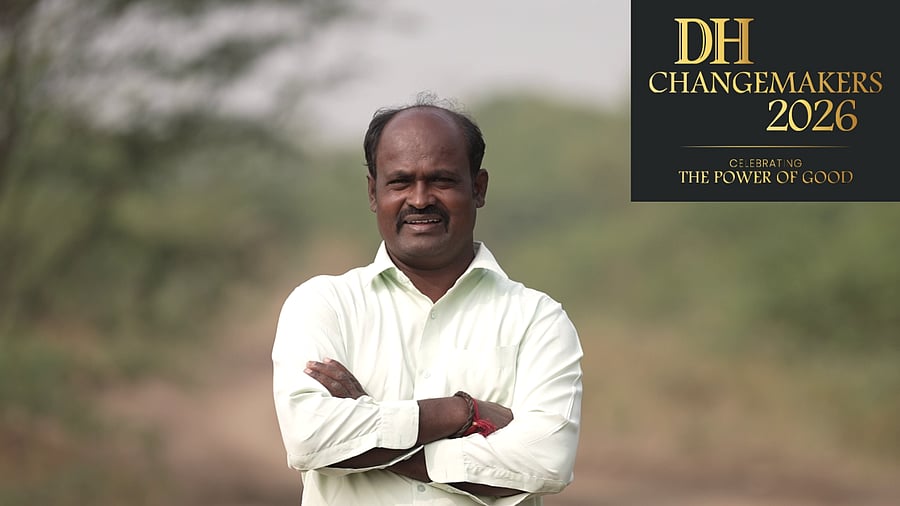
Imagine 1,600 acres of barren land — dry and lifeless. Now, reimagine that land transformed into a lush landscape of 68,000 trees. Not only did 44-year-old Sadashiva Hydra imagine this transformation, but also turned it into reality. A resident of Honna Kiranagi village in Kalaburagi, Sadashiva Hydra hasn’t stopped at converting the vast stretch of land into a green paradise but has also transformed the lives of over 1,000 workers who are part of the Mahatma Gandhi National Rural Employment Guarantee (MGNREG) Scheme.
Today, thanks to wages earned under the scheme, several households have, over the last decade, purchased sheep and leased farmland to become self-reliant. They have built houses and enabled their children’s education, as well.
Sadashiva began working as a daily-wage worker alongside 15-20 villagers under the scheme, which initially received a poor response in 2015. Landless and jobless labourers faced acute poverty due to recurring drought. There was also limited awareness of the scheme. Meanwhile, without the knowledge of poor labourers, some gram panchayat members were misusing job cards. The plight of these labourers motivated Sadashiva to approach district-level officials to request additional jobs and curb corruption.
A trusted ally
Recognising his tireless efforts in organising labourers and issuing job cards, officials appointed Sadashiva as ‘Kayaka Bandhu’, meaning a friend committed to the welfare of workers. He was also promoted to a field inspector two years later. Over the next five years, the MGNREG scheme gained traction in the village, with more than 1,000 people participating. With permission from the relevant authorities, they have grown more than 12 varieties of local species, including neem, peepal, bamboo, purple bauhinia, and pongamia pinnata, as part of the scheme’s afforestation drive. The plants have been raised in six layers along the 18-km boundary of a vast tract of land that earlier belonged to the Karnataka Power Corporation and has now been acquired by the Textile Department for the establishment of a mega textile park.
Sadashiva goes door to door providing the job cards to the village’s poor, monitors all works under the scheme and ensures timely wage payments to prevent migration in the 12,000-strong community.
In 2018, Sadashiva pledged an acre of the five acres he owned to secure a loan of Rs 9.5 lakh (since cleared) to water the plants. “Although my mother was initially sceptical about my campaign to plant one lakh trees (Laksha Vriksha Andolana), she is now proud and happy to see the results,” Sadashiva recalls.
Such growth of hundreds of trees, according to Range Forest Officer Nagesh Hadapad, has created a conducive microclimate, providing shelter to animals such as blackbucks, foxes and rabbits, apart from reducing temperatures during the summer.
Sadashiva has also led the construction of over 42,000 trench-cum-bunds as part of an afforestation drive, raising groundwater levels, preserving soil fertility, and easing drinking water scarcity after the village lake’s revival.
Over 80 per cent of the labourers on this project are women aged 30-75, says Sadashiva. Bagamma is one such landless labourer who has worked for a decade. The 35-year-old and her physically challenged husband, Saibanna, have used their savings to rear sheep. For 25-year-old Bhagavantray Pujari and his wife Basamma, the scheme has been a godsend. Bhagavantray’s mother was able to have eye surgery with their savings. “The Rs 370 daily wages provided under the scheme have helped us support our families, as landlords in the village pay only up to Rs 300 a day for full-day agricultural work,” he says.
Against the odds
Sadashiva has faced severe personal challenges, including depression and thoughts of self-harm. A turning point came when the local panchayat development officer enrolled Sadashiva into the MGNREG scheme. After working as a cowherd for a landlord, Sadashiva now guides many villagers on saving their wages and resolving disputes. Sadashiva also spends Rs 1.5 lakh each season out of pocket to supply drinking water to labourers working under the scheme. He also earns additional income from agricultural activities through land leasing.
Sadashiva’s work at the grassroots level has brought about lasting change in many lives, drawing attention. Chandrakanth Jeevangi, Assistant Director of Agriculture, Jewargi, and former administrative officer of Honna Kiranagi Gram Panchayat, credits Sadashiva with increasing enrollment in the scheme.
“Sadashiva has nurtured every plant like his own child and treated all job card holders as his family,” says Chandrakanth.
Anirudh Sravan, former chief executive officer of Kalaburagi Zilla Panchayat and current Personal Secretary to the Union Minister of Finance and Corporate Affairs, likens Sadashiva to the late Saalumarada Thimmakka, a legendary environmentalist. The senior IAS officer lauds Sadashiva as an inspiring personality who has turned around the fortunes of a land and its people.
“Honna Kiranagi was once barren land, but Sadashiva transformed it into a thriving ecosystem and helped the poor become self-reliant. His clarity of purpose enabled him to achieve remarkable results despite numerous difficulties,” he adds.
(If you are struggling with thoughts of self-harm or suicide, know that help is available. Please reach out for support at 14416 or 78930 78930)