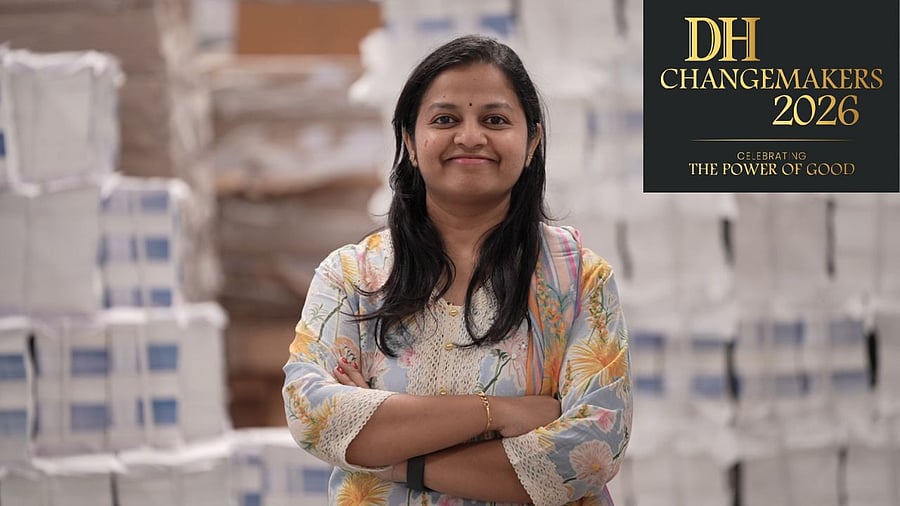
“I once bent too close to a millipede, and my breath made it curl into a tight circle. In that moment, I realised how important it is to be mindful of other beings that share this world with us. When I became a mother, I wanted my son to discover that same sense of magic,” says Anupama Benachinamaradi. She wanted him to learn about local ecosystems and culture through stories rooted in his own surroundings rather than distant lands.
Growing up in Beniwad, a sleepy village near the Hiranyakeshi River in Belagavi district, Anupama Benachinamaradi saw the world as a web of symbiotic bonds — linking her home to the farmlands, the hillocks draped in forest-like greenery to the streams that meandered past them.
When she moved to Belagavi city to study engineering, she felt distanced from the meadows of her childhood. By the end of her MTech, nostalgia had deepened that longing. A stint as an assistant professor in Dharwad followed, before marriage took her even farther — to the United States.
When she returned to Bengaluru after nearly two years in Texas, those memories came rushing back. “I had just become a mother and wanted my child to experience the fullness of life I had known as a child. But I realised that the pastoral world and culture I grew up with were not only distant from their reality, but were not even available to them in any accessible form of literature,” Anupama says.
By then, she had quit the teaching job and begun writing science articles. But her child’s hunger for knowledge — “a hundred questions for every line of a story I told him” — made her look for children’s books. She wanted her child to experience a world of magic, not just receive information.
In the US, she had seen entire sections of libraries and bookshops devoted to children’s literature. Here, she found them relegated to a small corner. Apart from Panchatantra, Chandamama and the Amar Chitra Katha series, there were hardly any books. More importantly, literature focused on local culture or contemporary themes was scarce or of poor quality. “Their visuals and language felt unrelatable,” she says.
This was when the Covid-19 pandemic cast a blanket of uncertainty and forced isolation. A sense of urgency to provide her child with better reading material led her to write stories, drawing inspiration from her childhood memories, in which even a fallen leaf could tell a story. So did the fish that surged towards them when washing utensils in the stream behind the house.
Growing up as a girl child in a village, she didn’t have the same freedom as her male counterparts. Still, she discovered a world of wonder in her surroundings, and by twilight each day, she carried home a treasury of a thousand stories.
A platform for writers
The absence of books that captured local culture and connected children to their surroundings prompted Anupama to write a story. However, the not-so-positive experience of getting it published pushed her to think beyond the box.
The result was Awwa Books, a publication house, launched in 2022, where Anupama channels the magic of her childhood into engaging story arcs. It also serves as a platform for creators who can connect with a child’s sensibilities. She makes a conscious effort to avoid imposing rigid morality, choosing instead to emphasise values.
In her book Kempi, the eponymous stray cow finds herself stuck in a Bengaluru traffic gridlock. Motorists and shopkeepers shout at her, and the panicked cow begins to excrete, which only angers the bystanders further. Putta, a boy selling flowers nearby, offers Kempi a banana and gently leads her to an open space. The cow thanks him with soft moos, and Putta feels the quiet joy of having done a good deed.
Awwa Books now has 12 titles, including two by external writers and one translation. Anupama says she wants the publication to serve as a platform for value-based stories from other authors. Another book by an external author is in development.
Hema Khurshapur of Pratham Books, who has spent over a decade editing and curating children’s literature, says Anupama is among the few writers in Kannada who focus on children’s needs and are filling a crucial gap for quality books.
“People often talk about the lack of quality engagement for children, but rarely try to do something about it. It is encouraging to see young mothers like Anupama and Vanita Yaji, a writer and an art teacher, stepping in to fill those gaps. However, I hope that they go beyond the curve to come up with materials whose form and content are rich and deep,” she says.
Awwa has sold over 7,000 books in the last four years, despite limited distribution networks and modest marketing. Anupama remains committed to introducing a variety of new material, often seeking out people who can bring her ideas to life. She says Awwa aims to connect with children on a deeper level.
As part of that effort, Anupama regularly conducts workshops for children in government schools, offering them a space to express themselves. “Every child has so much to say, yet often there is no one to listen. Some don’t even realise they are struggling to express something. I wanted to give them an outlet. By listening to them, I understand what they truly need,” she said.
In November, she worked with students from a government school and about 30 resource persons from the Azim Premji Foundation’s programme to improve school education at Azim Premji University. Sheetal Kumar Malaganve, a participant resource person from Bagalkot, said Anupama’s workshop resonated deeply with children.
"The workshop on creative expression was a live demonstration. She reached even the shyest students. With her simple storytelling and careful attention to expression, she had every child brimming with stories by the end," he says.
Children’s author Anand Patil welcomes the enthusiasm of young writers but notes that many remain novices. He says Anupama’s work reflects that of a beginner and adds that she still needs to explore the rich tradition of children’s literature in Kannada and other Indian and global languages, to make her mark in the future.