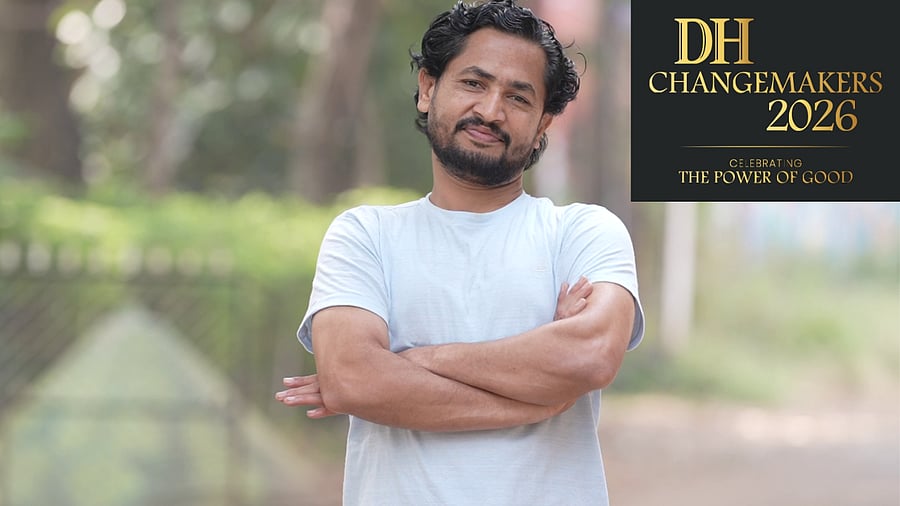
As the curtains fell on Shakeel Ahmmad’s solo play For a Bite of Food in Dharwad, the audience were in no hurry to disperse. A brief hush fell as they processed the performance, before conversations sparked about an individual’s right to choose what they eat. The play's impact, based on the Dadri lynching, lay not in ticket sales but in the thought-provoking questions it posed.
Such responses have become a hallmark of Shakeel’s plays. The 40-year-old director and actor has carved a practice that often unsettles audiences while insisting on meaningful engagement. His plays challenge citizens, the political class and institutions with uncomfortable yet important questions about governance, policies, cultural practices and social developments, reaffirming theatre’s role as a public and political space rather than a passive spectacle.
Plays such as Kodalla Andare Kodalla, which addresses taxation and price rise; Anamikana Saavu, his adaptation of Athol Fugard’s Sizwe Bansi Is Dead; Tindige Banda Tunderaya, a satirical allegory on Adolf Hitler’s rise to power, all reflect this intent.
“Shakeel’s For a Bite of Food continued to trouble me for months after watching. It forces us to confront the legitimacy of killing someone over a food choice,” says noted theatre artiste Mangala N, adding that Kodalla Andare Kodalla offers a sharp critique of everyday economic anxieties through its unconventional form.
Shankara N K, who has watched the play Anamikana Saavu, found it particularly relevant in current times. “It raises issues of identity crisis, economic exploitation and the fear surrounding documentation and belonging to a particular place or country, especially in the wake of debates around the National Register of Citizens (NRC),” he says.
Shakeel’s strength lies in translating complex social questions into clear theatrical narratives. Through The Spinning Tree Theatre Company, which he founded in 2015 in his native village in Vijayapura district, and his work with Nirdigantha and other groups, he has developed a performance language rooted in body dynamics.
Actor Dinesh Naik, a member of his troupe, says rehearsals begin with studying actors’ movements and encouraging the use of native dialects. “This allows actors to access honesty on stage,” he says. “This approach allows actors to achieve a naturalistic and truthful stage presence,” he says.
This emphasis on authenticity is reinforced by rigorous physical training.
“Shakeel blends corporeal mime, Tai Chi and other theatre elements in his plays, enabling performers to convey abstract emotions effectively while maintaining breath control and physical balance,” says Vishal, a movie actor.
Engaging directly with communal and political fault lines has often invited resistance. “At some venues in Karnataka, posters were removed. At others, arguments broke out immediately after performances,” Shakeel says. “But this is necessary. Democracy needs intellectual dialogue, not silence. Historically, power has always feared theatre that speaks the truth.”
Taking engagement beyond the stage
Shakeel takes this engagement beyond the stage. After performances, particularly in colleges, he stays back to interact with students. “They must understand their civic rights and learn to question the wrongs of society,” he says. “They are the future of our democracy.”
His plays closely mirror the challenges he has faced in life.
Hailing from a disadvantaged family in Loni B K village in Indi taluk of Vijaypura district, Shakeel was a bright student in school. His exposure to theatre was limited to school annual-day performances and occasional watching of commercial dramas staged in the village, although his father had also performed in theatre in his earlier days. While pursuing pre-university education in the science stream in Vijaypura, his confidence began to wane due to weak English skills. Feeling increasingly alienated, he turned to films and theatre, discovering an interest in acting.
He travelled to Pune to seek admission at the Film and Television Institute of India but was rejected. With family responsibilities pressing him to contribute financially, he opted for a diploma in education, a decision that proved decisive. He chose to study in Mysuru, known for its theatre culture, where he came under the influence of some well-known authors and theatre personalities. Literature and theatre gradually became his primary pursuits.
While working as a primary school teacher, he took a short break from teaching to train at the Ninasam Theatre Institute. However, in 2011, he left teaching to pursue theatre full-time, driven by his passion for theatre and repeated instances of communal discrimination in the village where he was posted.
Trained in traditional forms such as Yakshagana, Shakeel began touring Karnataka with various theatre groups. He later secured admission to Singapore’s Intercultural Theatre Institute, made possible by a philanthropist's support.
There, Shakeel trained in Asian theatre forms such as Kutiyattam from Kerala, Wayang Wong from Indonesia, Noh from Japan and Kunqu from China. “While Ninasam taught me the grammar of theatre, the Singapore institute taught me to adopt intercultural theatre, where I realised body movements on the stage matter more than language,” he says.
A few years back, he earned a master’s degree in theatre arts from the University of Kent and has since conducted workshops and lectures at institutions such as Rangayana, Sanehalli and the National School of Drama. He has also worked as an actor and director with internationally acclaimed artists like Leela Alaniz.
While Shakeel has performed on stages across the world, his focus remains on the villages and small towns of north Karnataka. “This region, rich in folk forms, is open to meaningful theatre. I want to rebuild artists, audiences and performance spaces here,” he says, adding that theatre, as a social tool, has withstood the test of time.
Satish Tiptur, director of Rangayana, Mysuru, highlights the significance of Shakeel’s journey. “He is bringing fresh ideas to the theatre. A rare talent in Karnataka’s theatre landscape, he is tackling every subject differently and experimenting with unconventional techniques beyond classical theatre,” he says.
Acclaimed theatre personality S Raghunandana praises Shakeel for blending a strong sense of political responsibility with sharp language, qualities reflected in both his plays and the themes he chooses to explore.
While his family, settled in his native village, supports his pursuits, Shakeel credits his ethical compass to his high school mathematics teacher Rajashekhar or Shekh sir, who lived modestly despite financial comfort and consistently helped villagers, including him. “People like him keep humanity alive,” Shakeel says. “Through my theatre, I want to do the same.”