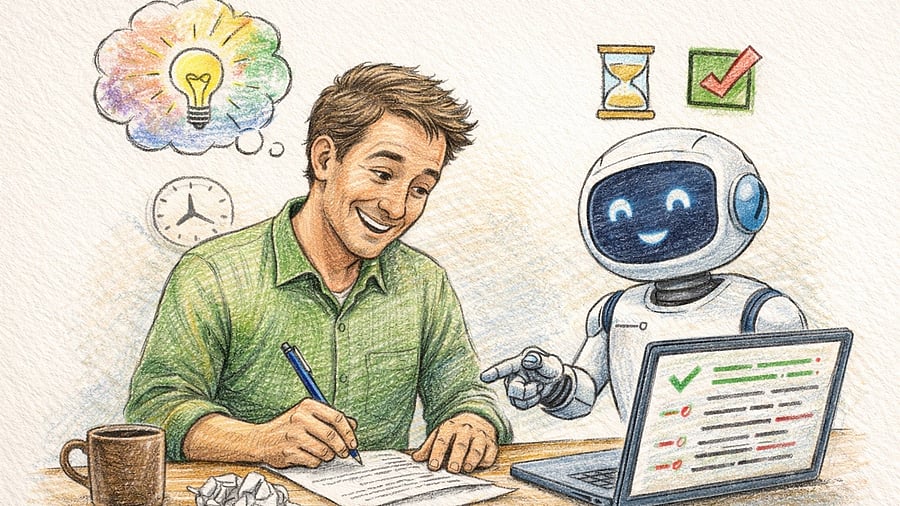
The world of writers is a broad brushstroke. It has many divisions: authors who write books; journalists who write for newspapers and magazines; content writers who create content or blog posts for various companies; technical writers who handle technical manuals and documentation for corporations; and anonymous ghostwriters who write for others. Depending on the kind of writing, AI can be either a good friend or a foe.
For people who are authors who write books or stories, the advent of LLM/AI hasn’t changed the way they write. For them, words are bread and butter, and if lucky, jam and mayonnaise, too. Originality and creativity are their forte. People pick up an author’s books because of their unique writing voice, which no AI, however advanced, capable or savvy, can replicate.
Yes, AI, with a prompt or two, can spin a story with grammar that will have an English teacher nodding in approval. But can AI penetrate an author’s mind to get their viewpoint and look through the author’s perspective? An author has the advantage of drawing on their personal experiences when writing, getting into a character’s skin and mind. All this is what makes their writing stand out. That is the author’s advantage.
The speed at which AI produces the words makes one giddy. Speed is never an author’s forte, as they like to ponder each word, savour each description, and run each sentence through their mind again and again. This is something AI doesn’t need to do. That is the advantage of an AI.
But when a writer races against a deadline to submit a story or tries to finish an assignment, the speed automatically picks up.
For people who hate stringing words into a sentence without tripping over themselves or confusing readers, AI is a blessing. It can generate write-ups, both long and short, without the writer breaking a sweat. A few prompts produce pages of good writing, which, to an extent, one can even be proud to have generated — the stress is on the word “generating,” not “writing”.
A relative who wrote something and had it professionally edited told me that he ran the professionally edited version through an AI platform for a grammatical check. The platform went a step further: it improved the writing, corrected the grammar, made the sentences racy and crisp, and, overall, perked up the writing by restructuring everything.
He sent me both versions without telling me which was the human’s edit and which was the AI’s. I liked a version. Then he told me that it was the AI version.
I was quite awestruck by AI’s efficiency. Because as a writer and author, I pride myself on my creativity, on my originality, my quirky way of thinking and my unique voice, aka writing style, which I think no AI can replicate or match. I pat myself on my back for my ability to string words in a way that leaves the readers stunned. So, if AI can replace me, I would be jobless.
A young boy told me he writes all his emails using AI, and since these tools came out, he hasn’t written a single email. AI has made people lazy. Most people always hated writing, and now AI can do it for them.
It won’t be surprising if publishers use AI to write a book, or, shall I say, to generate it. Give a flurry of prompts, include a few phrases and type some sentences and bingo, pages are ready, with perfect grammar, sentence structure and style. AI definitely won’t suffer from writer’s block or let deadlines whoosh past. It has surely replaced some content and technical writers because it does a good job, is cheaper, works at dizzying speed, and suggests and brainstorms before one can even blink.
An editor I knew ran all the articles the writers submitted to him through a grammar check. For me, that was pure laziness. This made me think that, at some point, all these tools may end up replacing editors, too.
These thoughts pose some questions. Can AI invest in research like a writer? Will that research be authentic, meticulous, and unbiased? Can AI make its writing emotionally resonant to the readers, as writers do? Can AI beat a writer’s viewpoint? Important questions that need answers.
More important is the ethical question. Who owns the copyright for writing or creating on these platforms? And if, by chance, someone else types in the same prompts, cues, catchphrases, and information, will the same writing appear on their screen? Won’t figuring out copying become tricky in such cases?
Perhaps in future, writers will use AI as an ally, as an assistant, to brainstorm, fix grammatical errors, tweak sentences, and make the entire write-up more readable, before they hit the send button. Will it replace a writer? Perhaps not.
(The author is a creative writer)