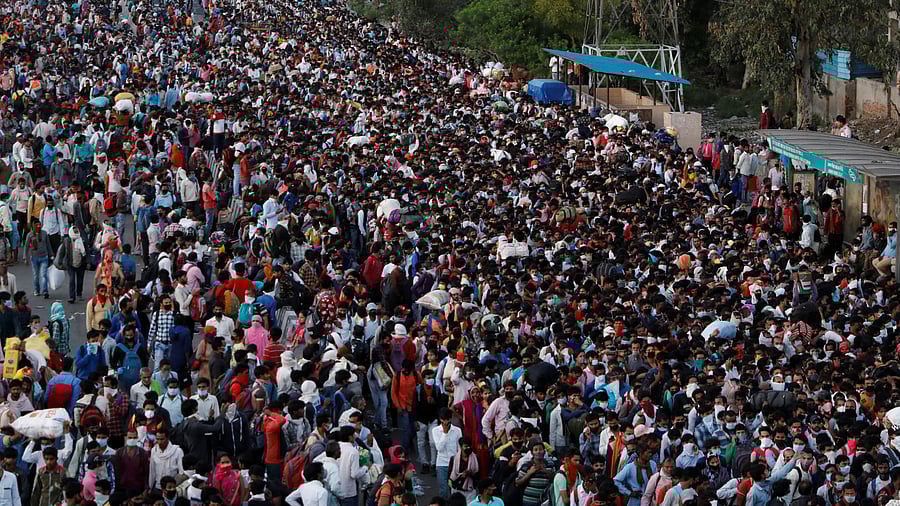
Image for representational purposes.
Credit: Reuters Photo
India’s 16th census is going to begin from April this year. A census is an official survey of a country's population conducted to enumerate its population and collect data on age, gender distribution, education, and employment.
A country is identified by its demographics. Various economic indicators are used to measure a nation's performance. Determinants of these parameters include income, savings, health conditions and well-being of individuals and households in the country. The importance of population studies is evident in this context.
Population study is a social science subject. Undergraduate and postgraduate curricula in anthropology, economics, geography and sociology may include this study. Population science can also be studied as an independent, full-fledged course at the higher education level.
Population studies involve analysing human populations and their characteristics and changes over time. They help us understand the causes and consequences of population change. The findings from these studies form the basis for policy formulation in education, housing, healthcare, rural/urban planning, and environmental protection. They are also used to develop policies to address inequality, poverty, and unemployment, as they provide the basis for evidence-based strategies to meet the needs and address the challenges of changing populations.
The subject investigates the interconnectedness between population dynamics and economic and social outcomes. For example, population ageing calls for higher outlays for social welfare and healthcare demands.
Topics under a postgraduate course in population studies usually include introduction to demography, population sociology, mortality and morbidity, economics of population, fertility-theories and determinants, population and development, migration, urbanisation, relation between population and environment, gender issues and reproductive health, population policies and programmes, aging and health transition, collection, evaluation and analysis of population data, sampling and research methods, using computer applications and AI in demographics etc.
However, Population Studies isn’t only about data. AI has applicability in population studies, but only to a limited extent. It can support data and trend analysis. However, in policy-making, budgeting, and resource allocation for specific segments of the population, human interventions and insights take centre stage.
Where to study?
A dedicated institution for the study of population science, named the International Institute of Population Sciences (IIPS), was established in our country in July 1956. Situated in Mumbai, the Institute is now a deemed university. Its offerings include an MA/MSc in Population Studies, an MSc in Biostatistics and Demography, and Doctoral and Postdoctoral programmes. Gokhale Institute of Politics and Economics, Pune, conducts M.Sc. Economics (Population Studies and Health Economics).
The Indian Statistical Institute (ISI), Kolkata, has a Population Studies Unit that conducts research on various population parameters, including mortality, migration characteristics, and life contingencies.
Master's courses in population studies are taught at several universities in India. Indira Gandhi National Open University offers a distance-learning MA course in Population and Family Health Studies.
The Ministry of Health and Family Welfare has established a network of 18 Population Research Centres spread across 16 states to provide critical research-based inputs on health and family welfare programmes and policies at the national and sub-national levels. Of these, 12 are affiliated with universities, and six operate as independent research units. Dharwad in Karnataka has one such centre. Regular and project-based work opportunities are available at the research centres listed above.
Statistical methods, research and quantitative techniques have wide applicability in population studies. Students of subjects such as statistics, quantitative economics, and econometrics may choose to pursue population studies at the higher education and research levels.
Also, students pursuing (or having completed) a master’s degree in economics, social work, sociology, public policy, or development studies and keen to pursue a PhD, may take up a population-related theme for their research. Population studies are included in the UGC NET subject list.
Work opportunities
Employment and work opportunities exist with entities such as NITI Aayog, the National Sample Survey Organisation, the Office of the Registrar General and Census Commissioner, the Ministry of Home Affairs, and Population Research Centres under the Department of Health and Family Welfare.
Population Studies has universal academic appeal. Many foreign universities also offer teaching and research opportunities in the subject. Those interested in academics can look forward to teaching the subject at universities, including IIPS, ISI, Dr B R Ambedkar School of Economics, University of Bengaluru, Institute for Social and Economic Change, Bengaluru, and social science departments at IITs, NITs, IIMs, etc. The Indian Institute of Human Settlements in Bengaluru, also a deemed university, offers study, research, and teaching opportunities in population-related themes.
With some experience and exposure, one can explore opportunities at international organisations such as UNICEF, UNFPA, and WHO. The World Bank regularly releases data on population size, growth, and composition for countries worldwide. The United Nations Population Division publishes reports on population trends and projections. In addition to these well-known organisations, opportunities may also come from the International Labour Organisation.
The National Programme on Technology-Enhanced Learning has developed a few modules on population studies, which are freely accessible. It would be advisable to review a few of these to see if the subject interests you.
(The author is a human resource development professional)