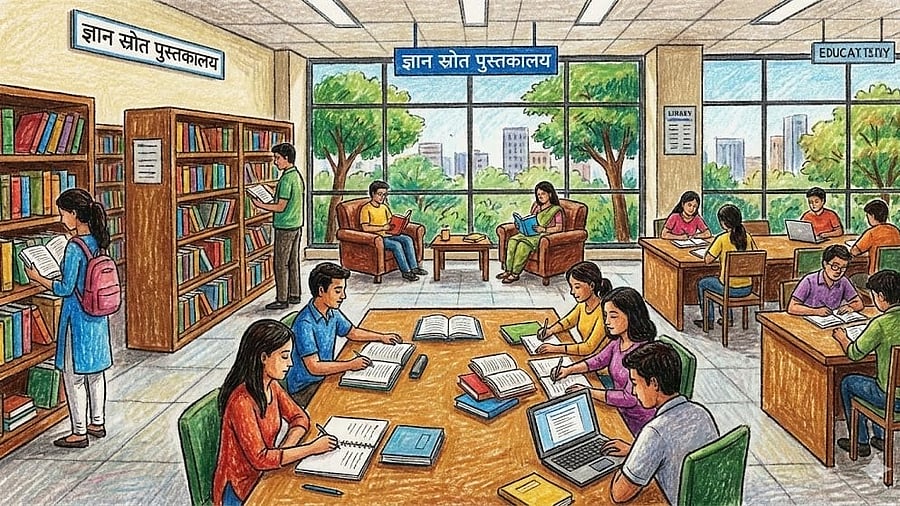
I still remember my college library, where I could smell the pages, what we call Bibliosmia. Once we opened the doors to the college library, we sensed a cosy blend of dust, old paper, and silence. To my generation, the library was not just a room with shelves; it was a place to work on our assignments. It taught us patience, inquisitiveness, modesty, and discipline. These qualities subtly influenced our reading, writing, and thinking. We were students, and we learned. There were no shortcuts. We immediately conducted a second search when one of the references could not be found. When a book was out of stock, we waited, borrowed, or negotiated with a librarian, who often had better judgment than the catalogue itself. We had been trained to scan, skim, cross-match, and cross-reference concepts. It was a slower, more deliberate way of writing. Reading was not merely schoolwork; it was a process.
Libraries taught us to think carefully before we write. Someone might discover you when you quote out of context, whether you are in front of your teacher, peers in class, or even your conscience. You gained the admiration of authorship. It was not about being clever, as you wrote, but about being specific and unique.
I recall reading a single topic across four books to understand and internalise the point. That effort mattered. It developed our intellectual strength. It sharpened our language. This gave us confidence as writers. We could write what we knew, which was not how we would write using algorithms today.
Nowadays, I see something unbelievable: empty libraries with no one inside. They are filled with shelves but lack readers.
The same cannot be said for technology or AI. What is concerning is how the convenience of using technology is replacing thinking. Many students today do not even bother to verify sources, exchange ideas, or question authenticity. Production, replication, copying, and pasting content occur without knowledge, consideration, or ownership. The habit of inquisitiveness is gradually fading away.
Learning to ask questions more effectively is also educational, not just about finding answers. This skill is naturally cultivated in libraries. A library stimulates curiosity. You go out to get a book and come back with three. You realise that you have been looking at things you never intended to examine. It is a challenging form of learning in which information is presented to learners. This environment fosters creativity by allowing the mind to explore without bias.
AI cannot replace the habit of reading broadly, the joy of rediscovering a forgotten author, or the pleasure of connecting ideas across different books. As a result, students miss the most vital part of learning: trusting their own thinking instead of relying solely on generated content.
More importantly, libraries teach you to locate sources, synthesise insights, draw correlations, and share knowledge. This skill is largely lost when content is delivered all at once, without references. It also diminishes the appreciation of the output when Artificial Intelligence tools produce everything. While students’ use of AI does not concern me personally, I feel that they are less engaged with the material. AI is replacing the ability to verify, interpret and reflect.
Libraries are not outdated; the real problem is that our habits are evolving. Students should be encouraged to read more to improve their writing. They need exposure to complex texts to develop a strong mind. Nothing can replace the skills gained through reading, questioning, and verification in the library. Students should not only reclaim the library’s physical space but also its mindset. They should sit with a book, argue with it, and also learn to disagree with the author. Take notes and rephrase sentences in their own words. I don’t mean they should write only through sheer hard work, but rather through quick, thoughtful effort, because the best writers are not the fastest but the most thoughtful.
Those who can think and express their ideas in writing will always stand out among students. It is not those who constantly absorb information but those who can understand, question, and wisely acquire knowledge who will shape the future. The use of traditional writing and libraries is part of the past, but remains an essential component of a good education. By rediscovering the value of libraries, students can regain a sense of the traditional learning process and, accordingly, restore confidence, clarity, and meaning.
However, young people spend more time on social media than on other activities. They are in a rush for no meaningful purpose and have low attention spans. Even governments are thinking about it. Australia has banned more than 1 million social media accounts linked to users under 16, a measure that has sparked debate.
Meanwhile, words of T S Eliot, “The very existence of libraries affords the best evidence that we may yet have hope for the future of man,” remind us that libraries patiently await a future generation that will take the time to rediscover the joy of learning the hard but righteous way.
(The author is an academic)