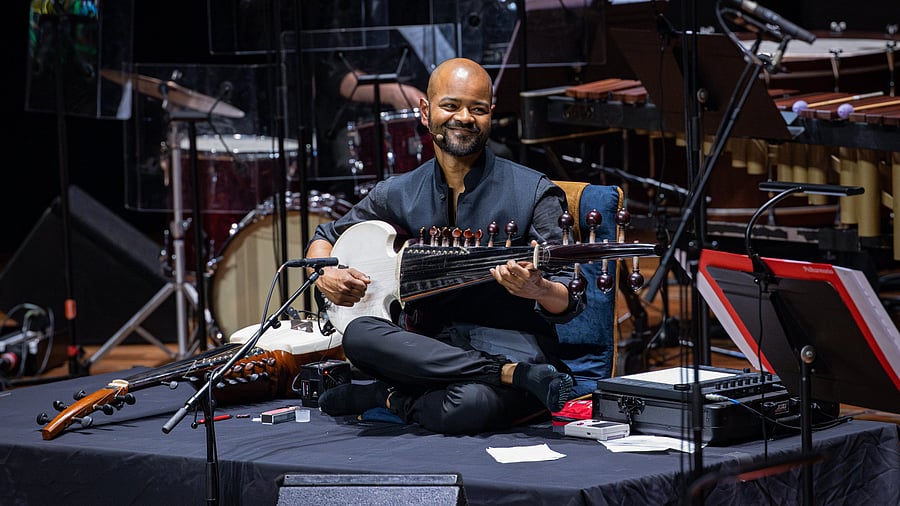
Soumik Datta.
Credit: X/@philharmonia
Noted sarod player Soumik Datta is among a handful of artistes blending Hindustani music with genres like pop, rock and electronica. Since the beginning of October, he has been travelling across the country on his ‘Melodies in Slow Motion’ tour, which he describes as being “inspired by India’s rich history of travelling musicians, which predates the record industry”.
“As a kid visiting my grandparents near Shantiniketan, West Bengal, I was profoundly influenced by the community of Bauls (mystic minstrels) whose lives were dedicated to travelling village to village to spread spiritual messages through their music,” he shares.
Through the tour, he will not only perform but also conduct workshops in schools “to demonstrate how music builds empathy”. “The tour stems from a desire to redefine the model of touring, moving away from the transactional nature of modern performance. I felt compelled to create a structure focused on mindful travel and deep, sustained engagement,” he notes. It is evidently an extension of the messages embedded in his music, which addresses important issues such as humanitarian crises, climate change and mental health.
The London-based musician explains that the performances, titled ‘Travellers’, offer a multi-layered sonic experience that “blurs the line between a traditional concert and an immersive audio documentary”. The shows are informed by Datta’s fascination with cinema and the mood created by the coming together of music, dialogue and sound effects.
The music, he says, was born from an urgent, almost visceral response to the humanitarian crises across the world. He was moved by the images of the displaced families and the suffering in war-torn regions like Gaza. “My primary intention was to create an extended piece that actively holds and shares that raw feeling of helplessness and grief, rather than offering simplistic comfort,” he elaborates, adding, “‘Travellers’ is more a piece of active grief work, a way to process the world’s pain”.
Datta was not aiming for a traditional song structure, but a soundscape. He explains that the piece moves through distinct emotional phases, beginning with a sense of jarring dissonance. It is punctuated with samples from news broadcasts, which act as the percussive base for several tracks. Drawing heavily from Indian classical and folk traditions, it also uses sarod for its deep, melancholic resonance. This is contrasted sharply with unfiltered vocal samples of the cries of the refugees. “Genre-wise, it exists in a space between contemporary classical composition, ambient sound art, and urgent folk lament,” he states.
The performances from the tour will be turned into an album, which he hopes to release next year.