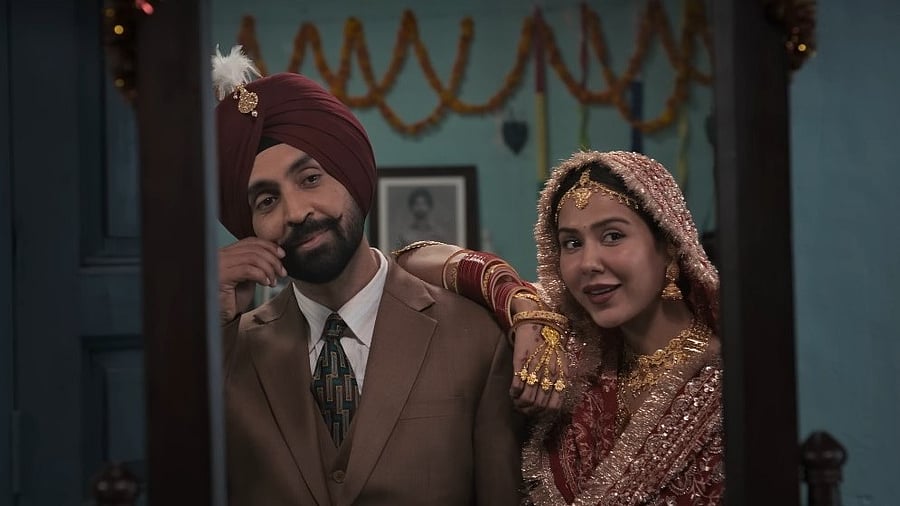
Diljit Dosanjh and Sonam Bajwa in Border 2.
Credit: Special arrangement
Hypernationalist narrative, mass action sequences and unevocative nostalgia are the best ways to describe ‘Border 2’. Although the movie offers some heartwarming moments in flashbacks of the soldiers’ lives, they are overshadowed by the director’s display of over-the-top nationalism — amplified by the deafening background music in the climax.
The 1997 ‘Border’, directed by J P Dutta, explored the Battle of Longewala of the Indo-Pak War of 1971, that was fought at the Indian border post of Longewala, in Rajasthan’s Thar Desert. ‘Border 2’ establishes itself as a sequel by exploring four other battles and operations that took place during the same 1971 war — Operation Chengiz Khan, Battle of Poonch, Battle of Basantar and Defence of INS Khukri.
The movie follows three defence officers from the Defence Academy — Major Hoshiar Singh Dahiya (Varun Dhawan), Fg Offr Nirmal Jit Singh Sekhon (Diljit Dosanjh) and Lt Cdr M S Rawat (Ahan Shetty) — their friendship and brotherhood. It is this part of the movie that is heartening and touching. But soon, you realise that the director intends on using these poignant stories of the soldiers and their families to glorify war.
The film does not even come across as technically sound. The VFX is jarring and most of the movie looks like it’s shot behind a green screen. While the film does try to balance its narrative by showing the losses of war, it fails to effectively show the horrors of wars — in the sense that it is not an anti-war film, which is the need of the hour. Having said that, the scenes featuring Diljit and three Kashmiri kids will stay in my memory for a very long time.