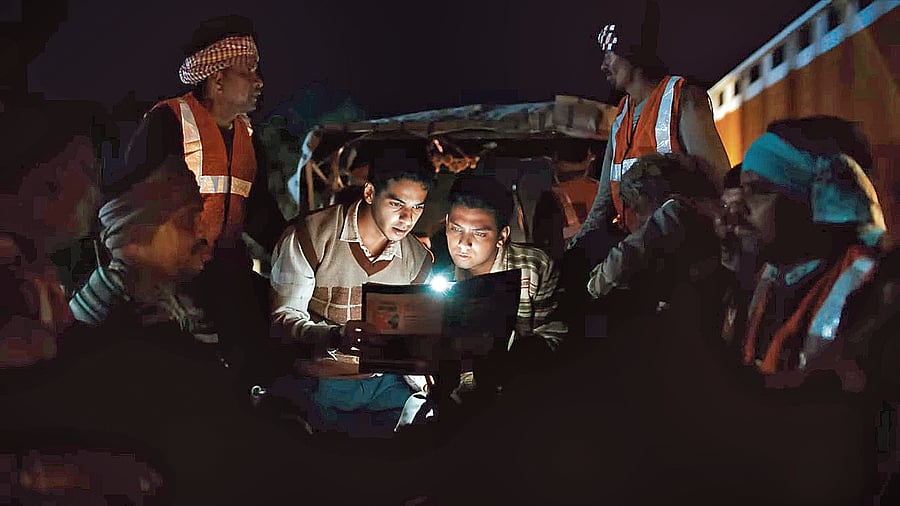
A still from the film 'Homebound'.
A film like Neeraj Ghaywan’s ‘Homebound’ puts all kinds of pressures on an Indian film critic. In the first place, it brings two marginalised communities — Dalit and Muslim — together, and any criticism by someone not from among them could be taken as a position against the communities. Secondly, Neeraj Ghaywan has made it known that he is a Dalit and also that it took him courage to admit it. Lastly, the film has been well received at Cannes (and now shortlisted for best international feature at the Academy Awards), which means that critics who dislike ‘Homebound’ risk further marginalisation. Still, since honest film criticism is nearing extinction, it needs to assert itself, at least as a marginalised category.
The film is inspired by a New York Times article by Basharat Peer but we are not sure of the creative liberties taken. ‘Homebound’ follows two childhood friends chasing a police job that promises them dignity that they have been denied.
Ghaywan had concealed his identity as a Dalit, which implies that he belonged to a socio-economic class that allowed him to keep his distance from his caste folk: he was more privileged. Dalit ideologue Arjun Dangle (‘Poisoned Bread’) has a name for this, and he calls them ‘Dalit Brahmins’; former Chief Justice of India B R Gawai (himself a Dalit) also invoked it when he noted that a manual laborer and an IAS officer, even when both are Dalits, are not equal, and should not be equally compensated. My proposition is that a ‘Dalit Brahmin’ cannot speak authentically about the Dalit experience and his idea of caste identity may overlook ground realities.
Caste dominates Ghaywan’s work in cinema, and ‘Masaan’ (2015) is his first take. In that film, a police inspector extorts Rs 3 lakh from a Brahmin professor of Sanskrit in Varanasi. The reason is that the professor’s daughter is caught in a hotel room with a young man. Both are adults and the sex is consensual; what, then, was the heinous crime for which the professor has to pay Rs 3 lakh? Moreover, a Brahmin professor of Sanskrit is in a respected position in Varanasi and he is likely acquainted with powerful people to approach, especially since the extortionist is of low rank. Anyone educated in India knows someone powerful enough to approach, and a lowly placed adversary would not present a problem.
In ‘Homebound’, which is about a close friendship, Ghaywan brings a Dalit and a Muslim together as social victims, but the communities are not marginalised in the same way. A Muslim is not socially outcast and is only politically distanced by the discourse around Hindutva. But bringing the two together is a strategy to find a larger constituency, and there are terms like Dalit-Bahujan and Ahinda to testify to its popularity. Mayawati even brought Dalits and Brahmins together to fight the OBCs. ‘Homebound’ includes the standard instances to demonstrate Dalit and Muslim disadvantage — a Dalit employee not being allowed to cook in a school, a Muslim getting into a fight in a game of cricket for his so-called ‘Pakistani’ associations. Ghaywan is not even consistent here since the pickle from the Dalit boy’s home is grabbed by eager boys who are not Dalit, and they are boys who would know about his caste. Caste discrimination is practised not just by people who have social positions — it is horrifyingly all pervasive.
The fact that a Muslim and a Dalit are made close companions is a disingenuous strategy. Regardless of the tenets of the religion, the Islamicate category in Hindi cinema indicates hierarchical preoccupations. The tragedy in Pakeezah, for instance, is not that a woman should be a courtesan but that someone of aristocratic birth should be one, and the lowly born courtesans in the film are not wept over. Muslims under the Mughals were ranked as ‘Turani’, ‘Irani’ and ‘Hindustani’ and the last category (those without discernible foreign ancestry) were the lowest placed. Shared status between the two cannot therefore come naturally.
Regarding the economic detail in the narrative, both boys find unskilled blue-collar work in Surat. But loans are ridiculously easy to get and the Dalit boy helps his family construct a home that would cost tens of lakhs, even when the EMI on a housing loan is around 1% of the borrowed sum. The Dalit boy’s romantic interest is a Dalit girl (Janhvi Kapoor) whose father is a linesman in the railway, but Ghaywan gives her a home that would be the envy of a middle level executive.
Then we come to the central ploy, which is that both boys hope to pass a competitive examination to become police constables; they conduct themselves eagerly as though it were a real test of merit. I should not say more, but the attraction of certain government jobs is in the extra money it puts into one’s hands, and any job that does this will certainly necessitate a down payment. One is not sure if the film could have admitted this fact, but there could be a ruse to get around it. In the film ‘Santosh’ (2024), for instance, the heroine becomes a policewoman through a compassionate appointment since her husband is killed in the line of duty.
Lastly, and Ghaywan is not the only culpable one here, the casting of upper-caste actors (usually Brahmins) as Dalits is indifference to actualities. There has been a move to include caste discrimination under racism, which means that physiognomy plays a part in identifying caste. We cannot hence take the truly disadvantaged to be only grimy versions of the fortunate; there is an enormous gap between the two, and films like ‘Homebound’ hardly shed any light on it.
(The author is a well-known film critic)