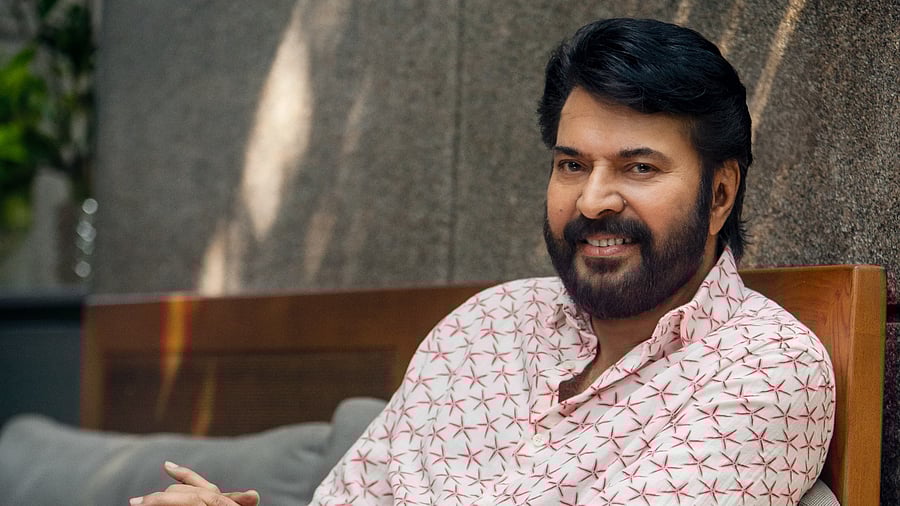
Padma Bhushan awardee and Malayalam film actor Mammootty.
Credit: X/ @mammukka
There is something faintly deceptive about Mammootty. For an actor who has been in the cinema universe for the past five decades, he has not quite settled into the comfort that longevity usually offers. He has been sharpening his act and never has he aged into reassurance. Even now, at 74, he moves through roles the way a master card player handles a complex deck. He pulls out unexpected hands and places them down with quiet authority and dares the table to keep up.
In Kerala, his characters have escaped the screen and entered the language. A slightly challenged person is still called ‘Puttu’ Urumees, after his portrayal in ‘Surya Manasam’ (1992). Achu, the weather-beaten and solitary fisherman of ‘Amaram’ (1991) is not merely remembered but felt. Mammootty painfully carried the salt of the seas in his eyes. Then there is Chandu, the betrayed warrior of Malabar lore, whose shadow still looms over Malayalam cinema’s moral imagination. Only a rare few actors have given names to the state of being. That is the scale of Mammootty; not stardom but saturation.
When the Padma Bhushan arrived in 2026, it felt less like recognition than a formal acknowledgement of something already settled. Mammootty, by all serious measures of the artistic, crossed that threshold of national honour long ago. Yet, what makes the award resonate is not what it crowns but what it frames: an actor who, instead of coasting on monumental legacy, has spent the last decade unsettling it.
To state a case, consider Chandu of ‘Oru Vadakkan Veeragatha’. There are many moments that refuse to age. In a poignant one, Chandu walks to the sacred space in one corner of the revered Kalari. Here, honour is supposed to be restored and rituals purify betrayal. Mammootty does not rush the walk. His shoulders are squared and his eyes carry the knowledge that the verdict has been delivered. When he finally chooses death by his own hands, it is not defeat but reclamation of complete control. He does not ask for absolution but takes it. That walk is not a mere performance. It is a philosophical argument rendered through muscle, breath, and silence. That scene alone explains why Mammootty has always been elusive to categories.
Over time, critics have tried to map his career across genres such as parallel cinema, mass cinema, literary adaptations, and historicals. But Mammootty resists tidy shelves. A better way to understand him is through the scale of difficulty. It need not be a technical difficulty, but the more ethical and psychological ones. He gravitates towards roles that test the audience’s willingness to stay with discomfort.
This is where the rubric matters. Psychological depth has always been Mammootty’s native terrain. In ‘Thaniyavarthanam’, superstitions eat away at a man’s sanity, not with hysteria, but with creeping inevitability. In ‘Mathilukal,’ desire is conveyed through voice and imagination rather than touch. In ‘Vidheyan’, submission becomes a form of moral corrosion. These are roles that do not seek empathy. They seek serious attention.
His emotional range, often mistaken for intensity, is actually about modulation. Mammootty knows where to withdraw. ‘Peranbu’ works not because of emotional outbursts but because of the long stretches where love sits unspoken, heavy, and unresolved. Restraint, in his hands, becomes the hardest performance choice of all.
Physical transformation has never been cosmetic. From the bodily awkwardness of ‘Mela’ to the muscular fatigue of ‘Amaram’, and the historical embodiment of Ambedkar, Mammootty treats the body as an argument. Posture thinks before dialogue does.
Narrative weight is another constant. Many Mammooty films would have collapsed without him. ‘Mathilukal’, ‘Kaazcha’, ‘Peranbu’, and ‘Nanpakal Nerathu Mayakkam’ are not ensemble shelters. They are acts of endurance. The camera leans on him and waits.
However, the most revealing parameter is resistance to his own public image. This is where the late-career Mammootty becomes interesting. ‘Kathal the Core’ asks him to play a man whose quiet life unravels under the weight of a truth he never publicly proclaims. ‘Bramayugam’ pushes him into the territory of myth and menace, where authority curdles into something primal. These are not roles designed to flatter legacy. They interrogate it. Thereby, Mammootty does not protect his image; he exposes it to risk.
That is also why the Padma Bhushan feels timely rather than retrospective. It marks and honours an artiste who refuses to treat experience as insulation. At an age when many actors rehearse their greatest hits, Mammootty is still learning new languages of silence, menace, tenderness, and doubt.
Kerala has produced many great actors, and India has honoured many legends. But Mammootty occupies a rarer space: an actor who understands that relevance is not about staying visible. It is about staying unsettled. And, in that space, Mammootty remains productively and stubbornly unfinished.