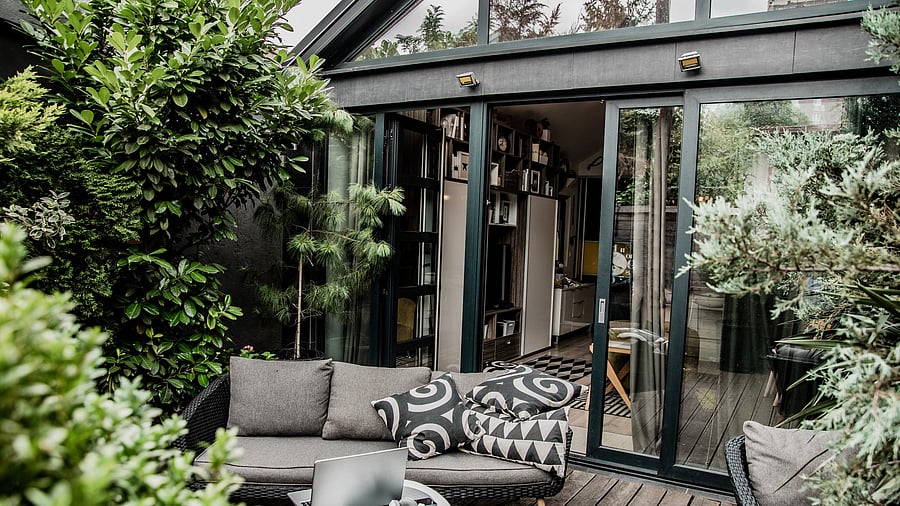
Representative image showing trees in the front yard.
Credit: iStock Photo
A guidebook on 26 tree species that can be easily grown in apartments and independent houses in Bengaluru was released recently. It also details where to plant them, tips to care for them, and their uses.
Tree Planting Guide for Houses and Apartments in Bengaluru has been authored by Seema Mundoli and Harini Nagendra, members of faculty at Azim Premji University, Sahana Subramanian, an alumnus of the University, and urban conservationist Vijay Nishanth. The hard and soft copies of the book are available for free.
Sharing why they compiled this 81-page booklet, Seema said, “We realised saying ‘Let’s plant trees’ wasn’t enough. We also needed to tell what trees people can plant. Weak trees, pollen allergies, sumps getting damaged by roots, and space constraints are common concerns in apartments.”
They have listed out trees you can grow in soil cover of a foot, typically near boundary walls. Hibiscus, crape jasmine, henna and peacock flower are some options. Species like star gooseberry require more space.
Trees with wide canopies and whose roots may spread far and potentially damage the underground parking space have not been listed. “But we have talked about root barriers in the book,” Seema said. These can be installed underground to deflect roots from growing deeper or in a certain direction. Stories of how a cluster fig tree, and a 48-year-old peepul tree in Bengaluru were saved from felling by installing a root barrier find a mention.
Tips to fight pests or diseases in mango, neem and guava trees, using organic treatments and chemicals, also feature in the book. They have also shared trivia about trees, ranging from why drumstick was a favourite of Cuban leader Fidel Castro, to why frangipani does not yield nectar.
The writers have also steered clear of ornamental trees like the bottle palm, which are a fixture in gated communities, and which, Seema rued, hardly provide shade. The book instead features a curation of fruiting and flowering trees that also have ecological, medicinal and cultural uses. Seema cited the example of avocado trees — they give fruits and shade, attract bees and insects, and ointment extracted from their seeds can treat skin infections.
They chose species that grow “fast”, going from a seed or a sapling to a sizable tree in two to six years. The frangipani and peacock flower can bloom in two to five years depending on the care given. She said that people should aim for a patch of diverse trees but also acknowledged that nurseries don’t stock a lot of varieties anymore. So, the book mentions trees that can be grown by grafting like chikoo, or by cuttings like the hummingbird tree.
A tech park and lake rejuvenation groups have grabbed the bulk of the hard copies. “Depending on the demand, we will print more,” she said.
Download the PDF from azimpremjiuniversity.edu.in. For a hard copy, write to environment.workshop@apu.edu. in