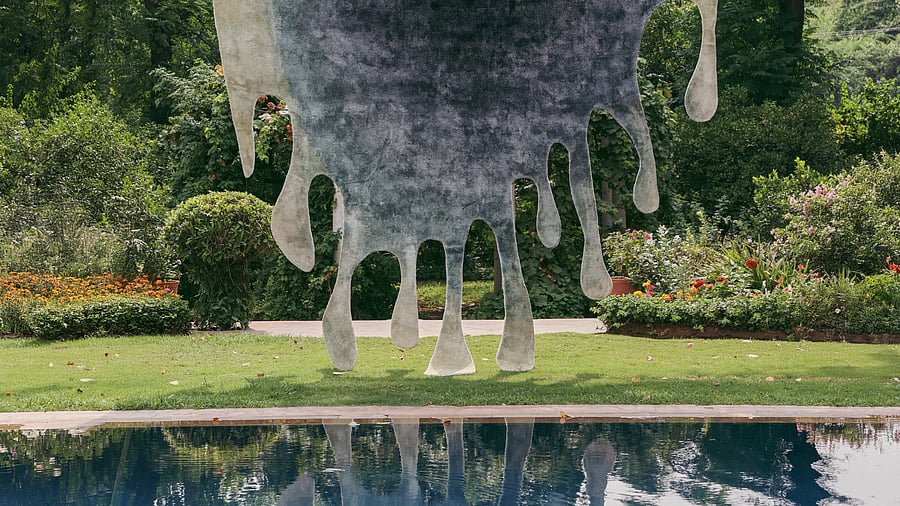
One of the unique rugs created by the designers.
Rugs have long been both functional surfaces and objects of beauty. Designers and sisters Saina and Kanika Takkar have recently unveiled a contemporary collection that repositions the rug to resemble a natural landscape through shifts in texture.
Each piece is hand-tufted over time, allowing texture and form to lead while decorative motifs take a step back. The technique uses a stretched fabric base into which the yarn is pushed using a special tool. The artisans control the density, height, and direction of the yarn, shaping the rug as they work, letting some areas rise while others sink. The rugs are made from plant-based silks. When the designers want a pronounced high-low effect, they use New Zealand wool as a base and layer silk on top to add height and reflect the light.
Contours of the land
The land-inspired rugs mix greys, sandy tones, and beiges, with slightly different pile heights to give them real texture and depth. Dense areas with tightly packed yarn feel solid like firm earth. Loam is inspired by the fertile plains, using dense silk and subtle colour variations to capture the richness of the earth.
Dune evokes a desert landscape through subtle high-low pile patterns. Beige, ochre, and ivory coloured silk yarns are mixed to create the undulating forms and shifting shadows of desert ridges. The slightly raised threads add the element of windblown sand.
Korra shows roots breaking through rock. Sections with high and low areas suggest the gentle dips of the stone. The irregular lines trace how roots spread, while the deep green threads signal vegetation.
Human influence enters through architectural forms. Arch uses an outline formed by using subtle differences in pile heights. The arch sits raised against a flatter background. Fine linear cuts mark edges and divisions. The surface feels architectural, but worn in, like an old opening softened by use. Quoin is also a nod to architecture; the idea comes from the simple act of sitting on a garden wall. The surface is divided into block-like sections using contrasting pile heights. Edges are softened rather than sharp. The air-inspired rugs focus more on colour blending, thread arrangement, and pile sculpting. Aeris feels airy because the colours are pale and blend gradually.
For Lunara, the designers create depth through sculpted threads cut at different heights: taller threads catch the light and cast tiny shadows, while shorter threads stay flat, creating a floating effect that invokes the feeling of moving clouds.
Ravyn shifts the mood entirely. It captures a storm in motion through sharp colour contrasts and directional carving of the yarn. After the rug is tufted, the surface is cut by hand in deliberate lines, guiding the pile in specific directions.
This carving creates channels and ridges that break up the surface, making colour appear fractured and restless. The varying pile heights disrupt uniformity, giving the rug an unsettled energy, like a sky on the verge of breaking.
Other rugs in the collection take inspiration from water. Ebbra captures the shoreline just after a wave pulls back. Thick wool marks the darker, wet parts of the ground, while the silk marks the lighter, drying areas. Beige forms the base, with muted greens taken from coastal surroundings. Selume shows water flowing between stones. Sandy threads form the main surface, with pale lilac threads mixed in to create highlights.
Nature is never shown in its literal form in these designs. “Trees are absent, but their colours remain. Water isn’t shown directly, but the design makes you feel it’s there,” notes Saina. Mirelle and Mireya take an even subtler approach. Instead of visible movement, they rely on tonal variation and small changes in pile heights to suggest dampness.
On Mirelle, the pile is mostly low and even, creating a plush surface, evoking the feel of rainclouds drifting downward. Mireya has sections of higher and lower pile, tracing the imprints water leaves as it moves across the ground.
The collection doesn’t spell everything out. There are no images to interpret or obvious references to spot. Its meaning comes from seeing and using the rugs. In a world where design is often immediate and obvious, these rugs ask you to slow down and pay attention, quietly challenging contemporary design.