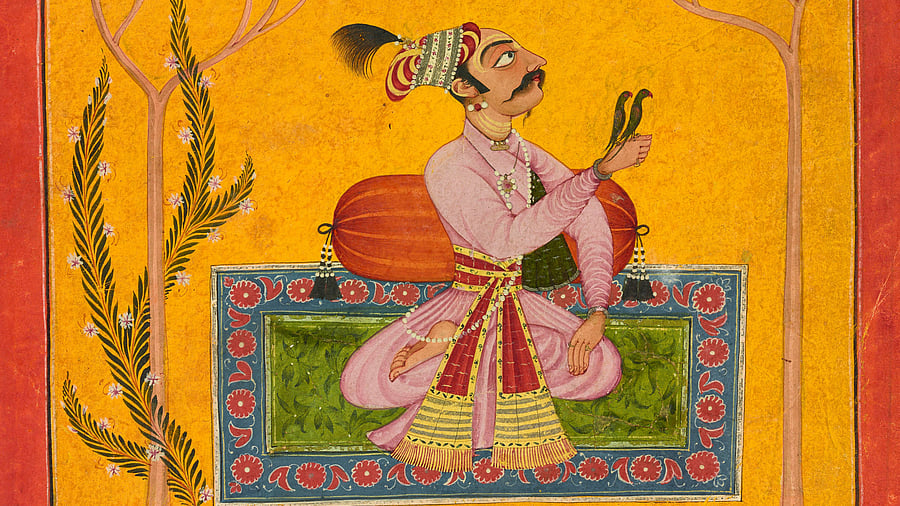
A pigment with an obscure history, Indian Yellow was prized for its striking orange-yellow tone and warm, glowing luminescence. In 1883, its enigmatic origins drew the attention of Sir Joseph Dalton Hooker, the British botanist and director of Kew Gardens. Intrigued by the pigment’s peculiar acrid odour and uncertain provenance, Hooker wrote to the Indian Department of Revenue and Agriculture seeking answers. Many months later, a letter arrived at the Royal Society of Arts in London from T N Mukherjee, a civil servant, responding to Hooker’s enquiry and shedding light on the pigment’s curious origins.
In his account, Mukherjee described encounters with cattle herders in the village of Mirzapur, in the Bengal province — today’s Munger in Bihar — who were responsible for producing the material. According to Mukherjee, the herders fed their cows exclusively on mango leaves (Mangifera indica Linn) and water. The resulting urine, concentrated and brilliant yellow, was collected, boiled, and strained, yielding lumps of yellow-green sediment. This sediment was then rolled, dried, and shipped to Calcutta, from where it made its way to London’s docks. Mukherjee also noted that the cows appeared sickly under this regimen.
Known locally as piuri or purree, the pigment was likely introduced to the Indian subcontinent through Persia in the 15th century and found early expression in miniature paintings commissioned by the royal courts of Rajasthan and the Punjab. Beyond its aesthetic appeal, the pigment’s remarkable resistance to sunlight fading made it ideal for dyeing cloth and painting frescoes and walls.
Indian Yellow’s arrival in Europe was facilitated by the far-reaching maritime networks of the British Empire. The pigment’s strong ammonia-like odour sparked speculation: some believed it derived from snake urine or ox bile, while a more popular theory suggested camel urine. Art stockists treated and separated the yellow substance from the raw material before selling it for use in watercolour and oil painting. The pigment found its way to the palettes of several European artists at the time. Jan Vermeer used it to achieve his distinctive light effects; JMW Turner integrated it into his watercolours; and Vincent van Gogh famously employed it in painting The Starry Night.
Beyond Mukherjee’s account, published in the Journal of the Royal Society of Arts, no trace of “mango cows” or Indian Yellow’s legal or cultural history exists before the 1900s. By the early years of the 20th century, the production of Indian Yellow had ceased. Historians suggest this may have been due to a ban on its production on humane grounds, but no official record of such legislation exists.
Modern scientific analyses have confirmed the pigment’s organic origins, revealing the presence of hippuric acid, a compound found in urine. Yet the exact methods and sites of production remain unverified. In the early 2000s, writer and journalist Victoria Finlay retraced Mukherjee’s steps, only to find no evidence of the pigment’s manufacture. Art historians continue to wonder whether the origin story of the colour may just be apocryphal.
Discover Indian Art is a monthly column that delves into fascinating stories on art from across the subcontinent, curated by the editors of the MAP Academy. Find them on Instagram as @map_academy