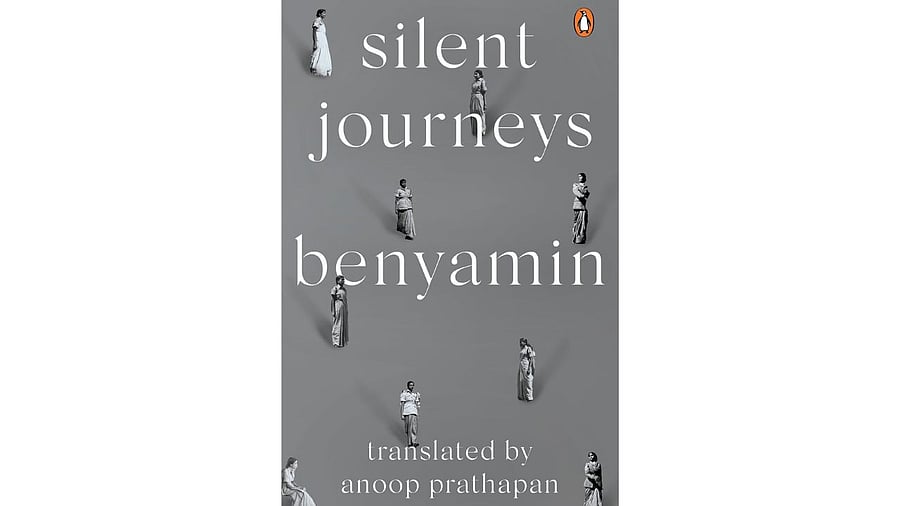
Benyamin’s Silent Journeys.
Some of the most remarkable stories in history cannot be found in a book. They live in half-remembered anecdotes recounted at family gatherings. In fading sepia photographs on the time-worn walls of ancestral homes. In letters hidden at the back of musty drawers or in suitcases carrying the remnants of long-forgotten travels.
Benyamin’s Silent Journeys is one such story. Translated from the Malayalam Nishabda Sancharangal, this latest work from the author of Goat Days traces the astonishing life of Mariamma Yohannan, a nurse whose travels spanned continents.
It all starts with Manu, a restless young man uncertain about his own future. His parents press him to migrate, while his sister pushes him to get into nursing. Yet, he remains unmoored with none of the options “speaking” to him. His life takes an unexpected turn when an extended hospital stay introduces him to Maria John, a young nurse whose compassion prods him to reflect on the invisible labour of those in her profession. This meeting coincides with the discovery of a letter from his great-grandmother, Mariamma, found in their crumbling ancestral home. It is this letter that propels him out of his own indecision and inertia into a search across the globe.
Information about Mariamma is scarce, but Manu doggedly pursues every clue, every letter, every diary entry he can lay his hands on. And slowly, Mariamma’s life begins to take shape through the mists of time. In a radical move, she chose nursing at a time when women in her community were expected to confine themselves to domestic spaces. What’s more, her choice carried her across the seas, from Kerala to Singapore and Borneo during World War II and the Japanese occupation. She then mysteriously ended up in Tanzania, after which she became untraceable. But Manu is determined to follow Mariamma’s footsteps and uncover her story.
Benyamin spotlights the extraordinary courage that seemingly ordinary women displayed as Mariamma’s decisions spur generations of women in her family to follow her path into nursing and travel across the world. He deftly intertwines personal and collective history by highlighting the lives of nurses, their daily endurance and sacrifices, which are central to the story of modern Kerala and its diasporas.
Stylistically, the book is a delightful mix of Manu’s present-day reflections with Mariamma’s letters, recollections of family members, and fragments from journal entries. At times, the prose carries the intimacy of a diary and at others, the straightforwardness of facts. Benyamin has excelled at portraying migration, as evidenced by the exceptional Goat Days. He shines at nudging out the psychological costs of leaving home, and tracing the small humiliations and triumphs that define exile.
Benyamin’s masterful blend of historical storytelling with a mystery at the heart of it propels the story forward. The translation, though, and perhaps the editing too, leaves much to be desired with clunky phrasing, repetitive sentence constructions, occasional typographical errors and the usage of Indian English. In a novel where words and turns of phrases have the power to amplify Mariamma’s raw defiance or the mercurial nature of Manu’s contemplations, these language missteps dull the force of the story.
Despite these flaws, the novel’s emotional core remains intact. Silent Journeys is replete with reflections on the dignity of labour, the unacknowledged sacrifices of women, and the generational weight of silence. It reminds us that healing is not confined to hospitals. That healing also includes the act of unearthing what families bury, and confronting the pain of the past. For Manu, Mariamma’s story is both a revelation and a mirror as he is forced to acknowledge his own passivity.
Mariamma’s journey rises above being just a family chronicle as it reminds us of the women who carried their families across oceans, leaving an indelible impact on future generations. It’s a story that lingers, that asks us to pause and listen to those who shape our silent journeys.