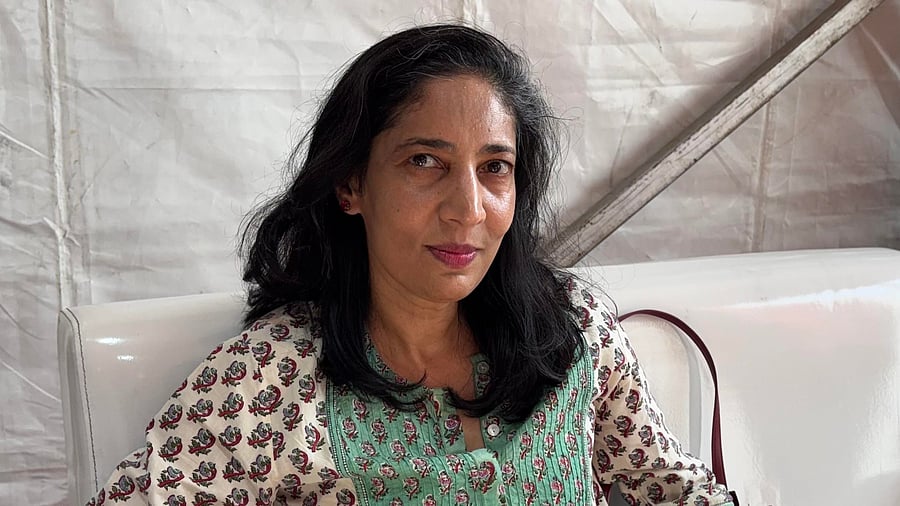
Kiran Desai.
At the ninth edition of the Kerala Literature Festival (KLF) held against the sun-drenched backdrop of the Kozhikode beach, Booker Prize winner Kiran Desai sat down for a candid conversation with DHoS. Known for her long hiatuses between works, Desai spoke about the supersonic pace of the modern world, the shifting landscape of global politics, and why she views Artificial Intelligence as a parasitic entity feeding on the labour of writers.
You are known for taking a long time between your books. Is this a personal tempo, or is it a conscious resistance to the supersonic world we live in?
Perhaps it is both. I think I withdrew. Once you withdraw and fall out of a certain “ton of time,” the years simply go by without you noticing them. It is a very happy space to be in, actually.
Your work often tackles globalisation. How has your view of it changed in today’s ‘Trump world’?
It is disconcerting. Many of us started writing about a world of shifting borders and migrations. Now, both in India and the United States, we see this nationalist rhetoric bursting out. I am all in favour of idiosyncratic culture, multiple perspectives, and translation, not a “single story.” Naturally, a writer fights back because our work is situated in a vibrant, syncretic society.
Does writing from the diaspora change your perception of home?
I worried when I first left India that I would lose my subject, that I wouldn’t find that depth of historical and family knowledge a novelist needs. But the diaspora is a place of ideas, transformation, and influx. Arguments happening in India get transported to the US, and vice versa. It’s an emotional centre, even if it has no fixed geographical location.
You often use various dialects and accents in your English. Is that a form of rebellion?
Perhaps. It’s about catching the English spoken by different kinds of people, the intonation, the word choice, the snobbery. In my current work, I’ve been focusing on very westernised, privileged Indians. It was quite fun to satirise them.
Should writers feel a responsibility to respond to the political movements of their time?
You can’t separate history, politics, and the novel. However, a novelist is focused on how politics influences the smallest, most private moments of a person’s life. It is about art for the sake of the human experience, not art for the sake of politics or propaganda.
If you were starting today, how would you negotiate the world of GPTs and AI?
I actually asked GPT to write a story in the style of Kiran Desai. It came up with something called The Dance of the Seven Veils set under a mango tree. We had a laugh, but it was spooky. It feeds off our work, and our collective labour has been fed into these machines. It isn’t “working”, it is parasitic.
How do you protect creative uncertainty in an age that demands instant clarity and answers?
People want answers from novels, but I love to emphasise that we don’t have them. What we offer is companionship and empathy.
What draws you to quiet, internal struggles rather than overt drama?
That is the heart of fiction: the private shape of a life, the pieties, and the anxieties felt when one is alone. That is where the real story lives.