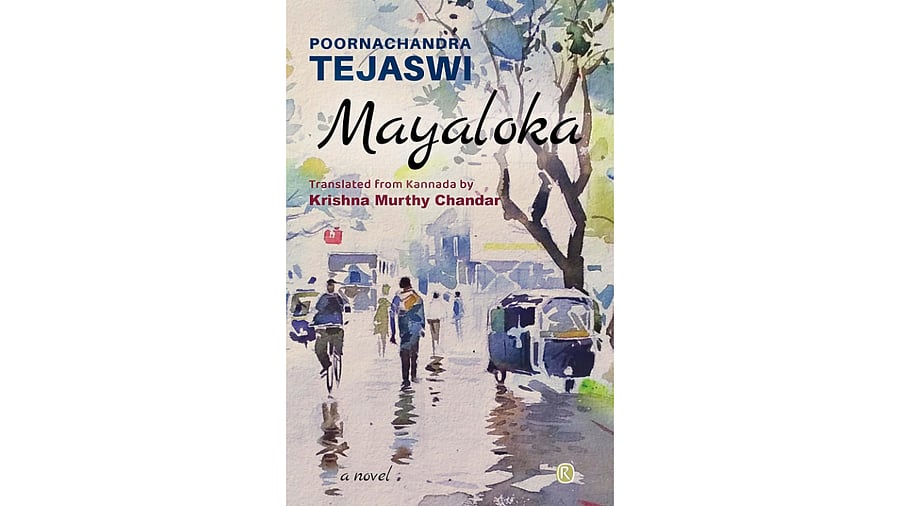
Mayaloka
My first encounter with Poornachandra Tejaswi’s storytelling, in a delicious irony, was not from reading his Kannada works, but from his superb translation of Kenneth Anderson's Hunting Tales. These translations introduced Kannada readers, like me, to thrilling real-life jungle stories featuring man-eating tigers and leopards. Thereafter, I read Tejaswi’s Mayaloka in Kannada, and it opened a world of magic, of illusion, and the scientific temper — a novel that weaves together the complexities of rural life and the philosophical questions of human existence, all while drawing the reader into a world of mystery and wonder. In this backdrop, a good question to start with is whether the English translation by Krishna Murthy Chandar, in bringing Tejaswi's evocative storytelling to a wider audience, reproduces successfully the essence of Mayaloka’s enchanting yet scientific world while remaining faithful to the original narrative?
Tejaswi's Kannada prose is known for its rich literary tapestry, drawing on the cultural and linguistic roots of Karnataka. A pioneer of the ‘Navyottara’ (post-modernist) literary movement, he gained prominence with his exploratory works that often delve into the mysteries of life and science. His ability to infuse local dialects, idioms, and cultural references into his narrative makes his work an authentic representation of life, blending the everyday with the extraordinary.
In Mayaloka, the mysticism that surrounds the natural world and the human mind coexists with the pragmatic realities of rural struggles, creating a literary experience that is at once immersive and thought-provoking. Chandar's translation of Mayaloka is commendable in its striving to retain the philosophical depth and narrative complexity of the original. The translation successfully conveys the novel's overarching themes of nature, human curiosity, and the quest for knowledge. However, certain aspects of Tejaswi's linguistic playfulness and cultural nuances are inevitably lost in translation. The English version often struggles to recreate the rhythmic cadence of Tejaswi's prose, which flows effortlessly in Kannada, drawing readers into the rustic landscapes and enigmatic events that unfold in his world.
One of the standout features of the original Mayaloka is Tejaswi's seamless blending of folklore and scientific inquiry. He crafts characters who are at once deeply rooted in their traditions and yet inquisitive about the unknown. While the translation manages somewhat to preserve this delicate balance, inevitably, the idiom and colloquial humour intrinsic to the Kannada language do not translate with the same effect. For instance, Tejaswi might describe a dense forest with a flowing sentence full of alliterations and poetic imagery, such as a sentence that roughly translates to: 'The forest grew denser and denser, with trees slipping into each other, making it seem darker.' Similarly, the dialogues in the original are spontaneous: 'Look here, boss, I don't know if this rain will come or go, but let's hope our fields don't dry up!'. The conversations that brim with local flavour in Kannada, such as the casual banter between villagers, lose their cadence in the translation. This is unavoidable: though the translator strives to present the original through a perfectly transparent pane of glass, it resembles a slightly distorting pane, because translation is a process of negotiation between the structure of two languages and the expressions of two cultures.
Therefore, the true test of a translation is that it should read as easily as if it had been originally written in English. Chandar does succeed in achieving this to a substantial degree. He captures Tejaswi's deep environmental consciousness with sensitivity, ensuring that the imagery remains intact. The philosophical musings that unfold throughout the novel retain their contemplative tone, allowing readers to engage with Tejaswi's reflections on humanity and the existential questions that circumscribe life. He successfully captures the simplicity and the beauty of the novel’s rural landscapes and the intertwining themes of the curiosity of the human mind, the symbiotic human connection with nature, and the interplay between tradition and modernity.
Chandar also succeeds in presenting complex character portrayals that come alive in Mayaloka, striking a balance between staying faithful to the original and making the text relatable to a global readership. What is lost in translation is the uniquely personal narrative voice that Tejaswi so masterfully employs, that thrives on an informal yet introspective storytelling style, which makes readers feel they are participants in the unfolding events rather than mere spectators.
Mayaloka in English remains an engaging read, transporting the reader to the heart of Tejaswi's world, a testament to Tejaswi's genius and Chandar's diligence. It reminds us that literature, even when traversing linguistic boundaries, has the power to transcend cultural barriers and offer universal insights into the human condition. Chandar’s translation is an important cultural contribution, bringing one of Karnataka’s celebrated authors to the attention of a wider readership.
The reviewer is the Director, School of Social Sciences, Ramaiah University of Applied Sciences.