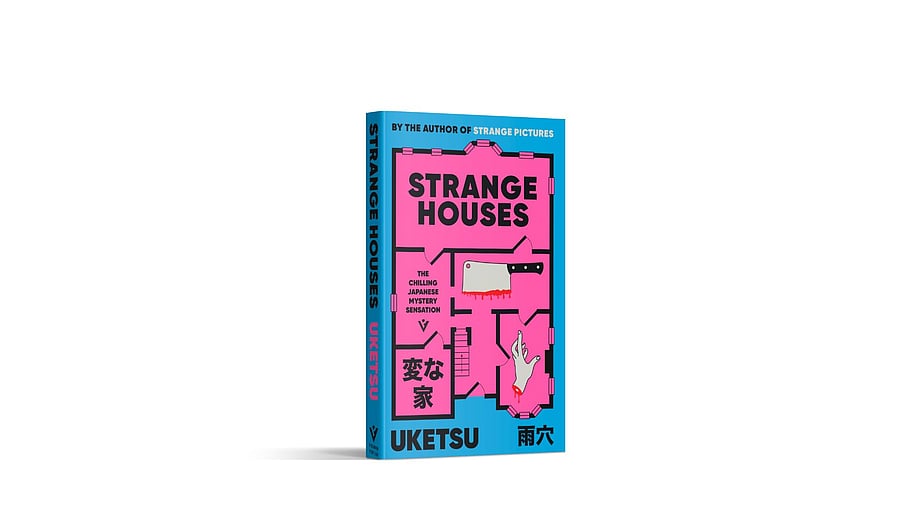
Strange Houses.
Strange Houses has much to pique your curiosity and lure you into its “murder rooms”, even before you have turned the first page. Uketsu, its author, is apparently a phenomenon in Japan. All three of his horror mystery novels are national bestsellers, including Strange Houses, whose translation by Jim Rion has been released in the English-speaking world this year. Uketsu is also known for his viral, eponymous YouTube channel with 1.87 million subscribers. There, using illustrations, architectural floor plans, and images as clues, he presents scary suspense stories and puzzles in phantom mode, speaking through a voice distorter and wearing a black stocking over his hair, a black turtleneck, black gloves, and a crude papier mâché mask. He makes public appearances too in the same costume, remaining entirely anonymous.
If this is not bait enough, Strange Houses quite clearly has an uncharacteristic structure. Just a cursory flipping of its pages reveals dozens of floor plans and hand-drawn diagrams alongside the text, seemingly as a sort of invitation for the reader to join in, analyse the information, and solve the mystery with the narrator.
The mystery is introduced at the outset, directly, with no build-up. An unnamed freelance writer who specialises in “stories of the macabre” is approached by an acquaintance to look into the floor plan of a fairly new house in a quiet residential area of Tokyo. The acquaintance is keen to buy the house, which looks bright, spacious, and almost perfect. But it has one strange and eerie element — a dead space, or a tiny room with no doors, concealed between two kitchen walls.
Flummoxed, the writer shares the floor plans with his friend Kurihara, an architect, and together, they discover other unsettling details about the house — a windowless child’s room at the centre of a larger master bedroom, a windowless bathroom, and a narrow enclosure adjoining the rear wall of the garage. The writer and the architect discuss all the probable reasons for this unusual layout and finally come to a bizarre but frighteningly logical conclusion — the incongruities make sense only if the house is built for murder.
Both become fixated on the idea that the dead space in the kitchen could be a secret passage from the child’s room to the bathroom. In the past, a child kept hidden from prying neighbours in the windowless child’s room could have entered the bathroom through the passage, even if the bathroom was locked from inside, to murder a particular person or persons taking a bath. And, perhaps the garage enclosure would have stored the bodies for as long as it took to dispose of them safely. Could this hypothesis be true? If true, who could use a child to murder people? The two friends plunge deeper into the mystery when, suddenly, a chopped-up body is found near the house, and a young woman reaches out to the writer about the existence of a second strange house.
The tagline on the cover describes the book as a “Japanese mystery sensation”, which is a nod to an early kind of thrillers that were popular in 1860s Britain. Sensation novels were quintessentially suspenseful stories with complicated plots involving crime, dark secrets, and conspiracies. Unlike the classic detective story, they did not have a central detective figure. Uketsu stays true to this genre of immersive storytelling. Despite the setting being 2019 Japan, this crime mystery is devoid of any actual, modern-day investigative work. There are no cops, forensics, or even suspects. Instead, it is a writer and an architect using floor plans, conversations, a letter, and a bunch of hypotheses to unravel a mystery involving occult, deep-rooted family rivalries, and sinister deaths.
Despite its freshness, Strange Houses carries some imprints of the Japanese crime fiction culture. For instance, the windowless bathroom in the Tokyo house is an element of the typical room mystery, a recurring theme in modern Japanese crime novel writing. The theme involves the discovery of a murder victim in a room locked from the inside, a seemingly improbable situation (think Agatha Christie’s The Murder of Roger Ackroyd). A key component of room mysteries is that they provide floor plans and all other clues to the reader to solve the mystery (referred to as Fair Play).
Strange Houses is a little over 180 pages, and at least a third of these carry floor plans and diagrams. So, understandably, its writing is stark and unembellished. But there are twists aplenty in the narrative to keep you captive in the murder rooms. Don’t ignore the Afterword!