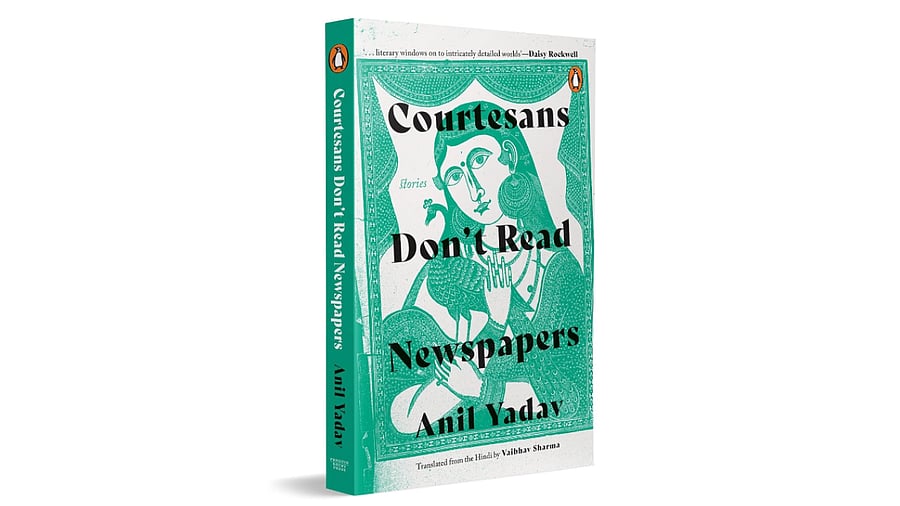
Courtesans Don't Read Newspapers
India is a country of contradictions, with a society trying to hold on to its orthodox ways while conveniently adapting modernity as per its will — or at least pretending to. It was Tagore who called out a section of our society, reminiscing about dead history rather than moving forward with the times. Anil Yadav, in Courtesans Don’t Read Newspapers, shifts our focus back to these contradictions and poses questions to us as a society.
Translated from Hindi by Vaibhav Sharma, the book consists of a novella and five short stories. The novella, originally titled Nagarvadhuyein Akhbaar Nahi Padhti, reveals the hypocritical nature of our society, where a police official, Ramashankar Tripathi, suddenly takes it upon himself to push sex workers out of the locality of Manduadih.
A decision not inspired by archaic morality, but instead a ploy to clear his image from the collective memory of the public, as he is suspected of having killed his wife, Lovely Tripathi. When a photojournalist tries to unravel the truth, we witness an unholy collaboration between the corrupt police official, local politicians, and even the corporate media.
In The Road to the Other World, the narrator goes down memory lane to a time when he was just a child, playing with pebbles and imagining them to be his cows. Soon, his interaction with his mother’s sister, who suffered from tuberculosis, takes centre stage. He was still too young to understand the gravity of her situation and goes on to narrate how he continued playing with her even as she grew weaker by the day. The story reveals unfair gender roles and the discrimination that stems from them.
In the times we live in, a title like Lord Almighty, Grant Us Riots! would worry us, but the author ensures that from the very first paragraph, we are pulled into the world of Mominpura, an overlooked locality in Varanasi. The setup of this story recalls the old parts of several cities where people live in terrible conditions, with poor sewage systems, and where even the most basic necessities are neglected.
The same is the case here — a Muslim ghetto surviving amid crumbling infrastructure.
As the monsoon arrives, the low-lying area begins to flood due to its proximity to a river, while also receiving garbage from the entire city. The floods bring deadly diseases, resulting in many deaths, mostly of children.
The apathetic administration proves useless, and eventually, people realise that the only way out of this mess is to have a riot —the only time the administration would pay any heed to a locality like Mominpura.
One of the most common criticisms of translation is that the text somewhat ‘loses’ its originality when rendered into another language. While this criticism holds some merit, we often come across books like this one that reaffirm the desperate need to transcend linguistic limitations and share such stories with a wider readership.
Anil Yadav’s stories in Courtesans Don’t Read Newspapers are reality checks for readers and do not pretend to be gentle or palatable. Instead, they are thrown in one’s face unabashedly, forcing readers to reassess reality and simply look around to trace these narratives. He cleverly uses satire to prick our sensitivities back to life, which may have been numbed by the bombardment of communal and sectarian content on social media and even mainstream media.
In times when actively and proudly participating in anti-social activities — or even praising them through one’s writing — earns fame and recognition backed by high-ranking politicians, these stories present reality as it is, holding a mirror up to society at large. The image we see is not a pretty one.
It is stories like these that demonstrate the richness of literature written in Indian languages and why they need to be translated. Vaibhav Sharma’s seamless translation deserves commendation for making this possible.