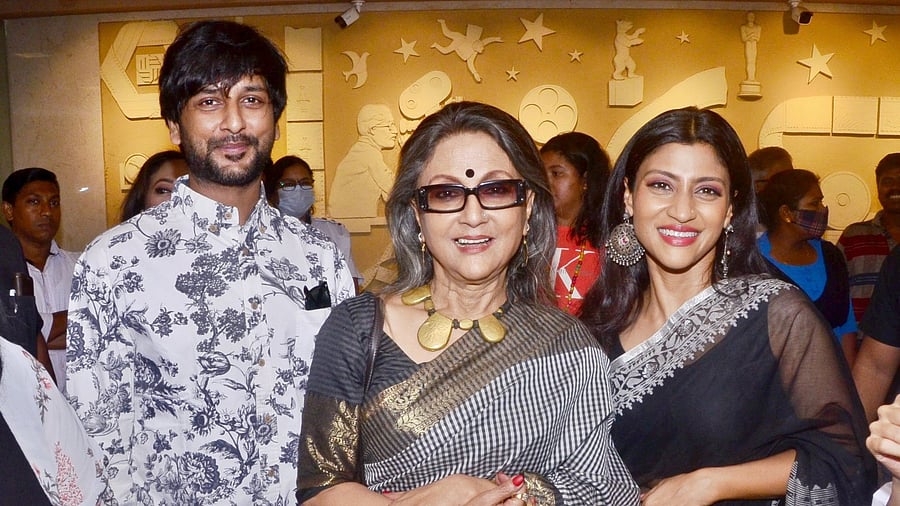
Aparna Sen with daughter actress Konkona and actor Tanmay Dhandhania at the Kolkata film festival
Credit: Special Arrangement
Aparna Sen stands as one of Indian cinema’s most compelling voices, a filmmaker whose four-decade career has consistently interrogated gender, class, and social power through a distinctly feminist lens. As both a woman navigating a male-dominated industry and an artist committed to centering women’s subjectivity, Sen has not merely participated in Indian cinema—she has reshaped conversations around what women’s stories can be, who gets to tell them, and how they challenge entrenched patriarchal structures. Her work as director, actor, and public intellectual has made her an indispensable figure in understanding the evolution of feminist cinema in India and the broader politics of women’s artistic production.
Sen’s emergence as a filmmaker in the 1980s occurred within a specific historical context. The Indian parallel cinema movement had created space for art-house filmmaking that engaged with social realities, yet even within this progressive milieu, women directors remained rare. When Sen directed her debut film 36 Chowringhee Lane (1981), she was entering a field where women’s perspectives behind the camera were largely absent. The film itself—a haunting portrait of an ageing Anglo-Indian teacher’s loneliness in Calcutta—announced Sen’s primary artistic concern: the interior lives of women, particularly those marginalised by age, class, or community. By focusing on Violet Stoneham’s dignified suffering and her exploitation by younger characters who use her flat for romantic trysts, Sen examined how society renders certain women invisible while simultaneously taking advantage of their vulnerability. This was not only sympathetic portrayal but structural critique—the film suggested that patriarchy’s violence includes abandonment and erasure as much as overt oppression.
Virtuous victims? Not at all
What distinguishes Sen’s feminist ideology is its refusal of simplification. Her films consistently present women as complex moral agents rather than virtuous victims or symbols. In Paroma (1984), she explored a middle-class housewife’s extramarital affair and the subsequent scandal that destroys her social standing. Rather than moralise, Sen examined the suffocating constraints of bourgeois Bengali respectability and how it polices women’s desires and autonomy. The film sparked considerable controversy precisely because it refused to punish its protagonist for transgression; instead, it indicted the social structures that deny women subjectivity beyond their roles as wives and mothers. This approach—treating women’s choices, including morally ambiguous ones, as legitimate subjects for serious artistic exploration—was radical for its time and remains central to Sen’s feminist vision.
Gaze on marriage, family
Sen’s Yugant (1995) and Paromitar Ek Din (2000) further developed her examination of marriage and family as sites of gendered power. Yugant deconstructed the institution of marriage itself, presenting it not as romantic fulfillment but as a battleground where two individuals struggle for recognition and autonomy. The film’s title, meaning “The End of an Era,” suggested both the collapse of a marriage and potentially the exhaustion of traditional patriarchal arrangements. Paromitar Ek Din shifted focus to the mother-daughter-in-law relationship, revealing how patriarchy pits women against each other and how women navigate competing loyalties within family structures designed to subordinate them. These films demonstrated Sen’s understanding that feminist cinema must examine the complex ways women are implicated in and resist patriarchal systems.
As a social commentator, Sen has used cinema to intervene in contemporary political debates. Mr. and Mrs. Iyer (2002), perhaps her most internationally acclaimed work, addressed Hindu-Muslim communal violence through the story of two strangers—a Hindu woman and Muslim man—who must pretend to be married while traveling through riot-torn India. By framing communal hatred through a gendered lens, Sen revealed how religious fundamentalism and patriarchal control are mutually reinforcing. The film’s protagonist, Meenakshi Iyer, undergoes a transformation from sheltered conservatism to moral courage, suggesting that women’s liberation and secular humanism are interconnected projects. Sen was making explicit what her work implies: that feminist consciousness cannot be separated from struggles for social justice.
Sen’s later films have also engaged with pressing social issues while focusing on women’s experiences. 15 Park Avenue (2005) examined schizophrenia and mental illness, centering the relationship between two sisters and refusing to sensationalise mental disability. The Japanese Wife (2010) explored an unconventional long-distance marriage, while Goynar Baksho (2013) used magical realism to trace three generations of Bengali women and their relationship to inheritance, autonomy, and tradition. Throughout, Sen has shown remarkable range while maintaining thematic consistency—her films always ask how women navigate structures designed to limit them, and what forms of resistance, accommodation, or transformation become possible. The feminist ideology in Sen’s work is neither dogmatic nor didactic. She has consistently resisted reducing her characters to political symbols, instead presenting them as fully realised individuals whose struggles illuminate larger structures of oppression. Her films trust audiences to grapple with complexity and ambiguity rather than delivering easy answers.
As gender equality debates intensify and women’s voices become increasingly central to political discourse, Aparna Sen’s work stands as both archive and provocation — her films remain essential viewing for understanding how feminist art can operate as both aesthetic achievement and social intervention.
(The writer is a national award-winning filmmaker and author of The Worlds of Aparna, published by Simon & Schuster India)