
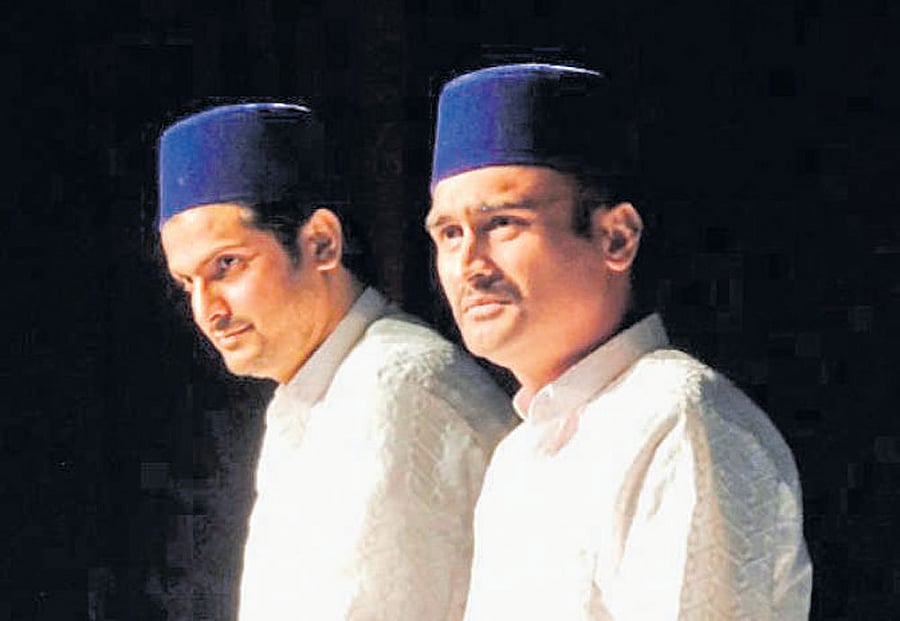
Nadeem Shah Suhrawardy teaches medieval history to students in Delhi University and Shankar Musafir is an educationist with UNESCO. But, when they come together as a storytelling pair, in their exquisite white Lucknawi kurta and colourful Turkish caps, they appear as transformed human beings who use a certain language and speak in a certain way that transports the listener to another world.
“I got interested in Urdu prose and poetry when I was in Berlin for my academic research,” reflects Nadeem, who had no background in storytelling or any performing art before 2010. “As it often happens, away from my land and my own people I started re-visiting the texts by Hindustani and Urdu poets and writers whose work I have grown up hearing about.” Nadeem is from Saharanpur in Uttar Pradesh, where he says poetry and storytelling is like a legacy. “I have heard my uncle talk about this middle-aged nearly-blind man in Saharanpur who used to sit under a tree and narrate stories in the dastanic or Hindustani oral storytelling format till the 1980s.”
Dastangoi or Qissagoi, where ‘dastan’ or ‘qissa’ means story and ‘goi’ is the Persian and Urdu word for ‘telling’, has been a popular entertaining art form in the northern parts of the sub-continent since medieval times.
So what is a dastanic format? Nadeem says, “For me a dastanic presentation is one which is a fine blend of narration and performativity, where both complement each other. And the language used has to be demonstrative in both text and performance.”
He says that he admires the finesse in Zia Muhiuddin and Naseeruddin Shah’s storytelling, their voice control as well as command over pauses.
Power performances
Nadeem has performed over a hundred shows in India, Pakistan and Afghanistan since 2010 along with fellow storyteller and theatre artist Manu Sikander Dhingra. He had performed on already available dastanic texts. But recently, Nadeem has also turned into a dastanic scriptwriter with Kahani Pandit Ki, an adaptation of one of Vijaydan Detha’s folktales; Husn-e-Faiz, a performative text on Faiz’s life and poetry; and Dastan Umro Ayyar, an adaptation of a story from Tilism-e-Hoshruba, which is the classical repertoire of Dastangoi. These texts and performances have been well received by the audience.
“It takes months to prepare a script that would make a performance last for 40 minutes or an hour,” reveals Nadeem. “There is a lot of research involved, and the writing should produce a text which contains tremendous scope for performativity.”
Musafir, who has been practising this storytelling art form since 2014, says, “My basic starting point was an article on Dastangoi in a newspaper, where it spoke of these people trying to revive a medieval art form. And one fine day I learnt that my former classmate from the university, Nadeem, is also a dastango. I met him at a friend’s party and we spoke about it, and then forgot all about it! After a while, I contacted him again and finally we did a story together from Tilism-e-Hoshruba, which is often referred to as the world’s first magical fantasy epic.”
All in the family
Musafir, who is from Himachal Pradesh, comes from a family where stories and storytelling has played an important role. His grandfather, B R Musafir, was a well-known writer in Urdu and Persian. “As a child, I often went to bed listening to stories narrated by my grandfather,” he reminisces.
“And during the rehearsal of Kahani Pandit Ki, I had flashbacks of my grandfather telling me stories as a child. Also, I had heard this story from my father, a funny story of three-four lines given by Rajneesh Osho to talk about the vanity of ego.
Obviously it must have been there in the folk space somewhere, which is why Vijaydan Detha picked it up. Nadeem has put it in a very nice dastanic narrative. But frankly, when he first told me that that he would be adapting this story into a dastanic tale, I wasn’t excited. But as I started preparing the story, the dastan grew on me and by the time I put my energy into it, I realised it is a fantastic dastan with so many twists and turns that continuously grips your attention!’
Over the years, Nadeem and Musafir have emerged as a strong storytelling pair who match energy for energy and have developed an effective technique for the exchange of narrative and emotive prowess. This is one powerful storytelling pair to look out for.