
There was a time when Hindi commercial films were full of stereotype characters to denote a region; Dosa-eating Madrasis, Thepla loving Gujaratis, and the typical Bangali babu (think of comedian Asit Sen) shown gulping down rosogollas from an earthen bowl.
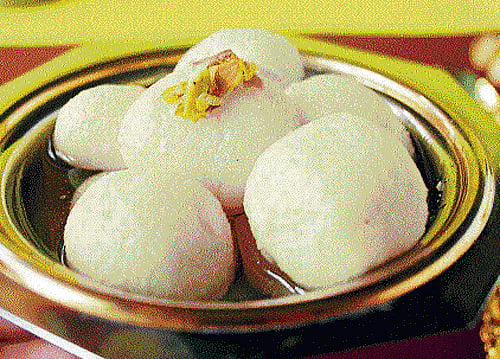
Be that as it may, nobody can deny the charm of the rosogollas — that spongy, milk-white round of sweetmeat swimming in sugar syrup. It has tickled the taste-buds of gourmands in Bengal for more than a century now. At weddings and social dos, rosogollas and doi-sweet curd, another Bengali trademark, is a never-failing combo to wrap up a sumptuous meal.
Once the tinned rosogollas arrived, it travelled beyond Bengal to win hearts with equal ease. Yet, the sweetmeat took birth more by accident than through planning. It is a century-old story with its antecedents rooted in the older part of Kolkata, Baghbazar.
It goes back to a person called Nobin Chandra Das, ensconced in a ramshackle shop in Baghbazar. His forefathers, coming from the Bardhaman district, were in the sugar business and had settled down by the Hooghly River, as it was easier for the barges to transport the sugarcane grown in the countryside. But by the time Nobin was born (1846), the family’s fortunes were on the wane. Losing his father even before his birth, Nobin and his mother had to fend for themselves. He worked as an assistant in a sweetmeat shop called ‘Kali-Indra’.
Nobin was always bubbling with ideas and wanted to make something new. The owner was not supportive of his ideas and he was thrown out. Next, he opened a sweetmeat shop himself near Jorasanko, the home of the Tagore family. But it did not do well and he had to close it down in 1864. Two years later, he opened a shop at Chitpur, a bustling business district of the time.
Nobin belonged to an age when Bengali mishti (sweets) meant the ubiquitous sandesh, made with channa or cottage cheese and sugar. He too made them, but desired to go beyond and make something new. His friends came to the shop for afternoon tea and goaded him to be more innovative.
One day, Nobin had a brainwave. Why not use the same channa to make a delicacy but dipped in sugar syrup? Alas, his attempts ended in failure as the cheese crumbled once put in the syrup. He continued to experiment and through trial and error found that the boiling syrup had to be kept at a certain temperature to keep the rounds intact. And so, after much ado, the rosogolla was born. That was in 1868. Ros in Bengali means syrup or sweet liquid, and golla, round. The name of the sweet stuck.
But the connoisseurs of the sweet were confined to friend circle of Nobin. People did not even know that something new had arrived on the sweetmeat horizon. Luck visited Nobin in the form of a businessman, Bhagwandas Bagla. One day, he was travelling with his family in a fashionable landau for an outing, when his son asked for water to quench his thirst. As it happened, the carriage stopped in front of Nobin’s shop.
As per local custom, one never offered water by itself, but with something sweet. So Nobin gave the little boy water accompanied by a rosogolla. The child loved it and told his father how delicious it was. Bhagwandas tasted it and fell in love with it instantly. He bought all that rosogolla available, ordering more whenever he was hosting any occasion. Word to mouth publicity did the rest to make the rosogolla a much sought after sweet. The rest, to use a cliché, is history.
Nobin’s son Krishna Chandra Das expanded the business with pioneering efforts. He started the first shop, Krishna Chandra Das Confectioner in 1930 with his youngest son Sarada Charan. Shortened to the crisp, K C Das, it became a brand name for the rosogolla. Krishna Chandra also masterminded the rosomalai, another great favourite in Bengal. To popularise the rosomalai, he opened a new sweet shop at Jorasanko in 1930, from where he also introduced the canned rosogolla. In fact, even today, the K C Das family introduces something new every year to their repertoire, especially before the annual Durga puja.
K C Das’s enterprising youngest son Sarada Charan opened new shops across the city, beginning with the one at Esplanade East. This shop broke new ground in many ways by introducing uniformed employees and western-style service to sit-down customers. His passion for innovation took him to Japan in 1937, from where he brought back fine porcelain services for use in his shop as well as Japanese handicrafts to be distributed to his customers as gifts. So far, sweets were offered on saal-pata (traditional leaf packing), but Sarada Charan replaced it with white cardboard cake boxes lined with butter paper on the inside.
Sarada Charan’s greatest contribution, however, was not just to the world of confectionery, but to the method of cooking itself. He conceived, designed and implemented a manufacturing process, which used steam, generated under high pressure in a boiler and passed through steam-jacketed pans to replace the traditional coal/wood burning stoves.
The milk comes from the suburbs with only cows’ milk being used.The company began its ‘southern campaign’ in 1972, when Sarada Charan set up a factory and a shop in Bangalore. It has been a success right from the beginning.
Despite many innovations in Bengal’s confectionery world, the rosogolla still rules. Now there are different versions too — mixed with nolen gur, date palm jaggery, etc. — ensuring it a continued place amongst the best sweets available.