
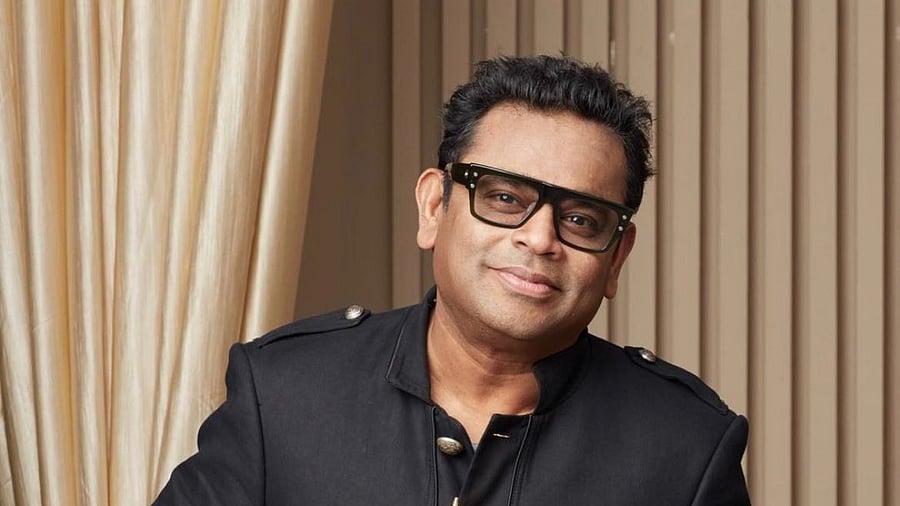
A R Rahman
Credit: X/@arrahman
This week’s A R Rahman’s interview, in which he said he wasn’t getting enough work because of communal bias, has upset trolls and set them off on a rampage.
Diehard fans have received his comments with bewilderment though. How could a composer, perceived as India’s most sought-after, be complaining about work not coming his way? How could the 'Mozart of Madras’, with two Oscars and a host of other prestigious awards under his belt, sound like a struggling composer?
“People who are not creative have the power now to decide things, and this might have been a communal thing also, but not in my face,” Rahman said in his interview with BBC Asian Network aired on Wednesday.
He said the last nine years had been slow for him, hinting at the rise of a right-wing cinema establishment that wasn’t keen on hiring him. The reaction was swift–many didn’t like his comment about the ‘communal thing’. Interestingly, the trolls had little to say about the ‘people who are not creative’ bit.
Rahman, who made a sensational debut with Roja (1992), has in recent years spoken about the difficulties of composing music in a corporatised film industry. In a 2018 interview with Deccan Herald, he had spoken about his Hollywood travails: “The mainstream movies are always about a gang of people coming in… like corporates, accountant-type of people who come in and dictate, ‘This music is not working’. There are like 12 people coming and attacking you.”
He had also spoken about how he approached Tamil and Hindi cinema: “Hindi has a more simple vibe, I think. The more simple, the better it is in Hindi. If the lyric drives the song… they are very happy with simple songs, simple beautiful songs. Here, people are always thirsty for newness, they are like, ‘What is he going to do?’ That is great. That thirst is what makes you push.”
Rahman’s list of hit films in Hindi is long. It includes 'Dil Se', 'Lagaan', 'Swades', 'Rang De Basanti' and 'Ranjhana'. All of them were released before 2015, and it is true that he hasn’t seen success of that magnitude in later years. But then, much has changed, and music lovers buying and treasuring CD albums is long gone.
Born A S Dileep Kumar in a Hindu family, he began his musical career as a teen, playing sessions for Ilaiyaraaja and composing commercial jingles. He converted to Islam in 1989. His film breakthrough came when Mani Ratnam hired him to score for Roja. Rahman delivered a string of hits in Tamil before he forayed into Hindi cinema.
Although Hindi cinema has embraced heroines from the south — Vyjayantimala, Hema Malini and Sridevi being among the top favourites — it hasn’t been as receptive to men. Ilaiyaraaja, Kamala Haasan and S P Balasubramanyam have contributed to Hindi cinema, but they didn’t thrive in Mumbai as much as they thrived in the south. Rahman is the first to win lasting acceptance and success in Hindi cinema. He became a pan-Indian phenomenon in the 1990s, bridging linguistic, cultural, and stylistic divides.
Not many have rushed to his defence in the current controversy. Many insiders have said Bollywood is free of communal bias; it has cheered for such stars as Shah Rukh Khan, Salman Khan and Amir Khan. On the other side, actor Naseeruddin Shah has repeatedly spoken about rising Islamophobia. In 2015, Amir Khan expressed worries about intolerance, and faced a backlash similar to the one Rahman is facing now. Swara Bhasker and Zoya Akhtar are among those who have faced boycott calls for films perceived as anti-Hindu.
Are there non-religious factors that might explain Rahman’s slowdown? When he debuted, he was hailed as a wizard fusing technology and music. At 59, he faces competition from savvy young composers for whom technology poses no challenge. Some industry insiders suggest Rahman may have priced himself out of the competition. Singer Shaan says fluctuating work is “common for artistes,” attributing it to creative churn rather than bias. The advent of artificial intelligence offers a new challenge for composers. It is cheap, and quick. Rahman was born A S Dileep Kumar, and his conversion to Islam adds another layer to the controversy.
Rahman spoke about ‘Chinese whispers’ reaching him about how five composers had been hired for a film he was to score for. A team of five composers means five styles and five approaches to one story. Rahman has founded a music academy in Chennai and is supportive of young artistes, but he is unlikely to be comfortable with sharing credit in a film whose musical quality he has no control over.
The trolls unwittingly strengthen his argument. Even if religion is not costing him film contracts, it is clearly policing his words and motives.