
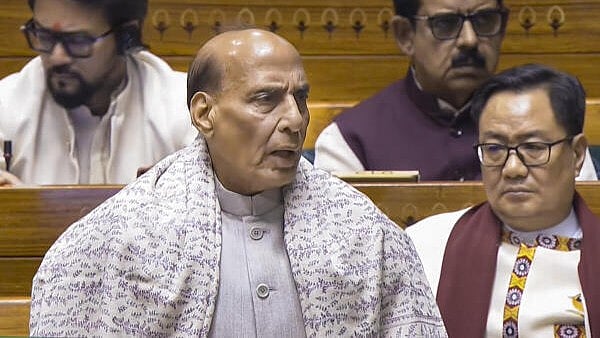
Union Defence Minister Rajnath Singh
Credit: Sansad TV via PTI Photo
New Delhi: Amid the ongoing theaterisation debate, Defence Minister Rajnath Singh on Thursday described air power as “not just a tactical asset”, but a “strategic instrument” that has emerged as a decisive force.
“Air power is not just a tactical asset, but a strategic instrument. Its speed, surprise and shock effects are its inherent characteristics,” the minister said at the Indian Air Force Commanders Conclave here.
Describing the IAF as a “technologically-advanced” and future ready force, Rajnath said, “Air power gives any leadership the capability to deliver a clear strategic message to the adversary. Through speed, reach, and precision, air power has become an effective tool for aligning the nation’s objectives with military means.”
The minister’s comments come amid the ongoing discussions within the government and the military on creating theatre commands by integrating the existing service-specific commands.
India currently has 17 single service commands shared between the army (7), air force (7) and navy (3) besides two tri-service commands. For the past six years, there has been an exercise to create geography-specific theatre commands, but they are yet to be realised.
In the initial plan drafted by the first Chief of the Defence Staff Gen Bipin Rawat, the IAF was not given any command as its assets were distributed among the three commands.
The air force was against such a plan from the very beginning and past IAF Chiefs expressed their reservations.
A few months ago Chief of the Air Staff Air Chief Marshal A P Singh. “Creating a new structure while disrupting everything was not a very good idea at this point of time because Operation Sindoor once again established the ‘primacy’ of the air power,” he had stated.
Rajnath stated the Russia-Ukraine conflict, Israel-Hamas war, Balakot air strikes and Operation Sindoor were proof that air power emerged as a decisive force in modern times.
In a separate bilateral engagement, the Defence Minister met Dutch Foreign Minister David van Weel and signed a Letter of Intent for "co-development and co-production" of defence equipment.