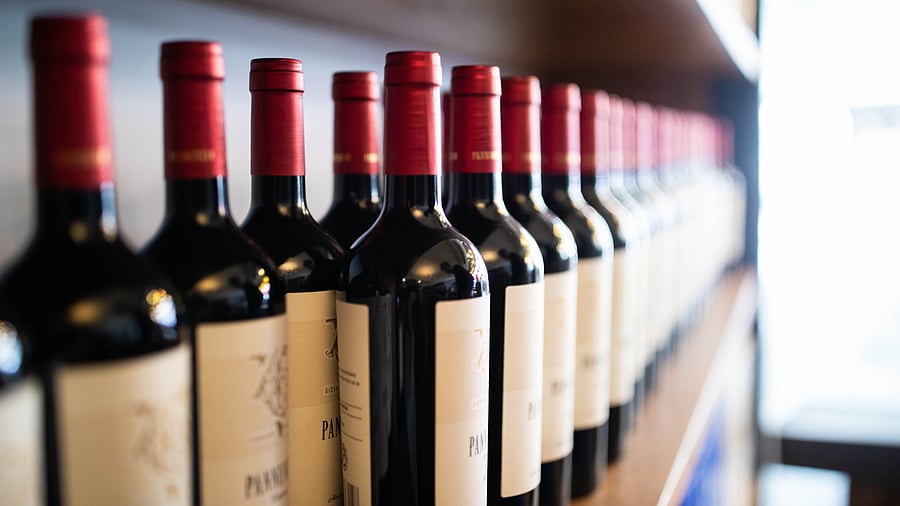
A representative image.
Credit: iStock Photo
New Delhi: Industry bodies representing both imported and domestic alcoholic beverage players have welcomed the proposed tariff reductions under the India-EU trade agreement, calling it a "historic" move that balances consumer access with the protection of domestic interests of existing players.
They said the agreed Minimum Import Price (MIP) cut on products priced above 2.5 euros would keep most of the domestic industry unaffected from cheap and dumped imports.
India and the European Union (EU) on Tuesday announced the conclusion and finalisation of negotiations for a free trade agreement. The agreement is likely to be implemented within the 2026 calendar year, Commerce Minister Piyush Goyal said.
The talks were concluded after 18 years. The negotiations started in 2007.
Under the agreement, India will give duty concessions to wines of the European Union (EU) in line with what it has agreed for Australia and New Zealand, but with slightly lower thresholds.
Under the pact, the duty on EU wines would fall from 150 per cent to 20 per cent (for expensive ones). It was a key demand for the EU. For wines priced below 2.5 euros, there will be no duty concessions. Indian wines, too, will get duty concessions in the EU member countries.
Industry associations such as CIABC, which represents home-grown whisky makers, sought "reciprocity and removal of non-tariff barriers on Indian spirits" by the European Union.
CIABC termed the trade agreement with the EU as 'historic', and said a number of key concerns raised by the domestic industry seem to have been addressed.
However, it said the domestic wine industry was hoping for a higher MIP threshold of 3.0-3.5 euros for duty-free imports.
The Confederation of Indian Alcoholic Beverage Companies (CIABC) also said it is awaiting further details of the deal.
"We hope that the Indian government addresses our concerns relating to dumping of cheaper products by eliminating the possibility of undervalued import prices and checking under-invoicing and strictly adhering to 'Rules of Origin' clause so that they are not misused for re-routing a third country's product," said its DG Anant S Iyer.
It has suggested robust and enforceable rules of origin, which would help stop third-country products from entering India through indirect routes, which often leads to unfair competition and loss of revenue for the country.
Indian brewers association BAI said the cut-off of 2.5 euros for wines to become illegible for tariff cuts will keep over 80 per cent of the domestic industry unaffected.
Wine culture is fairly underdeveloped in the country, and wines priced above the cut-off are very niche in the country. Consumer trials are restricted due to high duty and resultant high prices, said Brewers Association of India (BAI), which represents leading players like United Breweries, ABInBev and Carlsberg, that together account for around 85 per cent of the beer sold in the country.
"Bringing duty down to 30 per cent for premium wines and 20 per cent for super premium wines will bring prices down for sure and will create more consumer traction. I think the FTA serves both objectives - it opens up the market for quality European wines without putting the domestic industry at risk," said BAI Director General Vinod Giri.
It will also aid wine culture in the country and help lift the quality of domestic wines in the process, he said.
Another industry body, ISWAI, which represents an imported premium portfolio of spirits and wine brands in India, said that this agreement focuses on tariff reduction and is mutually beneficial for trade, offering significant strategic benefits for both markets.
ISWAI CEO Sanjit Padhi said that detailed provisions of the agreement are awaited; however, the initially released agreement indicates that the proposed reduction in import tariffs from the current 150 per cent to 75 per cent across all EU spirits and wines categories from the entry into force of the agreement is a clearly "welcome development".
"The agreement further outlines that the tariffs will then be lowered to 40 per cent for spirits and as low as 20 per cent on wines in a phased approach," he said, adding, "India's increasingly aspirational and discerning consumers will gain improved access to premium international brands at more accessible price points." According to IWSR, the Indian wine industry is around 3 million cases (of 9 bottles each), in which around 20 per cent are imported.
Out of that, 40 per cent was imported from Australia. Jacob's Creek, earlier owned by Pernod Ricard, is currently India's largest firm in the segment. A couple of years before, it sold its international wine portfolio, including the iconic Australian brand Jacob's Creek, to Australian Wine Holdco.
Around 20 per cent of wine is imported from Europe -- from France, Italy and Spain. Rest comes from markets such as Chile, the USA, Argentina and South Africa.